



Xeniamia atrithorax Fraser & Prokofiev, 2016
Hochladen Photos und videos
Google Bild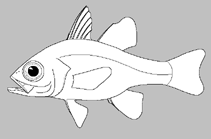 No image available for this species;
drawing shows typical species in Apogonidae.
Google Bild
drawing shows typical species in Apogonidae.
Klassifizierung / Names Namen | Synonyme | Catalog of Fishes(Gattung, Arten) | ITIS | CoL | WoRMS | Cloffa
> Kurtiformes (Nurseryfishes, cardinalfishes.) > Apogonidae (Cardinalfishes) > Apogoninae
Etymology: Xeniamia: Name from Greek 'Xenos' meaning stranger and 'Amia' referring to a type of fish, often used with cardinalfish names, treated as feminine noun; atrithorax: Name from Latin 'ater, atra, atrum' meaning black and Greek 'thorax' a masculine noun meaning breastplate, referring to the position of numerous melanophores as a dark spot in advanced of the pelvic-fin base; noun in apposition.
Etymology: Xeniamia: Name from Greek 'Xenos' meaning stranger and 'Amia' referring to a type of fish, often used with cardinalfish names, treated as feminine noun; atrithorax: Name from Latin 'ater, atra, atrum' meaning black and Greek 'thorax' a masculine noun meaning breastplate, referring to the position of numerous melanophores as a dark spot in advanced of the pelvic-fin base; noun in apposition.
Umwelt: Milieu / Klimazone / Tiefenbereich / Verbreitungsgebiet Ökologie
seewasser riff-verbunden; tiefenbereich 40 - 119 m (Ref. 110227), usually 70 - 119 m (Ref. 110227). Tropical
Verbreitung Territorien | FAO Gebiete | Ökosysteme | Vorkommen | Punkt Karte | Einführungen | Faunafri
Western Pacific: South China Sea off Khanh Hoa Province, Vietnam.
Größe / Gewicht / Alter
Geschlechtsreife: Lm ? range ? - ? cm
Max length : 3.0 cm SL (female)
Max length : 3.0 cm SL (female)
Kurzbeschreibung Bestimmungsschlüssel | Morphologie | Morphometrie
Rückenflossenstacheln (insgesamt) : 9; Rückenflossenweichstrahlen (insgesamt) : 9; Afterflossenstacheln: 2; Afterflossenweichstrahlen: 8; Wirbelzahl: 24. This miniature species (less than 3.0 cm SL) is distinguished by the following characters: with a large melanophore patch anterior to insertion of pelvic fin, extending forward on each side of isthmus, progressively thinning out; black stomach, anterior intestine pale with black spots black intestine from second bend; interior of lower gill chamber blackish with concentrated melanophores extending forward to dorsal part of isthmus; D VIII-I,9 with eighth dorsal spine visible, fourth dorsal spine longer than third; A II,8; first gill arch with 9 gill rakers (Ref. 110227).
Cross section: compressed.
Cross section: compressed.
This species has been taken in shrimp trawls on muddy bottom. Most specimens were collected from 70-119 m, some from 40-60 m, in the main waterway of the Bay of Nha Trang (latter samples might have been pumped through canyons cutting out the outer shelf as proposed for
other fish taxa collected from the unusually shallow depths in this area (Ref. 84063). No specimens or fragments of sea urchins commonly trawled together with Siphamia specimens. Year-to-year fluctuations in density of population were observed with this species present at 18 of 22 stations trawling eastward and southward of Pyramid Island in 2005 and 2007 and two of 17 stations sampled in 2006 and 2009-2012. All samples were made between April and July, and no specimens were collected during a winter monsoon season (October-January). It always appeared in groups of about 10-60 specimens per trawl, with many specimens having ripe ova or brooding eggs. The smallest, 1.45 cm SL was immature. The males with buccal enlargement suggestive of brooding eggs were 2.2-2.4 cm SL and showed loss of teeth on the vomer and palatines. A 2.3 cm SL male had approximately 280 orangish eggs, 0.5 mm in diameter. Females with developed ova were as small as 2.3 cm SL. The largest gravid female was 2.95 cm SL. No possible indications for commensal relationships of this species were present (Ref. 110227).
Lebenszyklus und Paarungsverhalten Geschlechtsreife | Fortpflanzung | Ablaichen | Eier | Fruchtbarkeit | Larven
Hauptreferenz
Laden Sie Ihre Referenzen hoch | Referenzen | Koordinator | Partner
Fraser, T.H. and A.M. Prokofiev, 2016. A new genus and species of cardinalfish (Percomorpha, Apogonidae, Sphaeramiini) from the coastal waters of Vietnam: luminescent or not? Zootaxa 4144(2):227-242. (Ref. 110227)
CITES
Not Evaluated
Bedrohung für Menschen
Harmless
Nutzung durch Menschen
Fischereien: bycatch
FAO - Publication: search | FishSource |
Mehr Information
Trophische Ökologie
Lebensmittel (Beutetiere)
Nahrungszusammensetzung
Nahrungsaufnahme
Lebensmittelrationen
Räuber
Lebensmittel (Beutetiere)
Nahrungszusammensetzung
Nahrungsaufnahme
Lebensmittelrationen
Räuber
Ökologie
Ökologie
Ökologie
Populationsdynamik
Wachstumsparameter
Max. Alter/Größen
Länge-Gewicht-Rel.
Länge-Länge-Verhältnis.
Längenhäufigkeiten
Massenkonvertierung
Rekrutierung
Dichte
Wachstumsparameter
Max. Alter/Größen
Länge-Gewicht-Rel.
Länge-Länge-Verhältnis.
Längenhäufigkeiten
Massenkonvertierung
Rekrutierung
Dichte
Lebenszyklus
Fortpflanzung
Geschlechtsreife
Reifung/Kiemen rel.
Fruchtbarkeit
Ablaichen
Laichaggregationen
Eier
Eientwicklung
Larven
Larven Pop.Dyn.
Fortpflanzung
Geschlechtsreife
Reifung/Kiemen rel.
Fruchtbarkeit
Ablaichen
Laichaggregationen
Eier
Eientwicklung
Larven
Larven Pop.Dyn.
Anatomie
Kiemenoberfläche
Gehirn
Otolith
Kiemenoberfläche
Gehirn
Otolith
Physiologie
Körperliche Zusammensetzung
Nährstoffe
Sauerstoffverbrauch
Schwimmart
Schwimmgeschwindigkeit
Visuelle Pigmente
Fischgeräusche
Krankheiten und Parasiten
Toxizität (LC50s)
Körperliche Zusammensetzung
Nährstoffe
Sauerstoffverbrauch
Schwimmart
Schwimmgeschwindigkeit
Visuelle Pigmente
Fischgeräusche
Krankheiten und Parasiten
Toxizität (LC50s)
Genetik
Genom
Genetik
Heterozygotie
Vererbbarkeit
Genetische Vielfalt
Genom
Genetik
Heterozygotie
Vererbbarkeit
Genetische Vielfalt
Menschenbezogen
Aquakultur-Systeme
Aquakultur Profile
Zuchtlinien
Ciguatera-Fälle
Briefmarken, Münzen, Verschiedenes.
Aquakultur-Systeme
Aquakultur Profile
Zuchtlinien
Ciguatera-Fälle
Briefmarken, Münzen, Verschiedenes.
Tools
Zusatzinformationen
Download XML
Zusammenfassung | Punktdaten | Namen | Photos
Internet Quellen
AFORO (otoliths) | Aquatic Commons | BHL | Cloffa | Websites from users | FishWatcher Einträge suchen | CISTI | Catalog of Fishes: Gattung, Arten | DiscoverLife | ECOTOX | FAO - Publication: search | Faunafri | Fishipedia | Fishtrace | GloBI | Google Books | Google Scholar | Google | IGFA World Record | OneZoom | Open Tree of Life | Otolith Atlas of Taiwan Fishes | PubMed | Reef Life Survey | Socotra Atlas | TreeBase | Tree of Life | Wikipedia: Gehe zu, Suchen | World Records Freshwater Fishing | Zoobank | Zoologischer Rekord
Schätzungen auf der Grundlage von Modellen
Phylogenetischer Diversitätsindex (Ref. 82804): PD50 = 1.0000 [Uniqueness, from 0.5 = low to 2.0 = high].
Bayesian length-weight: a=0.01514 (0.00700 - 0.03275), b=3.07 (2.89 - 3.25), in cm total length, based on LWR estimates for this (Sub)family-body shape (Ref. 93245).
Trophische Ebene (Ref. 69278): 3.2 ±0.5 se; based on size and trophs of closest relatives
Widerstandsfähigkeit (Ref. 120179): hoch, Verdopplung der Population dauert weniger als 15 Monate. (Preliminary K or Fecundity.).