>
Cypriniformes (Carps) >
Leuciscidae (Minnows) > Pogonichthyinae
Etymology: Cyprinella: Latin, cyprinus = carp (Ref. 45335); leptocheilus: Name from Greek 'leptocheilus', combination of 'leptós' (Greek λεπτός), meaning fine or thin and 'cheilus' from cheíl̄os (Greek χεῖλος), for thin lip; this was proposed by Drs. Robert E. Jenkins and Ernest A. Lachner in the early 1970s.
Environment: milieu / Klimaatzone / Diepte / distribution range
Ecologie
; zoet water benthopelagisch; diepte 1 - 3 m (Ref. 132547). Subtropical
North America: USA.
Grootte / Gewicht / Leeftijd
Maturiteit: Lm ? range ? - ? cm
Max length : 7.1 cm TL mannelijk / geslacht onbekend; (Ref. 132547); max. gerapporteerde leeftijd: 4 Jaren
Korte beschrijving
Determinatiesleutels | Morfologie | Morfometrie
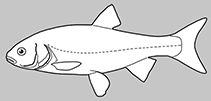
Dorsale zachte stralen (totaal) : 8; Anale zachte stralen: 8. This species is distinguished from its congeners except C. labrosa and C. zanema by the following characters: with maxillary barbels; differs from labrosa the number of modally 40 lateral-line scales (vs. 37), no dark blotches or cross hatching on back and side (vs. small, dark blotches and cross hatching on back and side), no white spot at anterior base of dorsal fin (vs. white spot present), side of body well pigmented below lateral line (vs. minimal pigmentation), with a line drawn from the posterior corner of the upper lip, immediately anterior to the barbel, extending vertically posterior to the anterior edge of the bony orbit (line drawn from the posterior corner of the upper lip, immediately anterior to the barbel, extending vertically anterior to the anterior edge of the bony orbit: differs from zanema by having the dorsal-fin origin positioned modally 1.5 scales posterior to the pelvic-fin origin (vs. positioned modally 2.5 scales posterior to the pelvic-fin origin0 with mean upper lip width at midpoint 2.1% of head length (vs. 3.5% of HL), mean upper lip width at midline 2.9% of HL (vs. 4.1% ofHL), mean maxillary barbel length 3.5% of HL (vs. 8.0% of HL) (Ref. 132547).
Cross section: oval.
This species prefers shallow pool areas of medium-sized, from clear to turbid to tannin-stained to dark blackwater, warm water creeks and rivers with moderate velocity, over clean, sandy and gravelly substrates. Usually form schools near stumps or other cover but can also be found mid-channel. In the Lynches River, this fish was reported to have been taken over gravel-bottom riffles and more commonly, in sand-bottom runs. In the Lumber and Black rivers, schools were observed moving along the edges of sandbars, also in sand-bottomed runs. In the Lower Little River (Cape Fear River basin) in late July to mid-August 2021, it was found in low specific conductance waters, 25–50 μS/cm . It has also been observed in the Lynches River in moderately swift current, mid-stream, over a sandy substrate at a depth of 1-3 ft; and associated with C. nivea, C. pyrrhomelas, and Notropis scepticus. In other collections over the years from the Lynches River, it has been collected alongside Alburnops petersoni, C. analostana, Hybognathus regius, Miniellus procne, N. leptocephalus, Notemigonus crysoleucas, Notropis amoenus, Pteronotropis cummingsae and in the Black River with A. petersoni, C. nivea, H. regius, and N. amoenus. Stomach contents of this fish from the Lynches River in May 1996 contained primarily dipteran larvae; mayfly and stonefly nymphs and caddisfly larvae were of minor importance. Reported maximum longevity is estimated to be four years (Ref. 132547).
Levenscyclus en paargedrag
Maturiteit | Voortplanting | Paaien | Eieren | Fecunditeit | Larven
Tracy, B. H., F.C. Rohde, M.A. Perkins, L.M. Lee, K.B. Carlson, M. McCutcheon, Jones. B.K. and H.K. Evans, 2024. A long-recognized but undescribed new species of Cyprinella (Cypriniformes: Leuciscidae) from North Carolina and South Carolina, United States. Southeastern Fisheries Council Proceedings 1(64):35-76. (Ref. 132547)
Status op de Rode Lijst van het IUCN (Ref. 130435: Version 2025-1)
Gevaar voor de mens
Harmless
Gebruik door de mens
Tools
Speciale rapporten
Download XML
Internetbronnen
Estimates based on models
Fylogenetische diversiteitsindex (Ref.
82804): PD
50 = 0.5000 [Uniqueness, from 0.5 = low to 2.0 = high].
Trofisch niveau (Ref.
69278): 3.1 ±0.4 se; based on size and trophs of closest relatives
Weerstandsvermogen (Ref.
120179): Hoog, minimale populatieverdubbelingstijd minder dan 15 maanden (Preliminary K or Fecundity.).
Fishing Vulnerability (Ref.
59153): Low vulnerability (10 of 100).
🛈