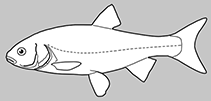
Классификация / Names
народные названия | синонимы | Catalog of Fishes(род, виды) | ITIS | CoL | WoRMS | Cloffa
>
Cypriniformes (Carps) >
Leuciscidae (Minnows) > Pogonichthyinae
Etymology: Cyprinella: Latin, cyprinus = carp (Ref. 45335); leptocheilus: Name from Greek 'leptocheilus', combination of 'leptós' (Greek λεπτός), meaning fine or thin and 'cheilus' from cheíl̄os (Greek χεῖλος), for thin lip; this was proposed by Drs. Robert E. Jenkins and Ernest A. Lachner in the early 1970s.
Environment: milieu / climate zone / пределы глубины / distribution range
экология
; пресноводный донно-пелагический; пределы глубины 1 - 3 m (Ref. 132547). Subtropical
распространение
страны | регионы FAO | Ecosystems | места находок | карта точек | интродукции | Faunafri
North America: USA.
Size / Вес / Возраст
половая зрелость: Lm ? range ? - ? cm
Max length : 7.1 cm TL самец/пол неопределен; (Ref. 132547); наибольший возраст (опубликованны данные): 4 годы
Краткое описание
определительные ключи | морфология | морфометрия
членистые (мягкие) лучи спинного плавника (общее число) : 8; членистые (мягкие) лучи анального плавника: 8. This species is distinguished from its congeners except C. labrosa and C. zanema by the following characters: with maxillary barbels; differs from labrosa the number of modally 40 lateral-line scales (vs. 37), no dark blotches or cross hatching on back and side (vs. small, dark blotches and cross hatching on back and side), no white spot at anterior base of dorsal fin (vs. white spot present), side of body well pigmented below lateral line (vs. minimal pigmentation), with a line drawn from the posterior corner of the upper lip, immediately anterior to the barbel, extending vertically posterior to the anterior edge of the bony orbit (line drawn from the posterior corner of the upper lip, immediately anterior to the barbel, extending vertically anterior to the anterior edge of the bony orbit: differs from zanema by having the dorsal-fin origin positioned modally 1.5 scales posterior to the pelvic-fin origin (vs. positioned modally 2.5 scales posterior to the pelvic-fin origin0 with mean upper lip width at midpoint 2.1% of head length (vs. 3.5% of HL), mean upper lip width at midline 2.9% of HL (vs. 4.1% ofHL), mean maxillary barbel length 3.5% of HL (vs. 8.0% of HL) (Ref. 132547).
Cross section: oval.
This species prefers shallow pool areas of medium-sized, from clear to turbid to tannin-stained to dark blackwater, warm water creeks and rivers with moderate velocity, over clean, sandy and gravelly substrates. Usually form schools near stumps or other cover but can also be found mid-channel. In the Lynches River, this fish was reported to have been taken over gravel-bottom riffles and more commonly, in sand-bottom runs. In the Lumber and Black rivers, schools were observed moving along the edges of sandbars, also in sand-bottomed runs. In the Lower Little River (Cape Fear River basin) in late July to mid-August 2021, it was found in low specific conductance waters, 25–50 μS/cm . It has also been observed in the Lynches River in moderately swift current, mid-stream, over a sandy substrate at a depth of 1-3 ft; and associated with C. nivea, C. pyrrhomelas, and Notropis scepticus. In other collections over the years from the Lynches River, it has been collected alongside Alburnops petersoni, C. analostana, Hybognathus regius, Miniellus procne, N. leptocephalus, Notemigonus crysoleucas, Notropis amoenus, Pteronotropis cummingsae and in the Black River with A. petersoni, C. nivea, H. regius, and N. amoenus. Stomach contents of this fish from the Lynches River in May 1996 contained primarily dipteran larvae; mayfly and stonefly nymphs and caddisfly larvae were of minor importance. Reported maximum longevity is estimated to be four years (Ref. 132547).
Life cycle and mating behavior
половая зрелость | размножение | нерест | икра | Fecundity | личинки
Tracy, B. H., F.C. Rohde, M.A. Perkins, L.M. Lee, K.B. Carlson, M. McCutcheon, Jones. B.K. and H.K. Evans, 2024. A long-recognized but undescribed new species of Cyprinella (Cypriniformes: Leuciscidae) from North Carolina and South Carolina, United States. Southeastern Fisheries Council Proceedings 1(64):35-76. (Ref. 132547)
Статус Красного Списка МСОП (Ref. 130435: Version 2025-1)
Угроза для людей
Harmless
Использование человеком
дополнительная информация
инструменты
Специальные отчеты
Скачать в формате XML
ресурсы в Интернет
Estimates based on models
Phylogenetic diversity index (ссылка
82804): PD
50 = 0.5000 [Uniqueness, from 0.5 = low to 2.0 = high].
Trophic level (ссылка
69278): 3.1 ±0.4 se; based on size and trophs of closest relatives
устойчивость к внешним воздействиям (ссылка
120179): высокий, минимальное время удвоения популяции до 15 месяцев (Preliminary K or Fecundity.).
Fishing Vulnerability (Ref.
59153): Low vulnerability (10 of 100).
🛈