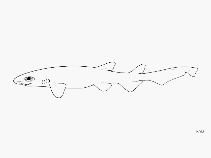
sub class Elasmobranchii (ฉลามและกระเบน) (sharks and rays) >
Carcharhiniformes (Ground sharks) >
Pentanchidae (Deepwater catsharks)
Etymology: Parmaturus: parma (L.), from parme (Gr.), small shield; oura (Gr.), tail, presumably referring to upper edge of caudal fin “armed with modified” scales (per Garman 1913) (See ETYFish); pilosus: Latin for hairy, allusion not explained, perhaps referring to its “minute, velvety” scales (See ETYFish).
More on author: Garman.
Environment: milieu / climate zone / ระดับความลึก / distribution range
นิเวศวิทยา
เกี่ยวกับทะเล,น้ำเค็ม สัตว์หน้าดินในเขตน้ำลึก; ระดับความลึก ? - 786 m (Ref. 244). Deep-water; 35°N - 32°N
Northwest Pacific: China and Japan.
ขนาด / น้ำหนัก / Age
วัยเจริญพันธุ์: Lm ? range ? - ? cm
Max length : 64.0 cm TL เพศผู้/กระเทย; (Ref. 244)
Found on the continental slope (Ref. 244). Oviparous (Ref. 559). Liver has a high concentration of squalene (Ref. 559).
Life cycle and mating behavior
วัยเจริญพันธุ์ | การสืบพันธุ์ | การวางไข่ | เซลสืบพันธ์ของเพศเมีย(ไข่) | ความดกของไข่ | ตัวอ่อน
Oviparous, paired eggs are laid. Embryos feed solely on yolk (Ref. 50449).
Compagno, L.J.V., 1984. FAO Species Catalogue. Vol. 4. Sharks of the world. An annotated and illustrated catalogue of shark species known to date. Part 2 - Carcharhiniformes. FAO Fish. Synop. 125(4/2):251-655. Rome: FAO. (Ref. 244)
IUCN Red List Status (Ref. 130435: Version 2025-1)
Threat to humans
Harmless
Human uses
การประมง: การประมงยังชีพ
เครื่องมือ
Special reports
Download XML
แหล่งที่มาจากอินเตอร์เน็ต
Estimates based on models
Phylogenetic diversity index (อ้างอิง
82804): PD
50 = 0.5078 [Uniqueness, from 0.5 = low to 2.0 = high].
Bayesian length-weight: a=0.00355 (0.00175 - 0.00721), b=3.08 (2.90 - 3.26), in cm total length, based on LWR estimates for this (Sub)family-body shape (Ref.
93245).
ระดับชั้นอาหาร (อ้างอิง
69278): 4.1 ±0.5 se; based on size and trophs of closest relatives
ความสามารถในการกลับคืนสู่ปกติ (อ้างอิง
120179): ต่ำ, เวลาต่ำสุดที่จะทำให้ประชากรเพิ่มขึ้นเป็น 2 เท่าใช้เวลา 4.5 - 14 ปี (Fec assumed to be <100).
Fishing Vulnerability (Ref.
59153): Moderate to high vulnerability (46 of 100).
🛈
Nutrients (Ref.
124155): Calcium = 8.93 [1.58, 55.62] mg/100g; Iron = 0.351 [0.074, 1.177] mg/100g; Protein = 16.9 [13.7, 20.0] %; Omega3 = 0.198 [0.081, 0.475] g/100g; Selenium = 12.7 [4.1, 39.2] μg/100g; VitaminA = 15.1 [3.3, 70.7] μg/100g; Zinc = 0.361 [0.175, 0.699] mg/100g (wet weight);