>
Gadiformes (Cods) >
Bregmacerotidae (Codlets)
Etymology: Bregmaceros: Greek, bregma = front of the head + Greek, keras, -atos = horn (Ref. 45335).
Eponymy: John McClelland (1805–1875) was a British doctor with interests in geology and natural history. [...] (Ref. 128868), visit book page.
Environment: milieu / Zona climática / intervalo de profundidade / distribution range
Ecologia
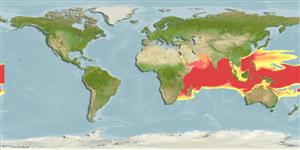
marinhas; estuarina pelagic-oceanic; oceanódromo (Ref. 51243); intervalo de profundidade 0 - 2000 m (Ref. 26165). Subtropical; 25°N - 6°N, 62°E - 100°E
Indian Ocean: confirmed from the Arabian Sea and Bay of Bengal. Reports from outside this area are most likely misidentifications (A.S. Harold, pers. comm., 18/08/98) and name reported from western Pacific may be a misidentification of B. pseudolanceolatus (Ref. 114229).
Tamanho / Peso / Idade
Maturidade: Lm ? range ? - ? cm
Max length : 9.6 cm SL macho/indeterminado; (Ref. 4496); common length : 7.0 cm SL macho/indeterminado; (Ref. 2872); peso máx. publicado: 8.50 g (Ref. 128684)
Descrição suscinta
Chaves de identificação | Morfologia | Morfometria
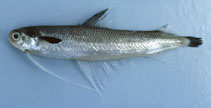
Espinhos dorsais (total) : 0; Raios dorsais (total) : 57 - 66; Espinhos anais: 0; Raios anais : 58 - 69; Vértebras: 52 - 58. Body is elongate, brownish and with speckling above and silvery below. The cheek and lower head also silver. Single occipital ray long and delicate, extending to near the middle of the second dorsal fin (Ref. 46075). Pelvic fins are jugular.
Body shape (shape guide): elongated; Cross section: oval.
If taxonomy is correct, both onshore in brackish water and oceanic. According to larval survey, occurrence in the tropics is wide (Ref. 9902, 45075). Feed on planktonic crustaceans. Also caught with bagnets (Ref. 2872).
Ciclo de vida ou comportamento de acasalamento
Maturidade | Reprodução | Desova | Ovos | Fecundidade | Larvas
Cohen, D.M., 1990. Bregmacerotidae. p. 524-525. In J.C. Quero, J.C. Hureau, C. Karrer, A. Post and L. Saldanha (eds.) Check-list of the fishes of the eastern tropical Atlantic (CLOFETA). JNICT, Lisbon; SEI, Paris; and UNESCO, Paris. Vol. 2. (Ref. 4496)
Status na Lista Vermelha da UICN (Ref. 130435: Version 2025-1)
Ameaça para os humanos
Harmless
Uso pelos humanos
Pescarias: espécies comerciais
Ferramentas
Relatórios especiais
Baixar XML
Fontes da internet
Estimates based on models
Preferred temperature (Ref.
123201): 5.6 - 13.1, mean 8.8 °C (based on 755 cells).
Índice de diversidade filogenética (Ref.
82804): PD
50 = 0.5000 [Uniqueness, from 0.5 = low to 2.0 = high].
Bayesian length-weight: a=0.00363 (0.00194 - 0.00680), b=3.16 (2.99 - 3.33), in cm total length, based on LWR estimates for this species & (Sub)family-body (Ref.
93245).
Nível Trófico (Ref.
69278): 3.3 ±0.42 se; based on food items.
Resiliência (Ref.
120179): Elevada, tempo mínimo de duplicação da população menor que 15 meses (Assuming tm=1).
Fishing Vulnerability (Ref.
59153): Low vulnerability (10 of 100).
🛈
Climate Vulnerability (Ref.
125649): Moderate to high vulnerability (48 of 100).
🛈
Nutrients (Ref.
124155): Calcium = 371 [67, 1,117] mg/100g; Iron = 2.89 [0.77, 7.08] mg/100g; Protein = 17.3 [14.9, 19.7] %; Omega3 = 0.283 [0.119, 0.635] g/100g; Selenium = 41.6 [13.0, 146.7] μg/100g; VitaminA = 63.1 [14.0, 271.9] μg/100g; Zinc = 1.04 [0.55, 2.50] mg/100g (wet weight); based on
nutrient studies.