>
Gadiformes (Cods) >
Bregmacerotidae (Codlets)
Etymology: Bregmaceros: Greek, bregma = front of the head + Greek, keras, -atos = horn (Ref. 45335).
Eponymy: John McClelland (1805–1875) was a British doctor with interests in geology and natural history. [...] (Ref. 128868), visit book page.
Environment: milieu / climate zone / rango de profundidad / distribution range
Ecología
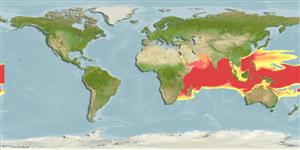
marino; salobre pelagic-oceanic; oceanodromo (Ref. 51243); rango de profundidad 0 - 2000 m (Ref. 26165). Subtropical; 25°N - 6°N, 62°E - 100°E
Indian Ocean: confirmed from the Arabian Sea and Bay of Bengal. Reports from outside this area are most likely misidentifications (A.S. Harold, pers. comm., 18/08/98) and name reported from western Pacific may be a misidentification of B. pseudolanceolatus (Ref. 114229).
Tamaño / Peso / Age
Madurez: Lm ? range ? - ? cm
Max length : 9.6 cm SL macho / no sexado; (Ref. 4496); common length : 7.0 cm SL macho / no sexado; (Ref. 2872); peso máximo publicado: 8.50 g (Ref. 128684)
Short description
Claves de identificación | Morfología | Morfometría
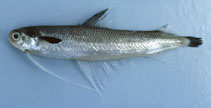
Espinas dorsales (total) : 0; Radios blandos dorsales (total) : 57 - 66; Espinas anales: 0; Radios blandos anales: 58 - 69; Vértebra: 52 - 58. Body is elongate, brownish and with speckling above and silvery below. The cheek and lower head also silver. Single occipital ray long and delicate, extending to near the middle of the second dorsal fin (Ref. 46075). Pelvic fins are jugular.
Body shape (shape guide): elongated; Cross section: oval.
If taxonomy is correct, both onshore in brackish water and oceanic. According to larval survey, occurrence in the tropics is wide (Ref. 9902, 45075). Feed on planktonic crustaceans. Also caught with bagnets (Ref. 2872).
Life cycle and mating behavior
Madurez | Reproducción | Puesta | Huevos | Fecundidad | Larva
Cohen, D.M., 1990. Bregmacerotidae. p. 524-525. In J.C. Quero, J.C. Hureau, C. Karrer, A. Post and L. Saldanha (eds.) Check-list of the fishes of the eastern tropical Atlantic (CLOFETA). JNICT, Lisbon; SEI, Paris; and UNESCO, Paris. Vol. 2. (Ref. 4496)
IUCN Red List Status (Ref. 130435: Version 2025-1)
Threat to humans
Harmless
Human uses
Pesquerías: comercial
Herramientas
Special reports
Download XML
Fuentes de Internet
Estimates based on models
Preferred temperature (Referencia
123201): 5.6 - 13.1, mean 8.8 °C (based on 755 cells).
Phylogenetic diversity index (Referencia
82804): PD
50 = 0.5000 [Uniqueness, from 0.5 = low to 2.0 = high].
Bayesian length-weight: a=0.00363 (0.00194 - 0.00680), b=3.16 (2.99 - 3.33), in cm total length, based on LWR estimates for this species & (Sub)family-body (Ref.
93245).
Nivel trófico (Referencia
69278): 3.3 ±0.42 se; based on food items.
Resiliencia (Referencia
120179): Alto, población duplicada en un tiempo mínimo inferior a 15 meses (Assuming tm=1).
Fishing Vulnerability (Ref.
59153): Low vulnerability (10 of 100).
🛈
Climate Vulnerability (Ref.
125649): Moderate to high vulnerability (48 of 100).
🛈
Nutrients (Ref.
124155): Calcium = 371 [67, 1,117] mg/100g; Iron = 2.89 [0.77, 7.08] mg/100g; Protein = 17.3 [14.9, 19.7] %; Omega3 = 0.283 [0.119, 0.635] g/100g; Selenium = 41.6 [13.0, 146.7] μg/100g; VitaminA = 63.1 [14.0, 271.9] μg/100g; Zinc = 1.04 [0.55, 2.50] mg/100g (wet weight); based on
nutrient studies.