Ελασμοβράγχιοι (καρχαρίες και σαλάχια) (sharks and rays) >
Myliobatiformes (Stingrays) >
Myliobatidae (Eagle and manta rays)
Etymology: Myliobatis: Greek, mylo = mill + Greek, + Greek, batis,-idos = a ray (Raja sp.) (Ref. 45335).
More on author: Macleay.
Issue
Synonym of Myliobatis tenuicaudata Hector 1877. according to White & Last, 2016 (Ref. 114953). This species page will be removed.
Environment: milieu / climate zone / εύρος βάθους / distribution range
Οικολογία
Θαλασσινό(ά) Υφαλόφιλο(α); εύρος βάθους 1 - 85 m (Ref. 9862). Subtropical; 27°S - 43°S
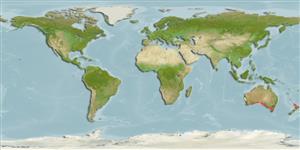
Eastern Indian Ocean: southern Australia, from Western Australia to Queensland. Possibly occurring off New Zealand.
Μέγεθος / Βάρος / Age
Γεννητική Ωρίμανση: Lm ? range ? - ? cm
Max length : 120 cm WD αρσενικό/απροσδιόριστο; (Ref. 6871); μεγ. δημοσιευμένο βάρος: 56.5 kg (Ref. 40637)
Commonly found off beaches and over sand flats in shallow water. Also found offshore down to 85 m (Ref. 9862). Feeds mainly on crabs and shellfish (Ref. 6871). Ovoviviparous (Ref. 50449).
Life cycle and mating behavior
Γεννητική Ωρίμανση | Αναπαραγωγή | Γεννοβολία | Αβγά | Γονιμότητα | Προνύμφες
Last, P.R. and J.D. Stevens, 1994. Sharks and rays of Australia. CSIRO, Australia. 513 p. (Ref. 6871)
IUCN Red List Status (Ref. 130435: Version 2025-1)
Threat to humans
Venomous
Human uses
αλιεία αναψυχής: ναί
Εργαλεία
Special reports
Download XML
Διαδικτυακές πηγές
Estimates based on models
Preferred temperature (Αναφ.
123201): 15 - 20.1, mean 17.4 °C (based on 236 cells).
Phylogenetic diversity index (Αναφ.
82804): PD
50 = 0.5002 [Uniqueness, from 0.5 = low to 2.0 = high].
Bayesian length-weight: a=0.00389 (0.00119 - 0.01269), b=3.08 (2.83 - 3.33), in cm total length, based on LWR estimates for this (Sub)family-body shape (Ref.
93245).
Τροφικό Επίπεδο (Αναφ.
69278): 3.4 ±0.4 se; based on size and trophs of closest relatives
Ελαστικότητα (Αναφ.
120179): Χαμηλό, ελάχιστος χρόνος για διπλασιασμό πληθυσμού 4,5 - 14 έτη (Fec assumed to be <100).
Fishing Vulnerability (Ref.
59153): Very high vulnerability (83 of 100).
🛈
Nutrients (Ref.
124155): Calcium = 4.25 [0.47, 67.92] mg/100g; Iron = 0.393 [0.033, 4.254] mg/100g; Protein = 21.5 [16.2, 26.7] %; Omega3 = 0.113 [0.037, 0.324] g/100g; Selenium = 15.7 [2.8, 83.7] μg/100g; VitaminA = 14.1 [1.2, 162.4] μg/100g; Zinc = 0.464 [0.031, 5.171] mg/100g (wet weight);