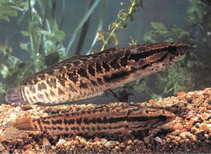
Environment: milieu / climate zone / गहराई सीमा / distribution range
पारिस्थितिकी
; स्वच्छ जल, अलवण जल बेनथोपिलाजिक. Tropical
Asia: Japan, southern China, Viet Nam, Taiwan and the Philippines.
आकार / वज़न / Age
परिपक्व अवधि: Lm ? range ? - ? cm
Max length : 20.0 cm TL पुल्लिंग / अलिंग; (Ref. 5258); common length : 11.0 cm SL पुल्लिंग / अलिंग; (Ref. 35840)
Short description
पहचान कुंजी | आकृति विज्ञान | मौरफोमैटरिक्स
Obligate air-breathing (Ref. 126274); Adults inhabit silty and weedy bottoms of rivers and ponds or lakes (Ref. 9671). Feed on crustaceans, large insects, frogs and fishes (Ref. 5258). Oviparous (Ref. 205). Recorded as having been or being farmed in rice fields (Ref. 119549).
Life cycle and mating behavior
परिपक्व अवधि | पुनरुत्पत्ति | मछलीऔ का अंडे देना | अंडे | Fecundity | लार्वा
Distinct pairing during breeding in shallow freshwater areas amid plants (Ref. 205). Oviparous (Ref. 205).
Masuda, H., K. Amaoka, C. Araga, T. Uyeno and T. Yoshino, 1984. The fishes of the Japanese Archipelago. Vol. 1. Tokai University Press, Tokyo, Japan. 437 p. (text). (Ref. 559)
IUCN Red List Status (Ref. 130435: Version 2025-1)
Threat to humans
Harmless
Human uses
मात्स्यिकी: व्यापारिक; जलीयकृषि: व्यापारिक; आखेट मत्स्य: हां
साधन
Special reports
Download XML
इंटरनेट स्रोत
Estimates based on models
Phylogenetic diversity index (संदर्भ
82804): PD
50 = 0.5000 [Uniqueness, from 0.5 = low to 2.0 = high].
Bayesian length-weight: a=0.00389 (0.00180 - 0.00842), b=3.12 (2.94 - 3.30), in cm total length, based on all LWR estimates for this body shape (Ref.
93245).
Trophic level (संदर्भ
69278): 3.7 ±0.60 se; based on food items.
लौटाव (संदर्भ
120179): ऊंचा, न्यूनतम जनसंख्या दुगनी समय अवलागत 15 महीने। (Preliminary K or Fecundity.).
Fishing Vulnerability (Ref.
59153): Low vulnerability (10 of 100).
🛈