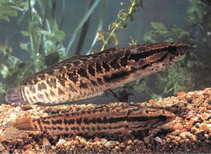
Channa maculata, Blotched snakehead : fisheries, aquaculture, gamefish

You can sponsor this page

Channa maculata (Lacepède, 1801)

Blotched snakehead
Upload your photos and videos
Bilder | Google image
Image of Channa maculata (Blotched snakehead)
Channa maculata
Picture by CAFS

Classification / Names Populärnamn | synonymer | Catalog of Fishes(Släkte, Arter) | ITIS | CoL | WoRMS | Cloffa

> Anabantiformes (Gouramies, snakeheads) > Channidae (Snakeheads)
Etymology: Channa: Greek, channe, -es = an anchovy (Ref. 45335).
More on author: Lacepède.

Environment: milieu / climate zone / djupintervall / distribution range Ekologi

; sötvatten bentopelagisk. Tropical

Utbredning Länder | FAO områden | Ekosystem | Förekomster | Prickkarta | Utplanteringar | Faunafri

Asia: Japan, southern China, Viet Nam, Taiwan and the Philippines.

Size / Vikt / Age

Könsmognad: Lm ?  range ? - ? cm
Max length : 20.0 cm TL hane/ej könsbestämd; (Ref. 5258); common length : 11.0 cm SL hane/ej könsbestämd; (Ref. 35840)

Short description Bestämningsnycklar | Morfologi | Morfometri


Body shape (shape guide): elongated.

Biologi     Ordlista (t.ex. epibenthic)

Obligate air-breathing (Ref. 126274); Adults inhabit silty and weedy bottoms of rivers and ponds or lakes (Ref. 9671). Feed on crustaceans, large insects, frogs and fishes (Ref. 5258). Oviparous (Ref. 205). Recorded as having been or being farmed in rice fields (Ref. 119549).

Life cycle and mating behavior Könsmognad | Reproduktion | Lek | Ägg | Fecundity | Larver

Distinct pairing during breeding in shallow freshwater areas amid plants (Ref. 205). Oviparous (Ref. 205).

Main reference Upload your references | referenser | Koordinator | Medarbetare

Masuda, H., K. Amaoka, C. Araga, T. Uyeno and T. Yoshino, 1984. The fishes of the Japanese Archipelago. Vol. 1. Tokai University Press, Tokyo, Japan. 437 p. (text). (Ref. 559)

IUCN Red List Status (Ref. 130435: Version 2025-1)

  Least Concern (LC) ; Date assessed: 25 October 2020

CITES

Not Evaluated

CMS (Ref. 116361)

Not Evaluated

Threat to humans

  Harmless


Human uses

Fiskeri: kommersiell; Vattenbruk: kommersiell; sportfisk: ja
FAO - Publication: search | FishSource |

Ytterligare information

Trophic ecology
Food items (preys)
Födosammansättning
Födointag
Food rations
Predatorer
Ekologi
Ekologi
Home ranges
Population dynamics
Tillväxtparametrar
Max. ages / sizes
Length-weight rel.
Length-length rel.
Length-frequencies
Mass conversion
Rekrytering
Abundans
Life cycle
Reproduktion
Könsmognad
Maturity/Gills rel.
Fecundity
Lek
Spawning aggregations
Ägg
Egg development
Larver
Larvdynamik
Anatomy
Gälyta
Brain
Otolith
Physiology
Body composition
Nutrients
Syreförbrukning
Swimming type
Simhastighet
Visual pigments
Fish sound
Diseases & Parasites
Toxicity (LC50s)
Genetik
Genome
Genetik
Heterozygosity
Ärftlighet
Human related
Aquaculture systems
Vattenbruksprofiler
Avelslinjer
Ciguatera cases
Stamps, coins, misc.
Outreach
Medarbetare
referenser
referenser

Verktyg

Special reports

Download XML

Internet-källor

Estimates based on models

Phylogenetic diversity index (Ref. 82804):  PD50 = 0.5000   [Uniqueness, from 0.5 = low to 2.0 = high].
Bayesian length-weight: a=0.00389 (0.00180 - 0.00842), b=3.12 (2.94 - 3.30), in cm total length, based on all LWR estimates for this body shape (Ref. 93245).
Trofisk nivå (Ref. 69278):  3.7   ±0.60 se; based on food items.
Resiliens (Ref. 120179):  Hög, lägsta populationsfördubblingstid mindre än 15 månader (Preliminary K or Fecundity.).
Fishing Vulnerability (Ref. 59153):  Low vulnerability (10 of 100). 🛈
Price category (Ref. 80766):   Unknown.