



Sciades couma (Valenciennes, 1840)
Couma sea catfish
Carica il tuo foto e Video
Immagini | Google image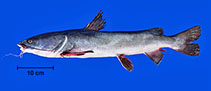 Sciades couma
Immagine di Barbosa, J.M./M. Deda
Immagini | Google image
Immagine di Barbosa, J.M./M. Deda
Classificazione / Nomi Nomi Comuni | Sinonimi | Catalog of Fishes(Genere, Specie) | ITIS | CoL | WoRMS | Cloffa
Ambiente: milieu / zona climatica / distribuzione batimetrica / gamma di distribuzione Ecologia
; acqua dolce; salmastro demersale. Tropical; 11°N - 8°S, 77°W - 34°W
Distribuzione Territories | Aree FAO | Ecosistemi | Presenze | Mappa dei ritrovamenti | Introduzioni | Faunafri
South America: Gulf of Paria to Pernambuco, Brazil.
Dimensione / Peso / Età
Maturità: Lm ? range ? - ? cm
Max length : 97.0 cm TL maschio/sesso non determinato; (Ref. 5217); common length : 50.0 cm TL maschio/sesso non determinato; (Ref. 5217); peso massimo pubblicato: 30.0 kg (Ref. 5217); Età massima riportata: 5 anni (Ref. 51994)
Max length : 97.0 cm TL maschio/sesso non determinato; (Ref. 5217); common length : 50.0 cm TL maschio/sesso non determinato; (Ref. 5217); peso massimo pubblicato: 30.0 kg (Ref. 5217); Età massima riportata: 5 anni (Ref. 51994)
Breve descrizione Chiavi di identificazione | Morfologia | Morfometria
Spine dorsali (totale) : 1. The head is rounded and flattened on the upper part. The mouth is slightly inferior. It has 3 pairs of barbels (1 pair of maxillary barbels and 2 pairs of mandibular barbels. The cephalic surface is very rough (Ref. 35381).
Body shape (shape guide): elongated.
Body shape (shape guide): elongated.
Confined chiefly to turbid waters in estuaries and the lower parts of rivers. Its delicate flesh is highly valued (Ref. 27188). Two annual cycles of slower growth are know during the two dry seasons (March and August to November). Probably has a short life span. In the beginning of reproduction, the male's mouth changes to function as a egg repository (buccal incubation). The female lays down her eggs in a sandy depression, then after fertilization, the male puts the eggs into its mouth which is provided with ventilation until hatching. Eggs diameter is about 2 mm and its number varies from 100 to 165 per female. Feeds mainly on crustaceans (Ref. 35381). Marketed fresh and salted.
Ciclo vitale e comportamento di accoppiamento Maturità | Riproduzione | Deposizione | Uova | Fecondità | Larve
Distinct pairing. Mouth brooding may be employed (Ref. 205).
Riferimento principale
Caricare le referenze | Bibliografia | Coordinatore : Ferraris, Jr., Carl J. | Collaboratori
Cervigón, F., R. Cipriani, W. Fischer, L. Garibaldi, M. Hendrickx, A.J. Lemus, R. Márquez, J.M. Poutiers, G. Robaina and B. Rodriguez, 1992. Fichas FAO de identificación de especies para los fines de la pesca. Guía de campo de las especies comerciales marinas y de aquas salobres de la costa septentrional de Sur América. FAO, Rome. 513 p. Preparado con el financiamento de la Comisión de Comunidades Europeas y de NORAD. (Ref. 5217)
Stato della Lista Rossa IUCN (Ref. 130435: Version 2025-2 (Global))
Least Concern (LC) ; Date assessed: 28 January 2009
CITES
Not Evaluated
Minaccia per l'uomo
Traumatogenic (Ref. 58010)
Usi umani
Pesca: commerciale
FAO - Publication: search | FishSource | Sea Around Us
Informazioni ulteriori
Ecologia trofica
Articoli alimentari (prede)
Alimentazione
Consumo di cibo
Razioni alimentari
Predatori
Articoli alimentari (prede)
Alimentazione
Consumo di cibo
Razioni alimentari
Predatori
Dinamica della popolazione
Parametri di crescita
Età massima / dimensioni massime
Rapporto lunghezza-peso.
Lunghezza-lunghezza rel.
Lunghezza-frequenze
Conversione di massa
Reclutamento
Abbondanza
Parametri di crescita
Età massima / dimensioni massime
Rapporto lunghezza-peso.
Lunghezza-lunghezza rel.
Lunghezza-frequenze
Conversione di massa
Reclutamento
Abbondanza
Ciclo di vita
Riproduzione
Maturità
Maturità/Gli occhielli sono relativi.
Fecondità
Deposizione
Aggregazioni riproduttive
Uova
Sviluppo delle uova
Larve
Dinamica popolazioni larvali
Riproduzione
Maturità
Maturità/Gli occhielli sono relativi.
Fecondità
Deposizione
Aggregazioni riproduttive
Uova
Sviluppo delle uova
Larve
Dinamica popolazioni larvali
Anatomia
Area branchiale
Cervello
Otolite
Area branchiale
Cervello
Otolite
Fisiologia
Composizione corporea
Nutrienti
Consumo di ossigeno
Tipo di nuoto
Velocità di nuoto
Pigmenti visivi
Suono del pesce
Malattie e parassiti
Tossicità (LC50)
Composizione corporea
Nutrienti
Consumo di ossigeno
Tipo di nuoto
Velocità di nuoto
Pigmenti visivi
Suono del pesce
Malattie e parassiti
Tossicità (LC50)
Genetica
Genome
Genetica
Eterozigosi
Ereditarietà
Diversità genetica
Genome
Genetica
Eterozigosi
Ereditarietà
Diversità genetica
Legato all'uomo
Sistemi di acquacoltura
Profili di acquacoltura
Varietà
Casi di Ciguatera
Francobolli, monete, materiale vario.
Sistemi di acquacoltura
Profili di acquacoltura
Varietà
Casi di Ciguatera
Francobolli, monete, materiale vario.
Strumenti
Libro elettronico | Giuda pratica | Chiavi di identificazione | Generatore frequenze di lunghezza | Strumento Parametri Biologici | Mappa dei ritrovamenti |
Cattura-MSY |
Rapporti speciali
Controllo della manutenzione dell'acquario | Verificare la presenza di schede informative sulle specie | Verifica delle schede informative sull'acquacoltura
Scarica XML
Fonti Internet
AFORO (otoliths) | Aquatic Commons | BHL | Cloffa | Websites from users | Check FishWatcher | CISTI | Catalog of Fishes: Genere, Specie | DiscoverLife | ECOTOX | FAO - Publication: search | Faunafri | Fishipedia | Fishtrace | GloBI | Google Books | Google Scholar | Google | IGFA World Record | OneZoom | Open Tree of Life | Otolith Atlas of Taiwan Fishes | PubMed | Reef Life Survey | Socotra Atlas | TreeBase | Tree of Life | Wikipedia: Go, ricerca | World Records Freshwater Fishing | Record zoologico
Stime basate su modelli
Indice di diversità filogenetica (Fonte Biblio. 82804): PD50 = 0.5078 [Uniqueness, from 0.5 = low to 2.0 = high].
Bayesian length-weight: a=0.00676 (0.00417 - 0.01096), b=3.16 (3.02 - 3.30), in cm total length, based on LWR estimates for this species & (Sub)family-body (Ref. 93245).
Livello trofico (Fonte Biblio. 69278): 3.9 ±0.5 se; based on diet studies.
Resilienza (Fonte Biblio. 120179): Medio, tempo minimo di raddoppiamento della popolazione 1.4 - 4.4 anni (K = 0.45; tmax = 5).
Prior r = 0.56, 95% CL = 0.37 - 0.84, Based on 1 data-limited stock assessment.
Nutrienti (Ref. 124155): Calcium = 107 [59, 230] mg/100g; Iron = 1.07 [0.66, 1.81] mg/100g; Protein = 17.3 [15.6, 19.0] %; Omega3 = 0.166 [0.093, 0.303] g/100g; Selenium = 77.1 [39.1, 154.6] μg/100g; VitaminA = 8.43 [3.64, 19.18] μg/100g; Zinc = 0.966 [0.654, 1.447] mg/100g (wet weight);