Environment: milieu / Klimaatzone / Diepte / distribution range
Ecologie
marien demersaal; diepte 10 - 1500 m (Ref. 26346). Temperate
Southwest Pacific: endemic to New Zealand.
Lengte bij maturiteit / Grootte / Gewicht / Leeftijd
Maturiteit: Lm 59.0 range ? - ? cm
Max length : 118 cm TL mannelijk / geslacht onbekend; (Ref. 26346); common length : 62.0 cm TL mannelijk / geslacht onbekend; (Ref. 9258); max. gerapporteerde leeftijd: 9 Jaren (Ref. 47618)
Korte beschrijving
Determinatiesleutels | Morfologie | Morfometrie
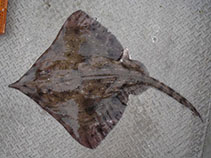
Brown dorsally, mottled with white and black spots, and a large dark blotch on each wing; white ventrally (Ref. 26346).
Body shape (shape guide): other.
Inhabit the continental shelf and upper slope (Ref. 26346); usually in coastal waters (Ref. 9258). Found partially buried in sand (Ref. 26346). Feed on fish, shellfish, crabs, and worms (Ref. 114953, 26346). Oviparous. Distinct pairing with embrace. Young may tend to follow large objects, such as their mother (Ref. 205). Eggs are oblong capsules with stiff pointed horns at the corners deposited in sandy or muddy flats (Ref. 205). Egg capsules are 10.2-12.7 cm long and 6.3-8.3 cm wide (Ref. 41249, 41308).
Levenscyclus en paargedrag
Maturiteit | Voortplanting | Paaien | Eieren | Fecunditeit | Larven
Oviparous, paired eggs are laid. Embryos feed solely on yolk (Ref. 50449). Young hatching at about 18-20 cm (Ref. 26346). Distinct pairing with embrace. Young may tend to follow large objects, such as their mother (Ref. 205).
McEachran, J.D. and K.A. Dunn, 1998. Phylogenetic analysis of skates, a morphologically conservative clade of elasmobranchs (Chondrichthyes: Rajidae). Copeia 1998(2):271-290. (Ref. 27314)
Status op de Rode Lijst van het IUCN (Ref. 130435: Version 2025-1)
Gevaar voor de mens
Harmless
Gebruik door de mens
Visserij: commercieel
Tools
Speciale rapporten
Download XML
Internetbronnen
Estimates based on models
Preferred temperature (Ref.
123201): 7.4 - 12.6, mean 9.2 °C (based on 95 cells).
Fylogenetische diversiteitsindex (Ref.
82804): PD
50 = 0.5625 [Uniqueness, from 0.5 = low to 2.0 = high].
Bayesian length-weight: a=0.00302 (0.00141 - 0.00645), b=3.24 (3.07 - 3.41), in cm total length, based on LWR estimates for this (Sub)family-body shape (Ref.
93245).
Trofisch niveau (Ref.
69278): 3.7 ±0.57 se; based on food items.
Generation time: 6.9 ( na - na) years. Estimated as median ln(3)/K based on 1
growth studies.
Weerstandsvermogen (Ref.
120179): laag, minimale populatieverdubbelingstijd 4,5-14 jaar (Fec assumed to be <100).
Fishing Vulnerability (Ref.
59153): High vulnerability (59 of 100).
🛈
Climate Vulnerability (Ref.
125649): High to very high vulnerability (70 of 100).
🛈
Nutrients (Ref.
124155): Calcium = 4.7 [0.7, 81.8] mg/100g; Iron = 0.238 [0.022, 2.862] mg/100g; Protein = 14.8 [12.3, 17.9] %; Omega3 = 0.808 [0.354, 1.936] g/100g; Selenium = 20.5 [4.3, 103.7] μg/100g; VitaminA = 4.51 [0.33, 51.42] μg/100g; Zinc = 0.31 [0.02, 3.49] mg/100g (wet weight);