Environment: milieu / climate zone / profondeur / distribution range
Écologie
marin démersal; profondeur 10 - 1500 m (Ref. 26346). Temperate
Southwest Pacific: endemic to New Zealand.
Length at first maturity / Taille / Poids / Âge
Maturité: Lm 59.0 range ? - ? cm
Max length : 118 cm TL mâle / non sexé; (Ref. 26346); common length : 62.0 cm TL mâle / non sexé; (Ref. 9258); âge max. reporté: 9 années (Ref. 47618)
Description synthétique
Clés d'identification | Morphologie | Morphométrie
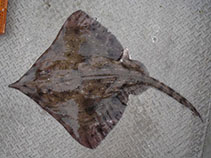
Brown dorsally, mottled with white and black spots, and a large dark blotch on each wing; white ventrally (Ref. 26346).
Body shape (shape guide): other.
Inhabit the continental shelf and upper slope (Ref. 26346); usually in coastal waters (Ref. 9258). Found partially buried in sand (Ref. 26346). Feed on fish, shellfish, crabs, and worms (Ref. 114953, 26346). Oviparous. Distinct pairing with embrace. Young may tend to follow large objects, such as their mother (Ref. 205). Eggs are oblong capsules with stiff pointed horns at the corners deposited in sandy or muddy flats (Ref. 205). Egg capsules are 10.2-12.7 cm long and 6.3-8.3 cm wide (Ref. 41249, 41308).
Life cycle and mating behavior
Maturité | Reproduction | Frai | Œufs | Fécondité | Larves
Oviparous, paired eggs are laid. Embryos feed solely on yolk (Ref. 50449). Young hatching at about 18-20 cm (Ref. 26346). Distinct pairing with embrace. Young may tend to follow large objects, such as their mother (Ref. 205).
McEachran, J.D. and K.A. Dunn, 1998. Phylogenetic analysis of skates, a morphologically conservative clade of elasmobranchs (Chondrichthyes: Rajidae). Copeia 1998(2):271-290. (Ref. 27314)
Statut dans la liste rouge de l'IUCN (Ref. 130435: Version 2025-1)
Menace pour l'homme
Harmless
Utilisations par l'homme
Pêcheries: commercial
Outils
Articles particuliers
Télécharger en XML
Sources Internet
Estimates based on models
Preferred temperature (Réf.
123201): 7.4 - 12.6, mean 9.2 °C (based on 95 cells).
Phylogenetic diversity index (Réf.
82804): PD
50 = 0.5625 [Uniqueness, from 0.5 = low to 2.0 = high].
Bayesian length-weight: a=0.00302 (0.00141 - 0.00645), b=3.24 (3.07 - 3.41), in cm total length, based on LWR estimates for this (Sub)family-body shape (Ref.
93245).
Niveau trophique (Réf.
69278): 3.7 ±0.57 se; based on food items.
Generation time: 6.9 ( na - na) years. Estimated as median ln(3)/K based on 1
growth studies.
Résilience (Réf.
120179): Faible, temps minimum de doublement de population : 4,5 à 14 années (Fec assumed to be <100).
Fishing Vulnerability (Ref.
59153): High vulnerability (59 of 100).
🛈
Climate Vulnerability (Ref.
125649): High to very high vulnerability (70 of 100).
🛈
Nutrients (Ref.
124155): Calcium = 4.7 [0.7, 81.8] mg/100g; Iron = 0.238 [0.022, 2.862] mg/100g; Protein = 14.8 [12.3, 17.9] %; Omega3 = 0.808 [0.354, 1.936] g/100g; Selenium = 20.5 [4.3, 103.7] μg/100g; VitaminA = 4.51 [0.33, 51.42] μg/100g; Zinc = 0.31 [0.02, 3.49] mg/100g (wet weight);