This website uses cookies to enhance your browsing experience and ensure the functionality of our site. For more detailed information about the types of cookies we use and how we protect your privacy, please visit our Privacy Information page.
×
Cookie Settings
This website uses different types of cookies to enhance your experience. Please select your preferences below:
> Ovalentaria/misc (Various families in series Ovalentaria) > Pseudochromidae (Dottybacks) > Pseudochrominae
Etymology: Ogilbyina:Taken from Ogilby, 1887-1915, icthiologist and zoologist (Ref. 45335). Eponymy: James Douglas Ogilby (1853–1925) was an Irish-born Australian ichthyologist and taxonomist, son of the famous zoologist William Ogilby (below). [...] (Ref. 128868), visit book page. More on author: Saville-Kent.
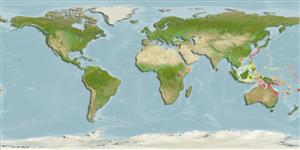
Environnement : milieu / zone climatique / profondeur / gamme de distribution Écologie
marin récifal; profondeur 1 - 20 m (Ref. 9710), usually 10 - 20 m (Ref. 9710). Tropical
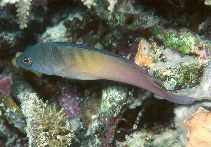
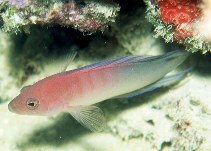
Épines dorsales (Total) : 3; Rayons mous dorsaux (Total) : 32 - 37; Épines anales: 3; Rayons mous anaux: 18 - 21. Color variable depending on sex; male mainly red anteriorly and purplish posteriorly; dorsal, anal and caudal fins bluish except dorsal reddish on anterior part; female with a grayish head, largely yellow-orange on side, with 5-6 brown bars on upper half of anterior part of body; fins largely reddish (Ref. 2334). Body shape (shape guide): fusiform / normal.
Usually found in or near holes of coral reefs (Ref. 9710). Minimum depth from https://www.reeflifesurvey.com/species/ogilbyina-queenslandiae/.
Cycle de vie et comportement reproducteur Maturité | Reproduction | Frai | Œufs | Fécondité | Larves
Bi-directional sex change has been proposed for this species though histological analysis of more specimens is needed for confirmation (Ref. 103751).
Paxton, J.R., D.F. Hoese, G.R. Allen and J.E. Hanley, 1989. Pisces. Petromyzontidae to Carangidae. Zoological Catalogue of Australia, Vol. 7. Australian Government Publishing Service, Canberra, 665 p. (Ref. 7300)
Statut dans la liste rouge de l'IUCN (Ref. 130435: Version 2025-2 (Global))
Dynamique des populations Paramètres de croissance Âges / tailles maximales Longueur-poids rel. Rel. longueur-longueur. Fréquences de longueurs Conversion de masse Recrutement Abondance
Cycle de vie Reproduction Maturité Maturité/épines rel. Fécondité Frai Agrégats de frai Œufs Développement de l'œuf Larves Dynamique des populations larvaires
Physiologie Composition corporelle Nutriments Consommation d'oxygène Type de natation Vitesse de nage Pigments visuels Son de poisson Maladies et parasites Toxicité (CL50)
Température préférée (Réf. 123201): 24.6 - 27.9, mean 26.6 °C (based on 72 cells).
Indice de diversité phylogénétique (Réf. 82804): PD50 = 0.6250 [Uniqueness, from 0.5 = low to 2.0 = high].
Bayesian length-weight: a=0.01148 (0.00470 - 0.02806), b=2.95 (2.74 - 3.16), in cm total length, based on LWR estimates for this (Sub)family-body shape (Ref. 93245).
Niveau trophique (Réf. 69278): 3.8 ±0.5 se; based on size and trophs of closest relatives
Résilience (Réf. 120179): Haut, temps minimum de doublement de population inférieur à 15 mois (Preliminary K or Fecundity.).
Vulnérabilité de la pêche (Ref. 59153): Low vulnerability (10 of 100). 🛈