This website uses cookies to enhance your browsing experience and ensure the functionality of our site. For more detailed information about the types of cookies we use and how we protect your privacy, please visit our Privacy Information page.
×
Cookie Settings
This website uses different types of cookies to enhance your experience. Please select your preferences below:
> Ovalentaria/misc (Various families in series Ovalentaria) > Pseudochromidae (Dottybacks) > Pseudochrominae
Etymology: Ogilbyina:Taken from Ogilby, 1887-1915, icthiologist and zoologist (Ref. 45335). Eponymy: James Douglas Ogilby (1853–1925) was an Irish-born Australian ichthyologist and taxonomist, son of the famous zoologist William Ogilby (below). [...] (Ref. 128868), visit book page. More on author: Saville-Kent.
Ambiente: milieu / zona climática / intervalo de profundidade / gama de distribuição Ecologia
marinhas associadas(os) a recifes; intervalo de profundidade 1 - 20 m (Ref. 9710), usually 10 - 20 m (Ref. 9710). Tropical
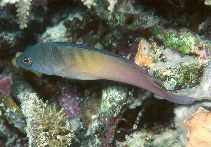
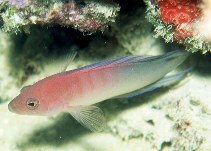
Espinhos dorsais (total) : 3; Raios dorsais moles (total) : 32 - 37; Espinhos anais: 3; Raios anais moles: 18 - 21. Color variable depending on sex; male mainly red anteriorly and purplish posteriorly; dorsal, anal and caudal fins bluish except dorsal reddish on anterior part; female with a grayish head, largely yellow-orange on side, with 5-6 brown bars on upper half of anterior part of body; fins largely reddish (Ref. 2334). Body shape (shape guide): fusiform / normal.
Usually found in or near holes of coral reefs (Ref. 9710). Minimum depth from https://www.reeflifesurvey.com/species/ogilbyina-queenslandiae/.
Ciclo de vida e comportamento de acasalamento Maturidade | Reprodução | Desova | Ovos | Fecundidade | Larvas
Bi-directional sex change has been proposed for this species though histological analysis of more specimens is needed for confirmation (Ref. 103751).
Paxton, J.R., D.F. Hoese, G.R. Allen and J.E. Hanley, 1989. Pisces. Petromyzontidae to Carangidae. Zoological Catalogue of Australia, Vol. 7. Australian Government Publishing Service, Canberra, 665 p. (Ref. 7300)
Categoria na Lista Vermelha da IUCN (Ref. 130435: Version 2025-2 (Global))
Ecologia Trófica Produtos alimentares (presas) Composição da dieta Consumo alimentar Rações alimentares Predadores
Ecologia Ecologia
Dinâmica das populações Parâmetros de crescimento Idades / tamanhos máximos Comprimento-peso rel. Comprimento-comprimento rel. Frequência de comprimento Conversão de massa Recrutamento Abundância
Ciclo de vida Reprodução Maturidade Maturidade/Rel. das guelras Fecundidade Desova Agregações de desova Ovos Desenvolvimento dos ovos Larvas Dinâmica larvar
Fisiologia Composição corporal Nutrientes Consumo de oxigénio Tipo de natação Velocidade de natação Pigmentos visuais Som de peixe Doenças e Parasitas Toxicidade (LC50s)
Temperatura preferida (Ref. 123201): 24.6 - 27.9, mean 26.6 °C (based on 72 cells).
Índice de diversidade filogenética (Ref. 82804): PD50 = 0.6250 [Uniqueness, from 0.5 = low to 2.0 = high].
Bayesian length-weight: a=0.01148 (0.00470 - 0.02806), b=2.95 (2.74 - 3.16), in cm total length, based on LWR estimates for this (Sub)family-body shape (Ref. 93245).
Nível Trófico (Ref. 69278): 3.8 ±0.5 se; based on size and trophs of closest relatives
Resiliência (Ref. 120179): Elevada, tempo mínimo de duplicação da população menor que 15 meses (Preliminary K or Fecundity.).
Vulnerabilidade da pesca (Ref. 59153): Low vulnerability (10 of 100). 🛈