>
Eupercaria/misc (Various families in series Eupercaria) >
Sciaenidae (Drums or croakers)
Eponymy: Rev Dr Christoph Samuel John (1747–1813) was a botanist and herpetologist and a medical missionary (1771–1813) at the Danish trading station of Tranquebar (now Tharangambadi), Tamil Nadu, not far from Madras (Chennai). [...] (Ref. 128868), visit book page.
More on author: Bleeker.
Environment: milieu / climate zone / profondeur / distribution range
Écologie
marin; eau douce; saumâtre benthopélagique. Tropical
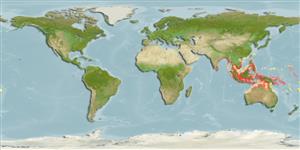
Indo-West Pacific: Bay of Bengal to Borneo and Java, and north to Viet Nam.
Taille / Poids / Âge
Maturité: Lm ? range ? - ? cm
Max length : 10.0 cm SL mâle / non sexé; (Ref. 9772); common length : 8.0 cm SL mâle / non sexé; (Ref. 9772)
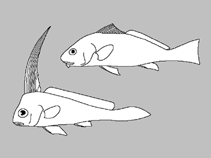
Épines dorsales (Total) : 10 - 12; Rayons mous dorsaux (Total) : 28 - 31; Épines anales: 2; Rayons mous anaux: 6 - 8. Eye large, about 30 % of head length; mental pores in 3 pairs, the first open at front of chin, separated by symphysis; teeth well differentiated into large and small in both jaws. Gill rakers slender, equal to or slightly shorter than gill filaments at angle of arch, 14 to 17 on lower limb. Second anal spine long , stiff, 40 to 50 % of head length. Swim bladder hammer-shaped, with about 13 pairs of arborescent appendages along its sides, the first entering head beyond transverse septum and sending a palmate branch to the front of pectoral arch. Sagitta (large earstone) with a tadpole-shaped impression, the head of which has its long axis lying obliquely to that of sagitta and the tail expanded and deepened as a hallow cone connected with the head by a narrow groove.
Body shape (shape guide): fusiform / normal.
Inhabits shallow coastal waters, estuaries and rivers (Ref. 9772).
Life cycle and mating behavior
Maturité | Reproduction | Frai | Œufs | Fécondité | Larves
Sasaki, K., 2001. Sciaenidae. Croakers (drums). p.3117-3174. In K.E. Carpenter and V.H. Niem (eds.) FAO species identification guide for fishery purposes. The living marine resources of the Western Central Pacific. Volume 5. Bony fishes part 3 (Menidae to Pomacentridae). Rome, FAO. pp. 2791-3380. (Ref. 9772)
Statut dans la liste rouge de l'IUCN (Ref. 130435: Version 2025-1)
Menace pour l'homme
Harmless
Utilisations par l'homme
Pêcheries: sans intérêt
Outils
Articles particuliers
Télécharger en XML
Sources Internet
Estimates based on models
Preferred temperature (Réf.
123201): 27.3 - 29.2, mean 28.5 °C (based on 906 cells).
Phylogenetic diversity index (Réf.
82804): PD
50 = 0.5000 [Uniqueness, from 0.5 = low to 2.0 = high].
Bayesian length-weight: a=0.00891 (0.00412 - 0.01928), b=3.08 (2.91 - 3.25), in cm total length, based on LWR estimates for this Genus-body shape (Ref.
93245).
Niveau trophique (Réf.
69278): 3.3 ±0.4 se; based on size and trophs of closest relatives
Résilience (Réf.
120179): Haut, temps minimum de doublement de population inférieur à 15 mois (Preliminary K or Fecundity.).
Fishing Vulnerability (Ref.
59153): Low vulnerability (10 of 100).
🛈