



Uploaden van uw Foto's en video's
Afbeeldingen | Postzegels, munten, diversen. | Google afbeelding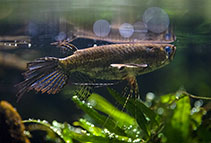 Pantodon buchholzi
Afbeelding van Muséum-Aquarium de Nancy/B. Alenda
Afbeeldingen | Postzegels, munten, diversen. | Google afbeelding
Afbeelding van Muséum-Aquarium de Nancy/B. Alenda
Classificatie / Namen Lokale namen | Synoniemen | Catalog of Fishes(Genus, Soort(en)) | ITIS | CoL | WoRMS | Cloffa
> Osteoglossiformes (Bony tongues) > Pantodontidae (Freshwater Butterflyfish)
Etymology: Pantodon: Greek, pan = all + Greek, odous = teeth (Ref. 45335); buchholzi: Named after Professor Dr. Buchholz, collector of the type specimens (Ref. 53310).
Eponymy: Dr Reinhold Wilhelm Buchholz (1837–1876) was a German physician, zoologist and explorer. [...] (Ref. 128868), visit book page.
More on author: Peters.
Etymology: Pantodon: Greek, pan = all + Greek, odous = teeth (Ref. 45335); buchholzi: Named after Professor Dr. Buchholz, collector of the type specimens (Ref. 53310).
Eponymy: Dr Reinhold Wilhelm Buchholz (1837–1876) was a German physician, zoologist and explorer. [...] (Ref. 128868), visit book page.
More on author: Peters.
Taxonomic Remarks
Type species of the genus, by monotypy (Ref. 3515). Also Ref. 53310.
Milieu: milieu / Klimaatzone / Diepte / verspreidingsgebied Ecologie
Verspreiding Gebieden | FAO regio's | Ecosystemen | Voorkomen | Verspreidingskaart | Introducties | Faunafri
West and Central Africa: Nigeria, Lake Chad, Cameroon, Ogowe basin, Congo basin and upper Zambezi River (Ref. 2921, Ref. 3515). Eastern distribution limit seems to be the Ouémé River in Benin (Ref. 1989, Ref. 3019), although it is also reported from the Jong River in Sierra Leone (Ref. 2921).
Grootte / Gewicht / Leeftijd
Korte beschrijving Determinatiesleutels | Morfologie | Morfometrie
Dorsale stekels (totaal) : 0; Dorsale zachte stralen (totaal) : 6; Anale stekels: 0; Anale zachte stralen: 9 - 15. Compressed body, flattened on the dorsal side and head, careened on the ventral side behind the pelvic fins (Ref. 2921, Ref. 13851). Large mouth, with numerous teeth and a prominent lower jaw (Ref. 2921), upwardly directed (Ref. 3054, Ref. 42873). Short dorsal fin placed very posterior on the back (Ref. 2921), inserted behind the longer anal fin (Ref. 3054, Ref. 13851). Large development of the pectoral fins (Ref. 2921, Ref. 3054), enlarged and wing-like (Ref. 42873). Very advanced position of the pelvic fins, with 4 elongated, filamentous rays (Ref. 2921, Ref. 3054). The caudal fin is long, pointed and rather ragged, with the two centre rays the longest (Ref. 13851). Large cycloid scales (Ref. 2921), subcircular, with rounded but evident laterobasal angles (Ref. 53264): 26-30 lateral line scales, 21-26 predorsal scales (Ref. 52030, Ref. 52046). Extremely brilliant colored (Ref. 2921): dorsal side of the body olive-colored, ventral side silvery yellow amplified with carmine; sometimes with darker transversal bands on the back (Ref. 2921, Ref. 3032). The fins are vivid pink-colored with small brown-violet spots, forming transversal bands on the pectoral fins, and tinted with violet on the inside and extremities (Ref. 2921).
Body shape (shape guide): fusiform / normal.
Body shape (shape guide): fusiform / normal.
Obligate air-breathing (Ref. 126274); Pantodon buchholzi is a creature from calm waters (Ref. 51626). It lives in swamps, creeks and backwaters (Ref. 31256), and inhabits the calmer parts of rivers (Ref. 41580), where it can be seen on the surface waters (Ref. 4910). They are capable to jump out of the water, to search for insects or to escape from predators (Ref. 2921). It is not a glider, but a ballistic jumper (Ref. 52282), with a tremendous jumping power (Ref. 31256). It is an exophageous insectivore, feeding on terrestrial insects and aquatic larvae and nymphs of insects (Ref. 41580). It also feeds on crustaceans and fish (Ref. 7020). Introduced in 1905 to European aquarists (Ref. 51626, Ref. 53207). Pantodon buchholzi is a favorite fish for aquarists; in the aquarium it can rest with the top of the head and the large pectoral fins touching the surface, while the long rays of the pelvic fin hang down perpendicularly, forming a tempting morsel for other aggressive fish in the same tank, and therefore it should be stocked together with only bottom dwellers (Ref. 13851). Observed maximum length of 15.0 cm TL in aquarium (Ref. 2921, Ref. 3515).
Levenscyclus en paargedrag Maturiteit | Voortplanting | Paaien | Eieren | Fecunditeit | Larven
Hoofdreferentie
Upload uw referenties | Referenties | Coördinator | Medewerkers
Teugels, G.G., 1990. Pantodontidae. p. 116-118. In C. Lévêque, D. Paugy and G.G. Teugels (eds.) Faune des poissons d'eaux douces et saumâtres de l'Afrique de l'Ouest. Tome 1. Coll. Faune Trop. 28. Musée Royal de l'Afrique Centrale, Tervuren and Éditions de l'ORSTOM, Paris. 384 p. (Ref. 2921)
Status op de Rode Lijst van het IUCN (Ref. 130435: Version 2025-2 (Global))
Niet bedreigd (LC) ; Date assessed: 05 June 2019
CITES
Not Evaluated
Gevaar voor de mens
Harmless
Gebruik door de mens
Visserij: van geen belang; Aquarium: Commercieel
FAO - Publication: search | FishSource |
Meer informatie
Trofische ecologie
Voedsel (prooien)
Dieetsamenstelling
Voedselconsumptie
Voedselrantsoenen
Predatoren
Voedsel (prooien)
Dieetsamenstelling
Voedselconsumptie
Voedselrantsoenen
Predatoren
Populatiedynamica
Groeiparameters
Max. leeftijden / maten
Lengte-gewicht rel.
Lengte-lengte rel.
Lengtefrequenties
Massaconversie
Rekrutering
Abundantie
Groeiparameters
Max. leeftijden / maten
Lengte-gewicht rel.
Lengte-lengte rel.
Lengtefrequenties
Massaconversie
Rekrutering
Abundantie
Levenscyclus
Voortplanting
Maturiteit
Rijpheid/kieuwen rel.
Fecunditeit
Paaien
Paaibestanden
Eieren
Ontwikkeling van de eieren
Larven
Larvale populatiedynamiek
Voortplanting
Maturiteit
Rijpheid/kieuwen rel.
Fecunditeit
Paaien
Paaibestanden
Eieren
Ontwikkeling van de eieren
Larven
Larvale populatiedynamiek
Fysiologie
Lichaamssamenstelling
Voedingsstoffen
Zuurstofverbruik
Type zwemmen
Zwemsnelheid
Visuele pigmenten
Vis geluid
Ziekten en parasieten
Toxiciteit (LC50)
Lichaamssamenstelling
Voedingsstoffen
Zuurstofverbruik
Type zwemmen
Zwemsnelheid
Visuele pigmenten
Vis geluid
Ziekten en parasieten
Toxiciteit (LC50)
Menselijk gerelateerd
Aquacultuursystemen
Aquacultuurprofielen
Kweeklijnen
Ciguatera gevallen
Postzegels, munten, diversen.
Aquacultuursystemen
Aquacultuurprofielen
Kweeklijnen
Ciguatera gevallen
Postzegels, munten, diversen.
Tools
Biologische quiz | E-boek | Veldgids | Lengtefrequentie Tool | Levenscyclus tool | Verspreidingskaart |
Vangst-MSY |
Speciale rapporten
Bekijk gegevens voor het houden in een aquarium | Bekijk Fact Sheets voor de soort | Bekijk Aquacultuur Fact Sheets
Download XML
Internetbronnen
AFORO (otoliths) | Aquatic Commons | BHL | Cloffa | Websites from users | Bekijk FishWatcher | CISTI | Catalog of Fishes: Genus, Soort(en) | DiscoverLife | ECOTOX | FAO - Publication: search | Faunafri | Fishipedia | Fishtrace | GloBI | Google Books | Google Scholar | Google | IGFA World Record | OneZoom | Open Tree of Life | Otolith Atlas of Taiwan Fishes | Publieke aquaria | PubMed | Reef Life Survey | Socotra Atlas | TreeBase | Tree of Life | Wikipedia: ga naar, zoek | World Records Freshwater Fishing | Zoobank | Zoological Record
Schattingen op basis van modellen
Fylogenetische diversiteitsindex (Ref. 82804): PD50 = 1.5000 [Uniqueness, from 0.5 = low to 2.0 = high].
Bayesian length-weight: a=0.01122 (0.00514 - 0.02450), b=3.04 (2.87 - 3.21), in cm total length, based on all LWR estimates for this body shape (Ref. 93245).
Trofisch niveau (Ref. 69278): 3.6 ±0.52 se; based on food items.
Weerstandsvermogen (Ref. 120179): Gemiddeld, minimale populatieverdubbelingstijd 1,4-4,4 jaar (Fec = 80-220).