



Carregue seu(sua) Fotos e vídeos
Fotos | Selos, moedas, diversos. | Imagem do Google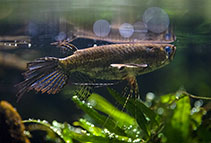 Pantodon buchholzi
Foto de Muséum-Aquarium de Nancy/B. Alenda
Fotos | Selos, moedas, diversos. | Imagem do Google
Foto de Muséum-Aquarium de Nancy/B. Alenda
Classificação / Nomes Nomes comuns | Sinônimos | Catalog of Fishes(Gênero, Espécies) | ITIS | CoL | WoRMS | Cloffa
> Osteoglossiformes (Bony tongues) > Pantodontidae (Freshwater Butterflyfish)
Etymology: Pantodon: Greek, pan = all + Greek, odous = teeth (Ref. 45335); buchholzi: Named after Professor Dr. Buchholz, collector of the type specimens (Ref. 53310).
Eponymy: Dr Reinhold Wilhelm Buchholz (1837–1876) was a German physician, zoologist and explorer. [...] (Ref. 128868), visit book page.
More on author: Peters.
Etymology: Pantodon: Greek, pan = all + Greek, odous = teeth (Ref. 45335); buchholzi: Named after Professor Dr. Buchholz, collector of the type specimens (Ref. 53310).
Eponymy: Dr Reinhold Wilhelm Buchholz (1837–1876) was a German physician, zoologist and explorer. [...] (Ref. 128868), visit book page.
More on author: Peters.
Taxonomic Remarks
Type species of the genus, by monotypy (Ref. 3515). Also Ref. 53310.
Meio ambiente: milieu / Zona climática / intervalo de profundidade / faixa de distribuição Ecologia
Distribuição Territórios | Áreas da FAO | Ecossistemas | Ocorrências | Mapa de pontos | Introduções | Faunafri
West and Central Africa: Nigeria, Lake Chad, Cameroon, Ogowe basin, Congo basin and upper Zambezi River (Ref. 2921, Ref. 3515). Eastern distribution limit seems to be the Ouémé River in Benin (Ref. 1989, Ref. 3019), although it is also reported from the Jong River in Sierra Leone (Ref. 2921).
Tamanho / Peso / Idade
Descrição suscinta Chaves de identificação | Morfologia | Morfometria
Espinhos dorsais (total) : 0; Raios dorsais (total) : 6; Espinhos anais: 0; Raios anais : 9 - 15. Compressed body, flattened on the dorsal side and head, careened on the ventral side behind the pelvic fins (Ref. 2921, Ref. 13851). Large mouth, with numerous teeth and a prominent lower jaw (Ref. 2921), upwardly directed (Ref. 3054, Ref. 42873). Short dorsal fin placed very posterior on the back (Ref. 2921), inserted behind the longer anal fin (Ref. 3054, Ref. 13851). Large development of the pectoral fins (Ref. 2921, Ref. 3054), enlarged and wing-like (Ref. 42873). Very advanced position of the pelvic fins, with 4 elongated, filamentous rays (Ref. 2921, Ref. 3054). The caudal fin is long, pointed and rather ragged, with the two centre rays the longest (Ref. 13851). Large cycloid scales (Ref. 2921), subcircular, with rounded but evident laterobasal angles (Ref. 53264): 26-30 lateral line scales, 21-26 predorsal scales (Ref. 52030, Ref. 52046). Extremely brilliant colored (Ref. 2921): dorsal side of the body olive-colored, ventral side silvery yellow amplified with carmine; sometimes with darker transversal bands on the back (Ref. 2921, Ref. 3032). The fins are vivid pink-colored with small brown-violet spots, forming transversal bands on the pectoral fins, and tinted with violet on the inside and extremities (Ref. 2921).
Body shape (shape guide): fusiform / normal.
Body shape (shape guide): fusiform / normal.
Obligate air-breathing (Ref. 126274); Pantodon buchholzi is a creature from calm waters (Ref. 51626). It lives in swamps, creeks and backwaters (Ref. 31256), and inhabits the calmer parts of rivers (Ref. 41580), where it can be seen on the surface waters (Ref. 4910). They are capable to jump out of the water, to search for insects or to escape from predators (Ref. 2921). It is not a glider, but a ballistic jumper (Ref. 52282), with a tremendous jumping power (Ref. 31256). It is an exophageous insectivore, feeding on terrestrial insects and aquatic larvae and nymphs of insects (Ref. 41580). It also feeds on crustaceans and fish (Ref. 7020). Introduced in 1905 to European aquarists (Ref. 51626, Ref. 53207). Pantodon buchholzi is a favorite fish for aquarists; in the aquarium it can rest with the top of the head and the large pectoral fins touching the surface, while the long rays of the pelvic fin hang down perpendicularly, forming a tempting morsel for other aggressive fish in the same tank, and therefore it should be stocked together with only bottom dwellers (Ref. 13851). Observed maximum length of 15.0 cm TL in aquarium (Ref. 2921, Ref. 3515).
Ciclo de vida ou comportamento de acasalamento Maturidade | Reprodução | Desova | Ovos | Fecundidade | Larvas
Referência principal
Carregar suas referências | Referências | Coordenador | Colaboradores
Teugels, G.G., 1990. Pantodontidae. p. 116-118. In C. Lévêque, D. Paugy and G.G. Teugels (eds.) Faune des poissons d'eaux douces et saumâtres de l'Afrique de l'Ouest. Tome 1. Coll. Faune Trop. 28. Musée Royal de l'Afrique Centrale, Tervuren and Éditions de l'ORSTOM, Paris. 384 p. (Ref. 2921)
Status na Lista Vermelha da UICN (Ref. 130435: Version 2025-2 (Global))
Segura ou pouco preocupante (LC) ; Date assessed: 05 June 2019
CITES
Not Evaluated
Ameaça para os humanos
Harmless
Uso pelos humanos
Pescarias: sem interesse; Aquário: Espécies comerciais
FAO - Publication: search | FishSource |
Mais informação
Ecologia Trófica
Itens alimentares (presas)
Composição da dieta
Consumo alimentar
Rações alimentares
Predadores
Itens alimentares (presas)
Composição da dieta
Consumo alimentar
Rações alimentares
Predadores
Dinâmica populacional
Parâmetros de crescimento
Idade máxima / tamanhos
Relação comprimento-peso.
Relação comprimento-comprimento.
Frequências de comprimento
Conversão de massa
Recrutamento
Abundância
Parâmetros de crescimento
Idade máxima / tamanhos
Relação comprimento-peso.
Relação comprimento-comprimento.
Frequências de comprimento
Conversão de massa
Recrutamento
Abundância
Ciclo de vida
Reprodução
Maturidade
Maturidade/Rel. das guelras
Fecundidade
Desova
Agregações de desova
Ovos
Desenvolvimento dos ovos
Larvas
Dinâmica larval
Reprodução
Maturidade
Maturidade/Rel. das guelras
Fecundidade
Desova
Agregações de desova
Ovos
Desenvolvimento dos ovos
Larvas
Dinâmica larval
Fisiologia
Composição corporal
Nutrientes
Consumo de oxigênio
Tipo de natação
Velocidade de natação
Pigmentos visuais
Som de peixe
Doenças e Parasitas
Toxicidade (LC50s)
Composição corporal
Nutrientes
Consumo de oxigênio
Tipo de natação
Velocidade de natação
Pigmentos visuais
Som de peixe
Doenças e Parasitas
Toxicidade (LC50s)
Relacionado a humanos
Sistemas de aquicultura
Perfis para aquacultura
Estirpes
Casos de Ciguatera
Selos, moedas, diversos.
Sistemas de aquicultura
Perfis para aquacultura
Estirpes
Casos de Ciguatera
Selos, moedas, diversos.
Ferramentas
Questionário orgânico | Livro eletrônico | Guia de campo | Ferramenta auxiliar de frequências de comprimento | Ferramenta sobre a história de vida | Mapa de pontos |
Catch-MSY |
Relatórios especiais
Checar Manutenção em Aquário | Checar Planilhas de Fatos sobre as Espécies | Checar Planilhas de Fatos sobre Aquicultura
Baixar XML
Fontes da internet
AFORO (otoliths) | Aquatic Commons | BHL | Cloffa | Websites from users | Checar Observador de Peixes (FishWatcher) | CISTI | Catalog of Fishes: Gênero, Espécies | DiscoverLife | ECOTOX | FAO - Publication: search | Faunafri | Fishipedia | Fishtrace | GloBI | Google Books | Google Scholar | Google | IGFA World Record | OneZoom | Open Tree of Life | Otolith Atlas of Taiwan Fishes | Aquários públicos | PubMed | Reef Life Survey | Socotra Atlas | TreeBase | Árvore da vida | Wikipedia: Ir para, procura | World Records Freshwater Fishing | Zoobank | Registro zoológico
Estimativas baseadas em modelos
Índice de diversidade filogenética (Ref. 82804): PD50 = 1.5000 [Uniqueness, from 0.5 = low to 2.0 = high].
Bayesian length-weight: a=0.01122 (0.00514 - 0.02450), b=3.04 (2.87 - 3.21), in cm total length, based on all LWR estimates for this body shape (Ref. 93245).
Nível Trófico (Ref. 69278): 3.6 ±0.52 se; based on food items.
Resiliência (Ref. 120179): médio(a), tempo mínimo de duplicação da população 1,4 - 4,4 anos (Fec = 80-220).