



Tải lên của bạn hình ảnh Và Video
Các tranh (Ảnh) | Tem, tiền xu, v.v. | Google image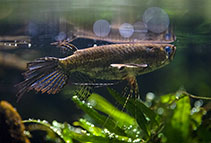 Pantodon buchholzi
Hình ảnh của Muséum-Aquarium de Nancy/B. Alenda
Các tranh (Ảnh) | Tem, tiền xu, v.v. | Google image
Hình ảnh của Muséum-Aquarium de Nancy/B. Alenda
Phân loại / Tên Tên thường gặp | Các synonym ( Các tên trùng) | Catalog of Fishes(Giống, Các loài) | ITIS | CoL | WoRMS | Cloffa
> Osteoglossiformes (Bony tongues) > Pantodontidae (Freshwater Butterflyfish)
Etymology: Pantodon: Greek, pan = all + Greek, odous = teeth (Ref. 45335); buchholzi: Named after Professor Dr. Buchholz, collector of the type specimens (Ref. 53310).
Eponymy: Dr Reinhold Wilhelm Buchholz (1837–1876) was a German physician, zoologist and explorer. [...] (Ref. 128868), visit book page.
More on author: Peters.
Etymology: Pantodon: Greek, pan = all + Greek, odous = teeth (Ref. 45335); buchholzi: Named after Professor Dr. Buchholz, collector of the type specimens (Ref. 53310).
Eponymy: Dr Reinhold Wilhelm Buchholz (1837–1876) was a German physician, zoologist and explorer. [...] (Ref. 128868), visit book page.
More on author: Peters.
Taxonomic Remarks
Type species of the genus, by monotypy (Ref. 3515). Also Ref. 53310.
Môi trường: môi trường / vùng khí hậu / Mức độ sâu / phạm vi phân phối Sinh thái học
Sự phân bố Lãnh thổ | Các khu vực của FAO | Các hệ sinh thái | Những lần xuất hiện | Bản đồ điểm | Những chỉ dẫn | Faunafri
West and Central Africa: Nigeria, Lake Chad, Cameroon, Ogowe basin, Congo basin and upper Zambezi River (Ref. 2921, Ref. 3515). Eastern distribution limit seems to be the Ouémé River in Benin (Ref. 1989, Ref. 3019), although it is also reported from the Jong River in Sierra Leone (Ref. 2921).
Bộ gần gũi / Khối lượng (Trọng lượng) / Tuổi
Chín muồi sinh dục: Lm ? range ? - ? cm
Max length : 11.9 cm TL con đực/không giới tính; (Ref. 52030)
Max length : 11.9 cm TL con đực/không giới tính; (Ref. 52030)
Mô tả ngắn gọn Khóa để định loại | Hình thái học | Sinh trắc học
Các tia vây lưng cứng (tổng cộng) : 0; Các vây lưng mềm (tổng cộng) : 6; Tia cứng vây hậu môn: 0; Tia mềm vây hậu môn: 9 - 15. Compressed body, flattened on the dorsal side and head, careened on the ventral side behind the pelvic fins (Ref. 2921, Ref. 13851). Large mouth, with numerous teeth and a prominent lower jaw (Ref. 2921), upwardly directed (Ref. 3054, Ref. 42873). Short dorsal fin placed very posterior on the back (Ref. 2921), inserted behind the longer anal fin (Ref. 3054, Ref. 13851). Large development of the pectoral fins (Ref. 2921, Ref. 3054), enlarged and wing-like (Ref. 42873). Very advanced position of the pelvic fins, with 4 elongated, filamentous rays (Ref. 2921, Ref. 3054). The caudal fin is long, pointed and rather ragged, with the two centre rays the longest (Ref. 13851). Large cycloid scales (Ref. 2921), subcircular, with rounded but evident laterobasal angles (Ref. 53264): 26-30 lateral line scales, 21-26 predorsal scales (Ref. 52030, Ref. 52046). Extremely brilliant colored (Ref. 2921): dorsal side of the body olive-colored, ventral side silvery yellow amplified with carmine; sometimes with darker transversal bands on the back (Ref. 2921, Ref. 3032). The fins are vivid pink-colored with small brown-violet spots, forming transversal bands on the pectoral fins, and tinted with violet on the inside and extremities (Ref. 2921).
Body shape (shape guide): fusiform / normal.
Body shape (shape guide): fusiform / normal.
Obligate air-breathing (Ref. 126274); Pantodon buchholzi is a creature from calm waters (Ref. 51626). It lives in swamps, creeks and backwaters (Ref. 31256), and inhabits the calmer parts of rivers (Ref. 41580), where it can be seen on the surface waters (Ref. 4910). They are capable to jump out of the water, to search for insects or to escape from predators (Ref. 2921). It is not a glider, but a ballistic jumper (Ref. 52282), with a tremendous jumping power (Ref. 31256). It is an exophageous insectivore, feeding on terrestrial insects and aquatic larvae and nymphs of insects (Ref. 41580). It also feeds on crustaceans and fish (Ref. 7020). Introduced in 1905 to European aquarists (Ref. 51626, Ref. 53207). Pantodon buchholzi is a favorite fish for aquarists; in the aquarium it can rest with the top of the head and the large pectoral fins touching the surface, while the long rays of the pelvic fin hang down perpendicularly, forming a tempting morsel for other aggressive fish in the same tank, and therefore it should be stocked together with only bottom dwellers (Ref. 13851). Observed maximum length of 15.0 cm TL in aquarium (Ref. 2921, Ref. 3515).
Vòng đời và hành vi giao phối Chín muồi sinh dục | Sự tái sinh sản | Đẻ trứng | Các trứng | Sự sinh sản | Ấu trùng
Tài liệu tham khảo chính
Tải lên tài liệu tham khảo của bạn | Các tài liệu tham khảo | Người điều phối | Người cộng tác
Teugels, G.G., 1990. Pantodontidae. p. 116-118. In C. Lévêque, D. Paugy and G.G. Teugels (eds.) Faune des poissons d'eaux douces et saumâtres de l'Afrique de l'Ouest. Tome 1. Coll. Faune Trop. 28. Musée Royal de l'Afrique Centrale, Tervuren and Éditions de l'ORSTOM, Paris. 384 p. (Ref. 2921)
Tình trạng Sách đỏ IUCN (Ref. 130435: Version 2025-2 (Global))
Least Concern (LC) ; Date assessed: 05 June 2019
CITES
Not Evaluated
Mối đe dọa đối với con người
Harmless
Sử dụng của con người
Các nghề cá: không ích lợi (thú vị); Bể nuôi cá: Tính thương mại
FAO - Publication: search | FishSource |
Thêm thông tin
Sinh thái dinh dưỡng
Thức ăn (con mồi)
Thành phần thức ăn
Thành phần thức ăn
Khẩu phần ăn
Các động vật ăn mồi
Thức ăn (con mồi)
Thành phần thức ăn
Thành phần thức ăn
Khẩu phần ăn
Các động vật ăn mồi
Biến động dân số
Các thông số tăng trưởng
Độ tuổi / kích thước tối đa
Chiều dài-trọng lượng tương đối
Chiều dài-chiều dài tương đối.
Chiều dài-tần số
Chuyển đổi khối lượng
Bổ xung
Sự phong phú
Các thông số tăng trưởng
Độ tuổi / kích thước tối đa
Chiều dài-trọng lượng tương đối
Chiều dài-chiều dài tương đối.
Chiều dài-tần số
Chuyển đổi khối lượng
Bổ xung
Sự phong phú
Vòng đời
Sự tái sinh sản
Chín muồi sinh dục
Độ trưởng thành/Mang liên quan
Sự sinh sản
Đẻ trứng
Tập hợp sinh sản
Các trứng
Sự phát triển của trứng
Ấu trùng
Sự biến động ấu trùng
Sự tái sinh sản
Chín muồi sinh dục
Độ trưởng thành/Mang liên quan
Sự sinh sản
Đẻ trứng
Tập hợp sinh sản
Các trứng
Sự phát triển của trứng
Ấu trùng
Sự biến động ấu trùng
Sự phân bố
Lãnh thổ
Các khu vực của FAO
Các hệ sinh thái
Những lần xuất hiện
Những chỉ dẫn
BRUVS - Video
Lãnh thổ
Các khu vực của FAO
Các hệ sinh thái
Những lần xuất hiện
Những chỉ dẫn
BRUVS - Video
Sinh lý học
Thành phần cơ thể
Chất dinh dưỡng
Thành phần ô-xy
Kiểu bơi
Tốc độ bơi
Sắc tố thị giác
Tiếng cá
Bệnh tật & Ký sinh trùng
Độc tính (LC50)
Thành phần cơ thể
Chất dinh dưỡng
Thành phần ô-xy
Kiểu bơi
Tốc độ bơi
Sắc tố thị giác
Tiếng cá
Bệnh tật & Ký sinh trùng
Độc tính (LC50)
Liên quan đến con người
Hệ thống nuôi trồng thủy sản
Các tổng quan nuôi trồng thủy sản
Các giống
Các trường hợp ngộ độc Ciguatera
Tem, tiền xu, v.v.
Hệ thống nuôi trồng thủy sản
Các tổng quan nuôi trồng thủy sản
Các giống
Các trường hợp ngộ độc Ciguatera
Tem, tiền xu, v.v.
Các công cụ
Trắc nghiệm sinh học | Sách điện tử | Hướng dẫn hiện trường | Tần suất chiều dài Wizard | Công cụ của vòng đời | Bản đồ điểm |
Bắt-MSY |
Báo cáo đặc biệt
Kiểm tra bảo trì bể cá | Kiểm tra các tờ thông tin về loài | Kiểm tra các tờ thông tin về nuôi trồng thủy sản
Tải xuống XML
Các nguồn internet
AFORO (otoliths) | Aquatic Commons | BHL | Cloffa | Websites from users | Check FishWatcher | CISTI | Catalog of Fishes: Giống, Các loài | DiscoverLife | ECOTOX | FAO - Publication: search | Faunafri | Fishipedia | Fishtrace | GloBI | Google Books | Google Scholar | Google | IGFA World Record | OneZoom | Open Tree of Life | Otolith Atlas of Taiwan Fishes | Bể cá công cộng | PubMed | Reef Life Survey | Socotra Atlas | TreeBase | Cây Đời sống | Wikipedia: Go, tìm | World Records Freshwater Fishing | Zoobank | Tạp chí Zoological Record
Ước tính dựa trên mô hình
Chỉ số đa dạng phát sinh loài (Tài liệu tham khảo 82804): PD50 = 1.5000 [Uniqueness, from 0.5 = low to 2.0 = high].
Bayesian length-weight: a=0.01122 (0.00514 - 0.02450), b=3.04 (2.87 - 3.21), in cm total length, based on all LWR estimates for this body shape (Ref. 93245).
Mức dinh dưỡng (Tài liệu tham khảo 69278): 3.6 ±0.52 se; based on food items.
Thích nghi nhanh (Tài liệu tham khảo 120179): Trung bình, thời gian nhân đôi của chủng quần tối thiểu là 1.4 - 4.4 năm (Fec = 80-220).