Gambusia affinis, Mosquitofish : fisheries, aquarium

Gambusia affinis (Baird & Girard, 1853)

Mosquitofish
Uploaden van uw Foto's en video's
Afbeeldingen | Google afbeelding

Classificatie / Namen Lokale namen | Synoniemen | Catalog of Fishes(Genus, Soort(en)) | ITIS | CoL | WoRMS | Cloffa

> Cyprinodontiformes (Rivulines, killifishes and live bearers) > Poeciliidae (Poeciliids) > Poeciliinae
Etymology: Gambusia: Gambusia: From the Cuban term, Gambusino, which means "nothing", usually in the context of a joke or a farce. Fishing for gambusinos = when one catches nothing (Ref. 45335)affinis: affinis meaning related (Ref. 10294).
More on authors: Baird & Girard.

Milieu: milieu / Klimaatzone / Diepte / verspreidingsgebied Ecologie

; zoet water; brak water benthopelagisch; pH range: 6.0 - 8.0; dH range: 5 - 19; potamodroom (Ref. 5258). Subtropical; 12°C - 29°C (Ref. 52055); 42°N - 26°N

Verspreiding Gebieden | FAO regio's | Ecosystemen | Voorkomen | Verspreidingskaart | Introducties | Faunafri

North and Central America: Mississippi River basin from central Indiana and Illinois in USA south to Gulf of Mexico and Gulf Slope drainages west to Mexico. One of the species with the widest range of introductions which acquired for itself a near pan-global distribution (Ref. 1739). Several countries report adverse ecological impact after introduction.

Grootte / Gewicht / Leeftijd

Maturiteit: Lm ?  range ? - ? cm
Max length : 5.1 cm TL mannelijk / geslacht onbekend; (Ref. 50932); 7.0 cm TL (female); common length : 3.9 cm TL mannelijk / geslacht onbekend; (Ref. 12193); max. gerapporteerde leeftijd: 3.00 Jaren (Ref. 796)

Korte beschrijving Determinatiesleutels | Morfologie | Morfometrie

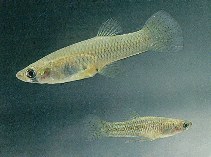
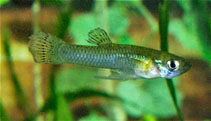
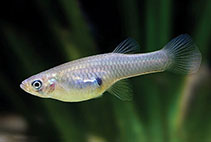
Dorsale stekels (totaal) : 0; Dorsale zachte stralen (totaal) : 7 - 9; Anale stekels: 0; Anale zachte stralen: 9 - 10. Origin of dorsal fin opposite 7th anal ray. Length of anal base much less than half distance from caudal. 8 horizontal scale rows between back and abdomen. Ventrals terminate immediately before anal fin. Pelvic fins reach ventrals.
Body shape (shape guide): fusiform / normal; Cross section: circular.

Biologie     Verklarende woordenlijst (bv. epibenthic)

Most abundant in lower reaches of streams (Ref. 44091). Adults inhabit standing to slow-flowing water; most common in vegetated ponds and lakes, backwaters and quiet pools of streams. They are found frequently in brackish water (Ref. 5258). Pelagic and surface predatory fish (Ref. 94816). They feed on zooplankton, small insects and detritus (Ref. 5258, 10294). Used as live food for carnivorous aquarium fishes. Viviparous (Ref. 5258, 30578). Effective in mosquito control and widely introduced, but found to compete with indigenous fish and to upset the ecological balance (Ref. 6351).

Levenscyclus en paargedrag Maturiteit | Voortplanting | Paaien | Eieren | Fecunditeit | Larven

The species is viviparous (Ref. 5258). Internal fertilization is possible because the anal fin of the male is modified into a copulatory organ. The females carries about 30 alevins and gestation lasts for a period of 24 days (Ref. 6348) to a month (Ref. 30578).

Hoofdreferentie Upload uw referenties | Referenties | Coördinator | Medewerkers

Page, L.M. and B.M. Burr, 1991. A field guide to freshwater fishes of North America north of Mexico. Houghton Mifflin Company, Boston. 432 p. (Ref. 5723)

Status op de Rode Lijst van het IUCN (Ref. 130435: Version 2025-2 (Global))

  Niet bedreigd (LC) ; Date assessed: 22 January 2019

CITES

Not Evaluated

CMS (Ref. 116361)

Not Evaluated

Gevaar voor de mens

  Potential pest


Gebruik door de mens

Visserij: van minder commercieel belang; Aquarium: Commercieel
FAO - Publication: search | FishSource |

Meer informatie

Trofische ecologie
Voedsel (prooien)
Dieetsamenstelling
Voedselconsumptie
Voedselrantsoenen
Predatoren
Ecologie
Ecologie
Populatiedynamica
Groeiparameters
Max. leeftijden / maten
Lengte-gewicht rel.
Lengte-lengte rel.
Lengtefrequenties
Massaconversie
Rekrutering
Abundantie
Levenscyclus
Voortplanting
Maturiteit
Rijpheid/kieuwen rel.
Fecunditeit
Paaien
Paaibestanden
Eieren
Ontwikkeling van de eieren
Larven
Larvale populatiedynamiek
Verspreiding
Gebieden
FAO regio's
Ecosystemen
Voorkomen
Introducties
BRUVS - Video's
Anatomie
Kieuwoppervlak
Hersenen
Otoliet
Fysiologie
Lichaamssamenstelling
Voedingsstoffen
Zuurstofverbruik
Type zwemmen
Zwemsnelheid
Visuele pigmenten
Vis geluid
Ziekten en parasieten
Toxiciteit (LC50)
Genetica
genoom
Genetica
Heterozygositeit
Erfelijkheid
Genetische diversiteit
Menselijk gerelateerd
Aquacultuursystemen
Aquacultuurprofielen
Kweeklijnen
Ciguatera gevallen
Postzegels, munten, diversen.
Outreach
Medewerkers
Referenties
Referenties

Tools

Speciale rapporten

Download XML

Internetbronnen

AFORO (otoliths) | Exoten/Invasieve soorten database | Aquatic Commons | BHL | Cloffa | Websites from users | Bekijk FishWatcher | CISTI | Catalog of Fishes: Genus, Soort(en) | DiscoverLife | ECOTOX | FAO - Publication: search | Faunafri | Fishipedia | Fishtrace | GloBI | GoMexSI (interaction data) | Google Books | Google Scholar | Google | IGFA World Record | Nationale databanken | OneZoom | Open Tree of Life | Otolith Atlas of Taiwan Fishes | Publieke aquaria | PubMed | Reef Life Survey | Socotra Atlas | TreeBase | Tree of Life | Wikipedia: ga naar, zoek | World Records Freshwater Fishing | Zoological Record

Schattingen op basis van modellen

Fylogenetische diversiteitsindex (Ref. 82804):  PD50 = 0.5000   [Uniqueness, from 0.5 = low to 2.0 = high].
Bayesian length-weight: a=0.00851 (0.00691 - 0.01048), b=3.13 (3.07 - 3.19), in cm total length, based on LWR estimates for this species (Ref. 93245).
Trofisch niveau (Ref. 69278):  3.1   ±0.2 se; based on diet studies.
Generation time: 1.4 ( na - na) years. Estimated as median ln(3)/K based on 2 growth studies.
Weerstandsvermogen (Ref. 120179):  Gemiddeld, minimale populatieverdubbelingstijd 1,4-4,4 jaar (K=1.20; tmax=3; Fec=10-60).
Kwetsbaarheid van de visserij (Ref. 59153):  Moderate vulnerability (38 of 100). 🛈
Prijsklasse (Ref. 80766):   Unknown.