This website uses cookies to enhance your browsing experience and ensure the functionality of our site. For more detailed information about the types of cookies we use and how we protect your privacy, please visit our Privacy Information page.
×
Cookie Settings
This website uses different types of cookies to enhance your experience. Please select your preferences below:
> Cyprinodontiformes (Rivulines, killifishes and live bearers) > Poeciliidae (Poeciliids) > Poeciliinae
Etymology: Gambusia:Gambusia: From the Cuban term, Gambusino, which means "nothing", usually in the context of a joke or a farce. Fishing for gambusinos = when one catches nothing (Ref. 45335); affinis:affinis meaning related (Ref. 10294). More on authors: Baird & Girard.
North and Central America: Mississippi River basin from central Indiana and Illinois in USA south to Gulf of Mexico and Gulf Slope drainages west to Mexico. One of the species with the widest range of introductions which acquired for itself a near pan-global distribution (Ref. 1739). Several countries report adverse ecological impact after introduction.
Μέγεθος / Βάρος / Ηλικία
Γεννητική Ωρίμανση: Lm? range ? - ? cm Max length : 5.1 cm TL αρσενικό/απροσδιόριστο; (Ref. 50932); 7.0 cm TL (female); common length : 3.9 cm TL αρσενικό/απροσδιόριστο; (Ref. 12193); μεγ. αναφερόμενη ηλικία: 3.00 έτη (Ref. 796)
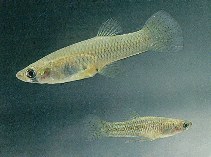
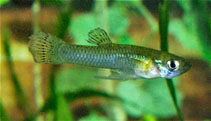
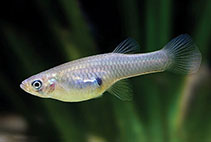
Ραχιαίες άκανθες (συνολικά) : 0; Μαλακές ραχιαίες ακτίνες (συνολικά) : 7 - 9; Εδρικές άκανθες: 0; Μαλακές εδρικές ακτίνες: 9 - 10. Origin of dorsal fin opposite 7th anal ray. Length of anal base much less than half distance from caudal. 8 horizontal scale rows between back and abdomen. Ventrals terminate immediately before anal fin. Pelvic fins reach ventrals. Body shape (shape guide): fusiform / normal; Cross section: circular.
Most abundant in lower reaches of streams (Ref. 44091). Adults inhabit standing to slow-flowing water; most common in vegetated ponds and lakes, backwaters and quiet pools of streams. They are found frequently in brackish water (Ref. 5258). Pelagic and surface predatory fish (Ref. 94816). They feed on zooplankton, small insects and detritus (Ref. 5258, 10294). Used as live food for carnivorous aquarium fishes. Viviparous (Ref. 5258, 30578). Effective in mosquito control and widely introduced, but found to compete with indigenous fish and to upset the ecological balance (Ref. 6351).
The species is viviparous (Ref. 5258). Internal fertilization is possible because the anal fin of the male is modified into a copulatory organ. The females carries about 30 alevins and gestation lasts for a period of 24 days (Ref. 6348) to a month (Ref. 30578).
Page, L.M. and B.M. Burr, 1991. A field guide to freshwater fishes of North America north of Mexico. Houghton Mifflin Company, Boston. 432 p. (Ref. 5723)
Κατάσταση Κόκκινου Καταλόγου IUCN (Ref. 130435: Version 2025-2 (Global))