



Carica il tuo foto e Video
Immagini | Google image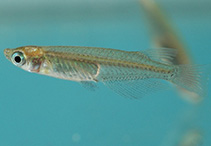 Oryzias latipes
Immagine di Ho, H.-C.
Immagini | Google image
Immagine di Ho, H.-C.
Classificazione / Nomi Nomi Comuni | Sinonimi | Catalog of Fishes(Genere, Specie) | ITIS | CoL | WoRMS | Cloffa
> Beloniformes (Needle fishes) > Adrianichthyidae (Ricefishes) > Oryziinae
Etymology: Oryzias: Greek, oryza = rice; because of the habitat used by this fish (Ref. 45335).
More on authors: Temminck & Schlegel.
Etymology: Oryzias: Greek, oryza = rice; because of the habitat used by this fish (Ref. 45335).
More on authors: Temminck & Schlegel.
Ambiente: milieu / zona climatica / distribuzione batimetrica / gamma di distribuzione Ecologia
; acqua dolce; salmastro benthopelagico; pH range: 7.0 - 8.0; dH range: 9 - 19; amfidromo (Ref. 51243). Subtropical; 18°C - 24°C (Ref. 2060); 55°N - 10°N, 85°E - 105°E
Distribuzione Territories | Aree FAO | Ecosistemi | Presenze | Mappa dei ritrovamenti | Introduzioni | Faunafri
Asia: Japan, Korea, China and Viet Nam. Reported from the middle Nam Theun, Mekong, Irrawaddy, Salween, Red River and Nanpangjiang in basins (Ref. 27732).
Dimensione / Peso / Età
Breve descrizione Chiavi di identificazione | Morfologia | Morfometria
Raggi dorsali molli (totale) : 6 - 7; Raggi anali molli: 15 - 21; Vertebre: 30 - 31. Meristic characters mainly from Nam Theun, Laos sample only (Ref. 27658). Scale count refers to the scales in longitudinal row (Ref. 41299).
Body shape (shape guide): elongated.
Body shape (shape guide): elongated.
Adults occur in ponds, marshes, paddy fields and small flows of plains (Ref. 41299). They prefer slow-moving streams. Inhabit mainly waters of lowlands and brackish water, and also known to inhabit tide pools of coasts of certain regions in Japan and Korea. They can withstand a wide range of salinity (Ref. 58933). Omnivorous (Ref. 58933). For indoor culture, a diluted sea water is rather better than the freshwater , and the use of a balanced salt solution is recommended, if the tap water proves to be unsuitable (Ref. 58933). Used in experimental research (Ref. 4537). Non-annual breeders. Are easy to maintain in the aquarium (Ref. 27139). A fluorescent ornamental variety (genetically modified fish), a product of fluorescent protein extracted from jellyfish and attaching to DNA in embryonic fish of this is now being sold in the aquarium trade (Ref. 48573).
Ciclo vitale e comportamento di accoppiamento Maturità | Riproduzione | Deposizione | Uova | Fecondità | Larve
Carries eggs for some time before deposition (Ref. 7471). Oocytes mature at night followed by ovulation at dawn (Ref. 58942).
Riferimento principale
Caricare le referenze | Bibliografia | Coordinatore : Seegers, Lothar | Collaboratori
Roberts, T.R., 1998. Systematic observations on tropical Asian medakas or ricefishes of the genus Oryzias, with descriptions of four new species. Ichthyol. Res. 45(3):213-224. (Ref. 27658)
Stato della Lista Rossa IUCN (Ref. 130435: Version 2025-2 (Global))
Least Concern (LC) ; Date assessed: 01 March 2018
CITES
Not Evaluated
Minaccia per l'uomo
Harmless
Usi umani
Pesca: commerciale; Acquario: Commerciale
FAO - Publication: search | FishSource |
Informazioni ulteriori
Ecologia trofica
Articoli alimentari (prede)
Alimentazione
Consumo di cibo
Razioni alimentari
Predatori
Articoli alimentari (prede)
Alimentazione
Consumo di cibo
Razioni alimentari
Predatori
Dinamica della popolazione
Parametri di crescita
Età massima / dimensioni massime
Rapporto lunghezza-peso.
Lunghezza-lunghezza rel.
Lunghezza-frequenze
Conversione di massa
Reclutamento
Abbondanza
Parametri di crescita
Età massima / dimensioni massime
Rapporto lunghezza-peso.
Lunghezza-lunghezza rel.
Lunghezza-frequenze
Conversione di massa
Reclutamento
Abbondanza
Ciclo di vita
Riproduzione
Maturità
Maturità/Gli occhielli sono relativi.
Fecondità
Deposizione
Aggregazioni riproduttive
Uova
Sviluppo delle uova
Larve
Dinamica popolazioni larvali
Riproduzione
Maturità
Maturità/Gli occhielli sono relativi.
Fecondità
Deposizione
Aggregazioni riproduttive
Uova
Sviluppo delle uova
Larve
Dinamica popolazioni larvali
Fisiologia
Composizione corporea
Nutrienti
Consumo di ossigeno
Tipo di nuoto
Velocità di nuoto
Pigmenti visivi
Suono del pesce
Malattie e parassiti
Tossicità (LC50)
Composizione corporea
Nutrienti
Consumo di ossigeno
Tipo di nuoto
Velocità di nuoto
Pigmenti visivi
Suono del pesce
Malattie e parassiti
Tossicità (LC50)
Legato all'uomo
Sistemi di acquacoltura
Profili di acquacoltura
Varietà
Casi di Ciguatera
Francobolli, monete, materiale vario.
Sistemi di acquacoltura
Profili di acquacoltura
Varietà
Casi di Ciguatera
Francobolli, monete, materiale vario.
Strumenti
Libro elettronico | Giuda pratica | Generatore frequenze di lunghezza | Strumento Parametri Biologici | Mappa dei ritrovamenti |
Cattura-MSY |
Rapporti speciali
Controllo della manutenzione dell'acquario | Verificare la presenza di schede informative sulle specie | Verifica delle schede informative sull'acquacoltura
Scarica XML
Fonti Internet
AFORO (otoliths) | Alien/Invasive Species database | Aquatic Commons | BHL | Cloffa | Websites from users | Check FishWatcher | CISTI | Catalog of Fishes: Genere, Specie | DiscoverLife | ECOTOX | FAO - Publication: search | Faunafri | Fishipedia | Fishtrace | GloBI | Google Books | Google Scholar | Google | IGFA World Record | Database Nazionali | OneZoom | Open Tree of Life | Otolith Atlas of Taiwan Fishes | Acquari pubblici | PubMed | Reef Life Survey | Socotra Atlas | TreeBase | Tree of Life | Wikipedia: Go, ricerca | World Records Freshwater Fishing | Record zoologico
Stime basate su modelli
Indice di diversità filogenetica (Fonte Biblio. 82804): PD50 = 0.5000 [Uniqueness, from 0.5 = low to 2.0 = high].
Bayesian length-weight: a=0.00479 (0.00190 - 0.01207), b=3.13 (2.91 - 3.35), in cm total length, based on LWR estimates for this (Sub)family-body shape (Ref. 93245).
Livello trofico (Fonte Biblio. 69278): 3.4 ±0.45 se; based on food items.
Generation time: 0.3 ( na - na) years. Estimated as median ln(3)/K based on 1 growth studies.
Resilienza (Fonte Biblio. 120179): Basso, tempo minimo di raddoppiamento della popolazione 4.5 - 14 anni (tm<1; Fec=40).