



Nudiantennarius subteres (Smith & Radcliffe, 1912)
Deep-water frogfish
Carica il tuo foto e Video
Immagini | Google image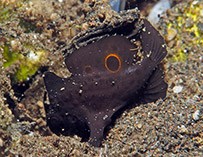 Nudiantennarius subteres
Immagine di Johnson, S.
Immagini | Google image
Immagine di Johnson, S.
Classificazione / Nomi Nomi Comuni | Sinonimi | Catalog of Fishes(Genere, Specie) | ITIS | CoL | WoRMS | Cloffa
> Lophiiformes (Anglerfishes) > Antennariidae (Frogfishes)
Etymology: Nudiantennarius: Latin, nudus = naked + Latin, antemna = sensory organ; in Aristotle = horn (Ref. 45335).
More on authors: Smith & Radcliffe.
Etymology: Nudiantennarius: Latin, nudus = naked + Latin, antemna = sensory organ; in Aristotle = horn (Ref. 45335).
More on authors: Smith & Radcliffe.
Ambiente: milieu / zona climatica / distribuzione batimetrica / gamma di distribuzione Ecologia
marino demersale; non migratori; distribuzione batimetrica 3 - 128 m (Ref. 116699). Tropical; 18°N - 11°S, 119°E - 122°E (Ref. 57386)
Distribuzione Territories | Aree FAO | Ecosistemi | Presenze | Mappa dei ritrovamenti | Introduzioni | Faunafri
Western Central Pacific: Philippines and Indonesia.
Dimensione / Peso / Età
Breve descrizione Chiavi di identificazione | Morfologia | Morfometria
Raggi dorsali molli (totale) : 12; Raggi anali molli: 7. This species is distinguished by the following combination of character states: reduced dermal spinules, skin only partially covered with bifurcate dermal spinules, that the body appears to be naked, length of spines of each spinule not more than twice the distance between tips of spines; distinct esca ; naked illicium, no dermal spinules, about half length of second dorsal-fin spine; second dorsal-fin spine is unusually long, narrow, without posterior membrane; narrow pectoral-fin lobe, somewhat detached from side of body; with caudal peduncle, the membranous posteriormost margin of soft-dorsal and anal fins attached to body distinctly anterior to base of outermost rays of caudal fin; all rays of caudal fin are usually bifurcate (outermost caudal fin rays simple, 7 innermost bifurcate in UW 117643 and CBG 13028); presence of endopterygoid, pharyngobranchial I, epural and swim bladder; absence of pseudobranch I; D 12; A 7; pectoral-fin rays 9 pelvic-fin rays 5, all simple (posteriormost ray not bifurcated); membranes between rays of paired fins are deeply incised; one or more large basidorsal ocelli often present (Ref. 116699).
Body shape (shape guide): short and / or deep.
Body shape (shape guide): short and / or deep.
Typically found in bottoms of brown or black sand, silt, or mud, with some soft corals, gorgonians, and sponges, but very little hard coral; also on pier pilings and occasionally among small patches of filamentous and leafy algae. Also observed to occur in the following habitats of collection sites: from 3-9 m, no deeper than about 18 m with large amounts of tree litter in the shallows, and a lot of trash, rubbish, and human refuse, especially those near native villages and towns (Lembeh Strait); no deeper than 6 m with bottom largely made up of very coarse sand or fine coral rubble, with some hard corals and gorgonians, numerous small cephalopods, many shrimps, crabs, other crustaceans, and lots of fishes, especially juveniles: small shark species, burrowing snake eels, 2 species of Rhinopias (R. eschmeyeri and R. frondosa), and several other species of scorpionfishes and waspfishes, 2 frogfishes were observed, Antennarius striatus and this species (Pantar dive site, Alor Arch.); coarse sand- and rubble-covered slopes, with random solitary and encrusting sponges, hydroids, mixed with lots of human refuse, the latter more or less covered with organic growth, used by animals for shelter (Ambon Bay); on black sandy slopes and most commonly seen during night dives (Bali); and, dark colored individuals most commonly found on coarse sand or gravel, often within patches of green algae, in 4-20 meters while the lighter and more colorful individuals are usually found associated with small, similarly colored sponges, at somewhat greater depths, at 12-30 m (Dauin, Negros I.). This species undergoes a distinct pelagic larval stage before metamorphosis to the adult form (Ref. 116699).
Ciclo vitale e comportamento di accoppiamento Maturità | Riproduzione | Deposizione | Uova | Fecondità | Larve
Oviparous.
Riferimento principale
Caricare le referenze | Bibliografia | Coordinatore | Collaboratori
Pietsch, T.W. and D.B. Grobecker, 1987. Frogfishes of the world. Systematics, zoogeography, and behavioral ecology. Stanford University Press, Stanford, California. 420 p. (Ref. 6773)
CITES
Not Evaluated
Minaccia per l'uomo
Harmless
Usi umani
Pesca: di nessun interesse
FAO - Publication: search | FishSource |
Informazioni ulteriori
Ecologia trofica
Articoli alimentari (prede)
Alimentazione
Consumo di cibo
Razioni alimentari
Predatori
Articoli alimentari (prede)
Alimentazione
Consumo di cibo
Razioni alimentari
Predatori
Ecologia
Ecologia
Ecologia
Dinamica della popolazione
Parametri di crescita
Età massima / dimensioni massime
Rapporto lunghezza-peso.
Lunghezza-lunghezza rel.
Lunghezza-frequenze
Conversione di massa
Reclutamento
Abbondanza
Parametri di crescita
Età massima / dimensioni massime
Rapporto lunghezza-peso.
Lunghezza-lunghezza rel.
Lunghezza-frequenze
Conversione di massa
Reclutamento
Abbondanza
Ciclo di vita
Riproduzione
Maturità
Maturità/Gli occhielli sono relativi.
Fecondità
Deposizione
Aggregazioni riproduttive
Uova
Sviluppo delle uova
Larve
Dinamica popolazioni larvali
Riproduzione
Maturità
Maturità/Gli occhielli sono relativi.
Fecondità
Deposizione
Aggregazioni riproduttive
Uova
Sviluppo delle uova
Larve
Dinamica popolazioni larvali
Anatomia
Area branchiale
Cervello
Otolite
Area branchiale
Cervello
Otolite
Fisiologia
Composizione corporea
Nutrienti
Consumo di ossigeno
Tipo di nuoto
Velocità di nuoto
Pigmenti visivi
Suono del pesce
Malattie e parassiti
Tossicità (LC50)
Composizione corporea
Nutrienti
Consumo di ossigeno
Tipo di nuoto
Velocità di nuoto
Pigmenti visivi
Suono del pesce
Malattie e parassiti
Tossicità (LC50)
Genetica
Genome
Genetica
Eterozigosi
Ereditarietà
Diversità genetica
Genome
Genetica
Eterozigosi
Ereditarietà
Diversità genetica
Legato all'uomo
Sistemi di acquacoltura
Profili di acquacoltura
Varietà
Casi di Ciguatera
Francobolli, monete, materiale vario.
Sistemi di acquacoltura
Profili di acquacoltura
Varietà
Casi di Ciguatera
Francobolli, monete, materiale vario.
Strumenti
Libro elettronico | Giuda pratica | Generatore frequenze di lunghezza | Strumento Parametri Biologici | Mappa dei ritrovamenti |
Cattura-MSY |
Rapporti speciali
Controllo della manutenzione dell'acquario | Verificare la presenza di schede informative sulle specie | Verifica delle schede informative sull'acquacoltura
Scarica XML
Fonti Internet
AFORO (otoliths) | Aquatic Commons | BHL | Cloffa | Websites from users | Check FishWatcher | CISTI | Catalog of Fishes: Genere, Specie | DiscoverLife | ECOTOX | FAO - Publication: search | Faunafri | Fishipedia | Fishtrace | GloBI | Google Books | Google Scholar | Google | IGFA World Record | OneZoom | Open Tree of Life | Otolith Atlas of Taiwan Fishes | PubMed | Reef Life Survey | Socotra Atlas | TreeBase | Tree of Life | Wikipedia: Go, ricerca | World Records Freshwater Fishing | Record zoologico
Stime basate su modelli
Indice di diversità filogenetica (Fonte Biblio. 82804): PD50 = 1.0000 [Uniqueness, from 0.5 = low to 2.0 = high].
Bayesian length-weight: a=0.02692 (0.01067 - 0.06789), b=2.96 (2.73 - 3.19), in cm total length, based on LWR estimates for this (Sub)family-body shape (Ref. 93245).
Livello trofico (Fonte Biblio. 69278): 3.7 ±0.6 se; based on size and trophs of closest relatives
Resilienza (Fonte Biblio. 120179): Alto, tempo minimo di raddoppiamento della popolazione meno di 15 mesi (Fec assumed to be > 10,000).