



Nudiantennarius subteres (Smith & Radcliffe, 1912)
Deep-water frogfish
上传你的 图片 和 影像
照片 | 谷歌图片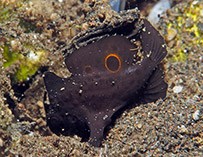 Nudiantennarius subteres
图片提供人 Johnson, S.
照片 | 谷歌图片
图片提供人 Johnson, S.
分类 / 名称 俗名 | 同种异名 | Catalog of Fishes(属, 种) | ITIS | CoL | WoRMS | Cloffa
Teleostei > Lophiiformes (Anglerfishes) > Antennariidae (Frogfishes)
Etymology: Nudiantennarius: Latin, nudus = naked + Latin, antemna = sensory organ; in Aristotle = horn (Ref. 45335).
More on authors: Smith & Radcliffe.
Etymology: Nudiantennarius: Latin, nudus = naked + Latin, antemna = sensory organ; in Aristotle = horn (Ref. 45335).
More on authors: Smith & Radcliffe.
环境:氛围 / 气候带 / 深度上下限 / 分布范围 生态学
分布 领土 | FAO区域 | 生态系 | 标本纪录 | 分布图 | 简介 | Faunafri
Western Central Pacific: Philippines and Indonesia.
中西太平洋: 菲律賓與印尼。
中西太平洋: 菲律賓與印尼。
大小 / 重量 / 年龄
简单描述 检索表 | 型态特徵 | 形态测量图
背的软条 (总数) : 12; 臀鳍软条: 7. This species is distinguished by the following combination of character states: reduced dermal spinules, skin only partially covered with bifurcate dermal spinules, that the body appears to be naked, length of spines of each spinule not more than twice the distance between tips of spines; distinct esca ; naked illicium, no dermal spinules, about half length of second dorsal-fin spine; second dorsal-fin spine is unusually long, narrow, without posterior membrane; narrow pectoral-fin lobe, somewhat detached from side of body; with caudal peduncle, the membranous posteriormost margin of soft-dorsal and anal fins attached to body distinctly anterior to base of outermost rays of caudal fin; all rays of caudal fin are usually bifurcate (outermost caudal fin rays simple, 7 innermost bifurcate in UW 117643 and CBG 13028); presence of endopterygoid, pharyngobranchial I, epural and swim bladder; absence of pseudobranch I; D 12; A 7; pectoral-fin rays 9 pelvic-fin rays 5, all simple (posteriormost ray not bifurcated); membranes between rays of paired fins are deeply incised; one or more large basidorsal ocelli often present (Ref. 116699).
Body shape (shape guide): short and / or deep.
Body shape (shape guide): short and / or deep.
Typically found in bottoms of brown or black sand, silt, or mud, with some soft corals, gorgonians, and sponges, but very little hard coral; also on pier pilings and occasionally among small patches of filamentous and leafy algae. Also observed to occur in the following habitats of collection sites: from 3-9 m, no deeper than about 18 m with large amounts of tree litter in the shallows, and a lot of trash, rubbish, and human refuse, especially those near native villages and towns (Lembeh Strait); no deeper than 6 m with bottom largely made up of very coarse sand or fine coral rubble, with some hard corals and gorgonians, numerous small cephalopods, many shrimps, crabs, other crustaceans, and lots of fishes, especially juveniles: small shark species, burrowing snake eels, 2 species of Rhinopias (R. eschmeyeri and R. frondosa), and several other species of scorpionfishes and waspfishes, 2 frogfishes were observed, Antennarius striatus and this species (Pantar dive site, Alor Arch.); coarse sand- and rubble-covered slopes, with random solitary and encrusting sponges, hydroids, mixed with lots of human refuse, the latter more or less covered with organic growth, used by animals for shelter (Ambon Bay); on black sandy slopes and most commonly seen during night dives (Bali); and, dark colored individuals most commonly found on coarse sand or gravel, often within patches of green algae, in 4-20 meters while the lighter and more colorful individuals are usually found associated with small, similarly colored sponges, at somewhat greater depths, at 12-30 m (Dauin, Negros I.). This species undergoes a distinct pelagic larval stage before metamorphosis to the adult form (Ref. 116699).
已知只来自四件标本了。 出现于泥泞的栖地。
已知只来自四件标本了。 出现于泥泞的栖地。
生命周期和交配行为 成熟度 | 繁殖 | 产卵场 | 卵 | 孕卵数 | 仔鱼
Oviparous.中西太平洋: 菲律賓與印尼。
主要参考文献
上传您的参考资料 | 参考文献 | 合作者 | 合作者
Pietsch, T.W. and D.B. Grobecker, 1987. Frogfishes of the world. Systematics, zoogeography, and behavioral ecology. Stanford University Press, Stanford, California. 420 p. (Ref. 6773)
CITES
Not Evaluated
对人类的威胁
无害处的
人类利用
渔业: 没有兴趣
FAO - Publication: search | FishSource |
更多信息
解剖学
鳃区
大脑
耳石
鳃区
大脑
耳石
生理学
身体成分
营养素
耗氧量
游泳类型
游泳速度
视觉色素
鱼声
疾病与寄生虫
毒性(半数致死浓度)
身体成分
营养素
耗氧量
游泳类型
游泳速度
视觉色素
鱼声
疾病与寄生虫
毒性(半数致死浓度)
遗传学
基因组
遗传学
异质性
遗传率
基因多样性
基因组
遗传学
异质性
遗传率
基因多样性
工具
特别资料
下载 XML
网络资源
AFORO (otoliths) | Aquatic Commons | BHL | Cloffa | Websites from users | 核实 FishWatcher | CISTI | Catalog of Fishes: 属, 种 | DiscoverLife | ECOTOX | FAO - Publication: search | Faunafri | Fishipedia | Fishtrace | GloBI | Google Books | Google Scholar | Google | IGFA World Record | OneZoom | Open Tree of Life | Otolith Atlas of Taiwan Fishes | PubMed | Reef Life Survey | Socotra Atlas | TreeBase | 树状分类阶层 | Wikipedia: 转至, 搜寻 | World Records Freshwater Fishing | 动物学的记录
基于模型的估算
系统发育多样性指数 (参考文献 82804): PD50 = 1.0000 [Uniqueness, from 0.5 = low to 2.0 = high].
Bayesian length-weight: a=0.02692 (0.01067 - 0.06789), b=2.96 (2.73 - 3.19), in cm total length, based on LWR estimates for this (Sub)family-body shape (Ref. 93245).
营养阶层 (参考文献 69278): 3.7 ±0.6 se; based on size and trophs of closest relatives
回复力 (参考文献 120179): 高度, 族群倍增时间少于 15个月 (Fec assumed to be > 10,000).