



Alburnoides idignensis Bogutskaya & Coad, 2009
Uploaden van uw Foto's en video's
Afbeeldingen | Google afbeelding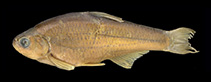 Alburnoides idignensis
Male Afbeelding van Bogutskaya, N.G. / Coad, B.W.
Afbeeldingen | Google afbeelding
Male Afbeelding van Bogutskaya, N.G. / Coad, B.W.
Classificatie / Namen Lokale namen | Synoniemen | Catalog of Fishes(Genus, Soort(en)) | ITIS | CoL | WoRMS | Cloffa
> Cypriniformes (Carps) > Leuciscidae (Minnows) > Leuciscinae
Etymology: Alburnoides: From the city of Al Bura, where the fish was known + particle Greek, oides = similar (Ref. 45335); idignensis: Named for the Tigris River which was called Idigna in Sumerian (Akkadian: Idiklat; biblical: Hiddekel; Arabic: Dijlah; Turkish: Dicle).
Etymology: Alburnoides: From the city of Al Bura, where the fish was known + particle Greek, oides = similar (Ref. 45335); idignensis: Named for the Tigris River which was called Idigna in Sumerian (Akkadian: Idiklat; biblical: Hiddekel; Arabic: Dijlah; Turkish: Dicle).
Taxonomic Remarks
The specific epithet is misspelled in Eschmeyer (CofF ver. Jul. 2010: Ref. 84883).
Milieu: milieu / Klimaatzone / Diepte / verspreidingsgebied Ecologie
; zoet water benthopelagisch; pH range: 6.8 - ?. Subtropical; 19°C - ? (Ref. 82592)
Verspreiding Gebieden | FAO regio's | Ecosystemen | Voorkomen | Verspreidingskaart | Introducties | Faunafri
Asia: Iran.
Grootte / Gewicht / Leeftijd
Korte beschrijving Determinatiesleutels | Morfologie | Morfometrie
Dorsale zachte stralen (totaal) : 9 - 12; Anale zachte stralen: 12 - 17; Wervels: 38 - 40. Alburnoides idignensis is distinguished by a combination of the following characters: an unbranched ray of pectoral fin strongly lined with melanophores on its inner margin; eye with average size, the orbit diameter larger than the snout length and markedly smaller than the interorbital width; caudal fin lobes rounded and fin shallowly forked; a variably scaled ventral keel though most commonly scaled along about 1/3-2/3 of its length; a deep head with a markedly rounded, stout snout; a small mouth which is between terminal and subterminal; a tip of the mouth cleft on a level from the lower margin of the pupil; dorsal fin commonly with 8½ branched rays; anal fin with 10-12(13-14)½ branched rays; 41-49(50-51) total lateral line scales (39-49 scales to posterior margin of hypurals); commonly 2.5-4.2 or 2.4-4.2 pharyngeal teeth; total vertebrae 38-40, with a mode of 39; predorsal vertebrae 11-13; abdominal vertebrae 19- 20; caudal vertebrae 19-20; a caudal vertebral region most commonly one vertebra shorter or one vertebra longer than the abdominal region; the most common vertebral formulae are 20+19 and 19+20, and the difference between the abdominal and caudal counts averaging 0 (Ref. 82592).
Body shape (shape guide): elongated.
Body shape (shape guide): elongated.
Inhabits springs and qanats (Ref. 106248); also bushy shore, with some plants in water and stone river bed (Ref. 82592). Occurs sympatrically with Barbus lacerta, Alburnus mossulensis, Cobitis avicennae, Capoeta aculeata, Cyprinion macrostomum, Garra rufa, Oxynoemacheilus kiabii, and Oxynoemacheilus kermanshahensis (Ref. 106248).
Levenscyclus en paargedrag Maturiteit | Voortplanting | Paaien | Eieren | Fecunditeit | Larven
Hoofdreferentie
Upload uw referenties | Referenties | Coördinator | Medewerkers
Bogutskaya, N.G. and B.W. Coad, 2009. A review of vertebral and fin-ray counts in the genus Alburnoides (Teleostei: Cyprinidae) with a description of six new species. Zoosystematica Rossica 18(1):126-173. (Ref. 82592)
CITES
Not Evaluated
Gevaar voor de mens
Harmless
Gebruik door de mens
Visserij: van geen belang
FAO - Publication: search | FishSource |
Meer informatie
Trofische ecologie
Voedsel (prooien)
Dieetsamenstelling
Voedselconsumptie
Voedselrantsoenen
Predatoren
Voedsel (prooien)
Dieetsamenstelling
Voedselconsumptie
Voedselrantsoenen
Predatoren
Ecologie
Ecologie
Ecologie
Populatiedynamica
Groeiparameters
Max. leeftijden / maten
Lengte-gewicht rel.
Lengte-lengte rel.
Lengtefrequenties
Massaconversie
Rekrutering
Abundantie
Groeiparameters
Max. leeftijden / maten
Lengte-gewicht rel.
Lengte-lengte rel.
Lengtefrequenties
Massaconversie
Rekrutering
Abundantie
Levenscyclus
Voortplanting
Maturiteit
Rijpheid/kieuwen rel.
Fecunditeit
Paaien
Paaibestanden
Eieren
Ontwikkeling van de eieren
Larven
Larvale populatiedynamiek
Voortplanting
Maturiteit
Rijpheid/kieuwen rel.
Fecunditeit
Paaien
Paaibestanden
Eieren
Ontwikkeling van de eieren
Larven
Larvale populatiedynamiek
Anatomie
Kieuwoppervlak
Hersenen
Otoliet
Kieuwoppervlak
Hersenen
Otoliet
Fysiologie
Lichaamssamenstelling
Voedingsstoffen
Zuurstofverbruik
Type zwemmen
Zwemsnelheid
Visuele pigmenten
Vis geluid
Ziekten en parasieten
Toxiciteit (LC50)
Lichaamssamenstelling
Voedingsstoffen
Zuurstofverbruik
Type zwemmen
Zwemsnelheid
Visuele pigmenten
Vis geluid
Ziekten en parasieten
Toxiciteit (LC50)
Genetica
genoom
Genetica
Heterozygositeit
Erfelijkheid
Genetische diversiteit
genoom
Genetica
Heterozygositeit
Erfelijkheid
Genetische diversiteit
Menselijk gerelateerd
Aquacultuursystemen
Aquacultuurprofielen
Kweeklijnen
Ciguatera gevallen
Postzegels, munten, diversen.
Aquacultuursystemen
Aquacultuurprofielen
Kweeklijnen
Ciguatera gevallen
Postzegels, munten, diversen.
Tools
Speciale rapporten
Bekijk gegevens voor het houden in een aquarium | Bekijk Fact Sheets voor de soort | Bekijk Aquacultuur Fact Sheets
Download XML
Internetbronnen
AFORO (otoliths) | Aquatic Commons | BHL | Cloffa | Websites from users | Bekijk FishWatcher | CISTI | Catalog of Fishes: Genus, Soort(en) | DiscoverLife | ECOTOX | FAO - Publication: search | Faunafri | Fishipedia | Fishtrace | GloBI | Google Books | Google Scholar | Google | IGFA World Record | OneZoom | Open Tree of Life | Otolith Atlas of Taiwan Fishes | PubMed | Reef Life Survey | Socotra Atlas | TreeBase | Tree of Life | Wikipedia: ga naar, zoek | World Records Freshwater Fishing | Zoobank | Zoological Record
Schattingen op basis van modellen
Fylogenetische diversiteitsindex (Ref. 82804): PD50 = 0.5000 [Uniqueness, from 0.5 = low to 2.0 = high].
Bayesian length-weight: a=0.00724 (0.00574 - 0.00915), b=3.14 (3.11 - 3.17), in cm total length, based on LWR estimates for this species (Ref. 93245).
Trofisch niveau (Ref. 69278): 3.1 ±0.4 se; based on size and trophs of closest relatives
Weerstandsvermogen (Ref. 120179): Hoog, minimale populatieverdubbelingstijd minder dan 15 maanden (Preliminary K or Fecundity.).