



Alburnoides idignensis Bogutskaya & Coad, 2009
Ladda upp din foton och Videor
Bilder | Google image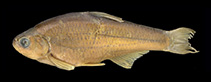 Alburnoides idignensis
Male Bild av Bogutskaya, N.G. / Coad, B.W.
Bilder | Google image
Male Bild av Bogutskaya, N.G. / Coad, B.W.
Klassificering / Namn Populärnamn | synonymer | Catalog of Fishes(Släkte, Arter) | ITIS | CoL | WoRMS | Cloffa
> Cypriniformes (Carps) > Leuciscidae (Minnows) > Leuciscinae
Etymology: Alburnoides: From the city of Al Bura, where the fish was known + particle Greek, oides = similar (Ref. 45335); idignensis: Named for the Tigris River which was called Idigna in Sumerian (Akkadian: Idiklat; biblical: Hiddekel; Arabic: Dijlah; Turkish: Dicle).
Etymology: Alburnoides: From the city of Al Bura, where the fish was known + particle Greek, oides = similar (Ref. 45335); idignensis: Named for the Tigris River which was called Idigna in Sumerian (Akkadian: Idiklat; biblical: Hiddekel; Arabic: Dijlah; Turkish: Dicle).
Taxonomic Remarks
The specific epithet is misspelled in Eschmeyer (CofF ver. Jul. 2010: Ref. 84883).
Miljö: miljö / Klimatzon / djupintervall / distributionsområde Ekologi
; sötvatten bentopelagisk; pH range: 6.8 - ?. Subtropical; 19°C - ? (Ref. 82592)
Utbredning Territorier | FAO områden | Ekosystem | Förekomster | Prickkarta | Utplanteringar | Faunafri
Asia: Iran.
Storlek / Vikt / Ålder
Kort beskrivning Bestämningsnycklar | Morfologi | Morfometri
Mjukstrålar i ryggfenan (totalt) : 9 - 12; Mjukstrålar i analfenan: 12 - 17; Ryggkotor: 38 - 40. Alburnoides idignensis is distinguished by a combination of the following characters: an unbranched ray of pectoral fin strongly lined with melanophores on its inner margin; eye with average size, the orbit diameter larger than the snout length and markedly smaller than the interorbital width; caudal fin lobes rounded and fin shallowly forked; a variably scaled ventral keel though most commonly scaled along about 1/3-2/3 of its length; a deep head with a markedly rounded, stout snout; a small mouth which is between terminal and subterminal; a tip of the mouth cleft on a level from the lower margin of the pupil; dorsal fin commonly with 8½ branched rays; anal fin with 10-12(13-14)½ branched rays; 41-49(50-51) total lateral line scales (39-49 scales to posterior margin of hypurals); commonly 2.5-4.2 or 2.4-4.2 pharyngeal teeth; total vertebrae 38-40, with a mode of 39; predorsal vertebrae 11-13; abdominal vertebrae 19- 20; caudal vertebrae 19-20; a caudal vertebral region most commonly one vertebra shorter or one vertebra longer than the abdominal region; the most common vertebral formulae are 20+19 and 19+20, and the difference between the abdominal and caudal counts averaging 0 (Ref. 82592).
Body shape (shape guide): elongated.
Body shape (shape guide): elongated.
Inhabits springs and qanats (Ref. 106248); also bushy shore, with some plants in water and stone river bed (Ref. 82592). Occurs sympatrically with Barbus lacerta, Alburnus mossulensis, Cobitis avicennae, Capoeta aculeata, Cyprinion macrostomum, Garra rufa, Oxynoemacheilus kiabii, and Oxynoemacheilus kermanshahensis (Ref. 106248).
Livscykel och parningsbeteende Könsmognad | Reproduktion | Lek | Ägg | Fekunditet | Larver
Huvudreferens
Ladda upp dina referenser | referenser | Koordinator | Medarbetare
Bogutskaya, N.G. and B.W. Coad, 2009. A review of vertebral and fin-ray counts in the genus Alburnoides (Teleostei: Cyprinidae) with a description of six new species. Zoosystematica Rossica 18(1):126-173. (Ref. 82592)
CITES
Not Evaluated
Hot mot människor
Harmless
Mänskliga användningsområden
Fiskeri: saknar intresse
FAO - Publication: search | FishSource |
Ytterligare information
Trofisk ekologi
Livsmedelsartiklar (preys)
Födosammansättning
Födointag
Matransoner
Predatorer
Livsmedelsartiklar (preys)
Födosammansättning
Födointag
Matransoner
Predatorer
Ekologi
Ekologi
Ekologi
Populationsdynamik
Tillväxtparametrar
Max. åldrar / storlekar
Längd-vikt rel.
Längd-längd rel.
Längd-frekvenser
Massakonvertering
Rekrytering
Abundans
Tillväxtparametrar
Max. åldrar / storlekar
Längd-vikt rel.
Längd-längd rel.
Längd-frekvenser
Massakonvertering
Rekrytering
Abundans
Livscykel
Reproduktion
Könsmognad
Mognad/Gills rel.
Fekunditet
Lek
Lekande aggregat
Ägg
Utveckling av ägg
Larver
Larvdynamik
Reproduktion
Könsmognad
Mognad/Gills rel.
Fekunditet
Lek
Lekande aggregat
Ägg
Utveckling av ägg
Larver
Larvdynamik
Anatomi
Gälyta
Hjärna
Otolit
Gälyta
Hjärna
Otolit
Fysiologi
Kroppssammansättning
Näringsämnen
Syreförbrukning
Typ av simning
Simhastighet
Visuella pigment
Ljud från fisk
Sjukdomar & Parasiter
Toxicitet (LC50)
Kroppssammansättning
Näringsämnen
Syreförbrukning
Typ av simning
Simhastighet
Visuella pigment
Ljud från fisk
Sjukdomar & Parasiter
Toxicitet (LC50)
Genetik
Genom
Genetik
Heterozygositet
Ärftlighet
Genetisk mångfald
Genom
Genetik
Heterozygositet
Ärftlighet
Genetisk mångfald
Människorelaterad
Vattenbrukssystem
Vattenbruksprofiler
Avelslinjer
Ciguatera-fall
Frimärken, mynt, diverse.
Vattenbrukssystem
Vattenbruksprofiler
Avelslinjer
Ciguatera-fall
Frimärken, mynt, diverse.
Verktyg
Särskilda rapporter
Kontrollera för underhåll av akvarium | Kontrollera om det finns faktablad om arter | Kontrollera om det finns faktablad om vattenbruk
Ladda ner XML
Internet-källor
AFORO (otoliths) | Aquatic Commons | BHL | Cloffa | Websites from users | Check FishWatcher | CISTI | Catalog of Fishes: Släkte, Arter | DiscoverLife | ECOTOX | FAO - Publication: search | Faunafri | Fishipedia | Fishtrace | GloBI | Google Books | Google Scholar | Google | IGFA World Record | OneZoom | Open Tree of Life | Otolith Atlas of Taiwan Fishes | PubMed | Reef Life Survey | Socotra Atlas | TreeBase | Tree of Life | Wikipedia: Go, sök | World Records Freshwater Fishing | Zoobank | Zoologiskt register
Uppskattningar baserade på modeller
Index för fylogenetisk mångfald (Ref. 82804): PD50 = 0.5000 [Uniqueness, from 0.5 = low to 2.0 = high].
Bayesian length-weight: a=0.00724 (0.00574 - 0.00915), b=3.14 (3.11 - 3.17), in cm total length, based on LWR estimates for this species (Ref. 93245).
Trofisk nivå (Ref. 69278): 3.1 ±0.4 se; based on size and trophs of closest relatives
Resiliens (Ref. 120179): Hög, lägsta populationsfördubblingstid mindre än 15 månader (Preliminary K or Fecundity.).