



Alburnoides idignensis Bogutskaya & Coad, 2009
Hochladen Photos und videos
Bilder | Google Bild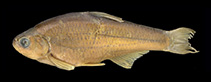 Alburnoides idignensis
Male Photo von Bogutskaya, N.G. / Coad, B.W.
Bilder | Google Bild
Male Photo von Bogutskaya, N.G. / Coad, B.W.
Klassifizierung / Names Namen | Synonyme | Catalog of Fishes(Gattung, Arten) | ITIS | CoL | WoRMS | Cloffa
> Cypriniformes (Carps) > Leuciscidae (Minnows) > Leuciscinae
Etymology: Alburnoides: From the city of Al Bura, where the fish was known + particle Greek, oides = similar (Ref. 45335); idignensis: Named for the Tigris River which was called Idigna in Sumerian (Akkadian: Idiklat; biblical: Hiddekel; Arabic: Dijlah; Turkish: Dicle).
Etymology: Alburnoides: From the city of Al Bura, where the fish was known + particle Greek, oides = similar (Ref. 45335); idignensis: Named for the Tigris River which was called Idigna in Sumerian (Akkadian: Idiklat; biblical: Hiddekel; Arabic: Dijlah; Turkish: Dicle).
Taxonomic Remarks
The specific epithet is misspelled in Eschmeyer (CofF ver. Jul. 2010: Ref. 84883).
Umwelt: Milieu / Klimazone / Tiefenbereich / Verbreitungsgebiet Ökologie
; süßwasser benthopelagisch; pH range: 6.8 - ?. Subtropical; 19°C - ? (Ref. 82592)
Verbreitung Territorien | FAO Gebiete | Ökosysteme | Vorkommen | Punkt Karte | Einführungen | Faunafri
Asia: Iran.
Größe / Gewicht / Alter
Kurzbeschreibung Bestimmungsschlüssel | Morphologie | Morphometrie
Rückenflossenweichstrahlen (insgesamt) : 9 - 12; Afterflossenweichstrahlen: 12 - 17; Wirbelzahl: 38 - 40. Alburnoides idignensis is distinguished by a combination of the following characters: an unbranched ray of pectoral fin strongly lined with melanophores on its inner margin; eye with average size, the orbit diameter larger than the snout length and markedly smaller than the interorbital width; caudal fin lobes rounded and fin shallowly forked; a variably scaled ventral keel though most commonly scaled along about 1/3-2/3 of its length; a deep head with a markedly rounded, stout snout; a small mouth which is between terminal and subterminal; a tip of the mouth cleft on a level from the lower margin of the pupil; dorsal fin commonly with 8½ branched rays; anal fin with 10-12(13-14)½ branched rays; 41-49(50-51) total lateral line scales (39-49 scales to posterior margin of hypurals); commonly 2.5-4.2 or 2.4-4.2 pharyngeal teeth; total vertebrae 38-40, with a mode of 39; predorsal vertebrae 11-13; abdominal vertebrae 19- 20; caudal vertebrae 19-20; a caudal vertebral region most commonly one vertebra shorter or one vertebra longer than the abdominal region; the most common vertebral formulae are 20+19 and 19+20, and the difference between the abdominal and caudal counts averaging 0 (Ref. 82592).
Body shape (shape guide): elongated.
Body shape (shape guide): elongated.
Inhabits springs and qanats (Ref. 106248); also bushy shore, with some plants in water and stone river bed (Ref. 82592). Occurs sympatrically with Barbus lacerta, Alburnus mossulensis, Cobitis avicennae, Capoeta aculeata, Cyprinion macrostomum, Garra rufa, Oxynoemacheilus kiabii, and Oxynoemacheilus kermanshahensis (Ref. 106248).
Lebenszyklus und Paarungsverhalten Geschlechtsreife | Fortpflanzung | Ablaichen | Eier | Fruchtbarkeit | Larven
Hauptreferenz
Laden Sie Ihre Referenzen hoch | Referenzen | Koordinator | Partner
Bogutskaya, N.G. and B.W. Coad, 2009. A review of vertebral and fin-ray counts in the genus Alburnoides (Teleostei: Cyprinidae) with a description of six new species. Zoosystematica Rossica 18(1):126-173. (Ref. 82592)
CITES
Not Evaluated
Bedrohung für Menschen
Harmless
Nutzung durch Menschen
Fischereien: nicht kommerziell
FAO - Publication: search | FishSource |
Mehr Information
Trophische Ökologie
Lebensmittel (Beutetiere)
Nahrungszusammensetzung
Nahrungsaufnahme
Lebensmittelrationen
Räuber
Lebensmittel (Beutetiere)
Nahrungszusammensetzung
Nahrungsaufnahme
Lebensmittelrationen
Räuber
Ökologie
Ökologie
Ökologie
Populationsdynamik
Wachstumsparameter
Max. Alter/Größen
Länge-Gewicht-Rel.
Länge-Länge-Verhältnis.
Längenhäufigkeiten
Massenkonvertierung
Rekrutierung
Dichte
Wachstumsparameter
Max. Alter/Größen
Länge-Gewicht-Rel.
Länge-Länge-Verhältnis.
Längenhäufigkeiten
Massenkonvertierung
Rekrutierung
Dichte
Lebenszyklus
Fortpflanzung
Geschlechtsreife
Reifung/Kiemen rel.
Fruchtbarkeit
Ablaichen
Laichaggregationen
Eier
Eientwicklung
Larven
Larven Pop.Dyn.
Fortpflanzung
Geschlechtsreife
Reifung/Kiemen rel.
Fruchtbarkeit
Ablaichen
Laichaggregationen
Eier
Eientwicklung
Larven
Larven Pop.Dyn.
Anatomie
Kiemenoberfläche
Gehirn
Otolith
Kiemenoberfläche
Gehirn
Otolith
Physiologie
Körperliche Zusammensetzung
Nährstoffe
Sauerstoffverbrauch
Schwimmart
Schwimmgeschwindigkeit
Visuelle Pigmente
Fischgeräusche
Krankheiten und Parasiten
Toxizität (LC50s)
Körperliche Zusammensetzung
Nährstoffe
Sauerstoffverbrauch
Schwimmart
Schwimmgeschwindigkeit
Visuelle Pigmente
Fischgeräusche
Krankheiten und Parasiten
Toxizität (LC50s)
Genetik
Genom
Genetik
Heterozygotie
Vererbbarkeit
Genetische Vielfalt
Genom
Genetik
Heterozygotie
Vererbbarkeit
Genetische Vielfalt
Menschenbezogen
Aquakultur-Systeme
Aquakultur Profile
Zuchtlinien
Ciguatera-Fälle
Briefmarken, Münzen, Verschiedenes.
Aquakultur-Systeme
Aquakultur Profile
Zuchtlinien
Ciguatera-Fälle
Briefmarken, Münzen, Verschiedenes.
Tools
Zusatzinformationen
Download XML
Zusammenfassung | Punktdaten | Namen | Photos
Internet Quellen
AFORO (otoliths) | Aquatic Commons | BHL | Cloffa | Websites from users | FishWatcher Einträge suchen | CISTI | Catalog of Fishes: Gattung, Arten | DiscoverLife | ECOTOX | FAO - Publication: search | Faunafri | Fishipedia | Fishtrace | GloBI | Google Books | Google Scholar | Google | IGFA World Record | OneZoom | Open Tree of Life | Otolith Atlas of Taiwan Fishes | PubMed | Reef Life Survey | Socotra Atlas | TreeBase | Tree of Life | Wikipedia: Gehe zu, Suchen | World Records Freshwater Fishing | Zoobank | Zoologischer Rekord
Schätzungen auf der Grundlage von Modellen
Phylogenetischer Diversitätsindex (Ref. 82804): PD50 = 0.5000 [Uniqueness, from 0.5 = low to 2.0 = high].
Bayesian length-weight: a=0.00724 (0.00574 - 0.00915), b=3.14 (3.11 - 3.17), in cm total length, based on LWR estimates for this species (Ref. 93245).
Trophische Ebene (Ref. 69278): 3.1 ±0.4 se; based on size and trophs of closest relatives
Widerstandsfähigkeit (Ref. 120179): hoch, Verdopplung der Population dauert weniger als 15 Monate. (Preliminary K or Fecundity.).