



Etheostoma jimmycarter Layman & Mayden, 2012
Bluegrass darter
Envoyez vos Photos et vidéos
Images Google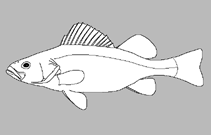 No image available for this species;
drawing shows typical species in Percidae.
Images Google
drawing shows typical species in Percidae.
Classification / Noms Noms communs | Synonymes | Catalog of Fishes(Genre, Espèce) | ITIS | CoL | WoRMS | Cloffa
> Perciformes/Percoidei (Perchs) > Percidae (Perches) > Etheostomatinae
Etymology: Etheostoma: Greek, etheo = to strain + Greek, stoma = mouth; Rafinesque said "various mouths", but Jordan and Evermann suggest the name might have been intended as "Heterostoma (Ref. 45335); jimmycarter: Named for President Jimmy Carter, the 39th President of the United States of America, and his environmental leadership and accomplishments in the areas of national energy policy and wilderness protection, and his life-long commitment to social justice and basic human rights; noun in apposition.
Eponymy: James Earl ‘Jimmy’ Carter Jr (b: 1924), the 39th President of the USA and well-known birdwatcher, was honoured for his environmental leadership and accomplishments in the areas of national energy policy and wilderness protection, and his life-long [...] (Ref. 128868), visit book page.
Etymology: Etheostoma: Greek, etheo = to strain + Greek, stoma = mouth; Rafinesque said "various mouths", but Jordan and Evermann suggest the name might have been intended as "Heterostoma (Ref. 45335); jimmycarter: Named for President Jimmy Carter, the 39th President of the United States of America, and his environmental leadership and accomplishments in the areas of national energy policy and wilderness protection, and his life-long commitment to social justice and basic human rights; noun in apposition.
Eponymy: James Earl ‘Jimmy’ Carter Jr (b: 1924), the 39th President of the USA and well-known birdwatcher, was honoured for his environmental leadership and accomplishments in the areas of national energy policy and wilderness protection, and his life-long [...] (Ref. 128868), visit book page.
Environnement : milieu / zone climatique / profondeur / gamme de distribution Écologie
; eau douce benthopélagique. Temperate
Distribution Territoires | Zones FAO | Écosystèmes | Occurrences | Carte par point | Introductions | Faunafri
North America: USA (Green River drainange of Kentucky and Tennessee).
Taille / Poids / Âge
Maturité: Lm ? range ? - ? cm
Max length : 4.9 cm SL mâle / non sexé; (Ref. 92294); 4.7 cm SL (female)
Max length : 4.9 cm SL mâle / non sexé; (Ref. 92294); 4.7 cm SL (female)
Description synthétique Clés d'identification | Morphologie | Morphométrie
Épines dorsales (Total) : 11 - 14; Rayons mous dorsaux (Total) : 10 - 13; Épines anales: 2; Rayons mous anaux: 7 - 9. This breeding male of this species, a member of the subgenus Doration, is distinguished by the following characters: spinous dorsal fin with black marginal band, orange medial band, black submedial band interrupted by vertical orange streaks extending from medial band above to basal band, the basal band with bright orange pigment; soft dorsal, caudal, and pectoral fins with distinct bright orange spots on rays; soft dorsal and anal fins without blue pigment; anal fin with many distinct orange spots on rays; the face and lower head tangerine orange with blue on operculum, preoperculum, cheek, and suborbital bar (not on lips and mid-gular region); quadrate lateral blue blotches extend ventrad from lateral line scale row; blue wedge on ventral half of caudal fin base but not developed dorsally. In addition, there is no frenum; incomplete lateral line, unpored scales modally greater than 10 (14); the cheek is usually naked; no palatine teeth; dorsal fin spines modally 12-13; dorsal soft rays modally 11; anal fin soft rays modally 8; pectoral fin rays modally 15; the principal caudal fin rays modally 15; caudal peduncle scales modally 16; preoperculomandibular canal pores modally 10 (Ref. 92294).
Cross section: oval.
Cross section: oval.
Cycle de vie et comportement reproducteur Maturité | Reproduction | Frai | Œufs | Fécondité | Larves
Référence principale
Téléchargez vos références | Références | Coordinateur | Collaborateurs
Layman, S.R. and R.L. Mayden, 2012. Morphological diversity and phylogenetics of the darter subgenus Doration (Percidae: Etheostoma), with descriptions of five new species. Bulletin of the Alabama Museum of Natural History 30:1-83. (Ref. 92294)
CITES
Not Evaluated
Menace pour l'homme
Harmless
Utilisations par l'homme
FAO - Publication: search | FishSource |
Plus d'informations
Écologie trophique
Aliments (proies)
Composition du régime alimentaire
Consommation alimentaire
Rations alimentaires
Prédateurs
Aliments (proies)
Composition du régime alimentaire
Consommation alimentaire
Rations alimentaires
Prédateurs
Écologie
Écologie
Écologie
Dynamique des populations
Paramètres de croissance
Âges / tailles maximales
Longueur-poids rel.
Rel. longueur-longueur.
Fréquences de longueurs
Conversion de masse
Recrutement
Abondance
Paramètres de croissance
Âges / tailles maximales
Longueur-poids rel.
Rel. longueur-longueur.
Fréquences de longueurs
Conversion de masse
Recrutement
Abondance
Cycle de vie
Reproduction
Maturité
Maturité/épines rel.
Fécondité
Frai
Agrégats de frai
Œufs
Développement de l'œuf
Larves
Dynamique des populations larvaires
Reproduction
Maturité
Maturité/épines rel.
Fécondité
Frai
Agrégats de frai
Œufs
Développement de l'œuf
Larves
Dynamique des populations larvaires
Anatomie
Surface branchiale
Cerveau
Otolithe
Surface branchiale
Cerveau
Otolithe
Physiologie
Composition corporelle
Nutriments
Consommation d'oxygène
Type de natation
Vitesse de nage
Pigments visuels
Son de poisson
Maladies et parasites
Toxicité (CL50)
Composition corporelle
Nutriments
Consommation d'oxygène
Type de natation
Vitesse de nage
Pigments visuels
Son de poisson
Maladies et parasites
Toxicité (CL50)
Génétique
génôme
Génétique
Hétérozygotie
Héritabilité
Diversité génétique
génôme
Génétique
Hétérozygotie
Héritabilité
Diversité génétique
Liées à l'homme
Systèmes d'aquaculture
Profils d'aquaculture
Souches
Cas de ciguatera
Timbres, pièces de monnaie, divers
Systèmes d'aquaculture
Profils d'aquaculture
Souches
Cas de ciguatera
Timbres, pièces de monnaie, divers
Outils
E-book | Guide de terrain | Générateur de fréquences de longueur | Outil de dynamique de population | Carte par point |
Capture-MSY |
Articles particuliers
Télécharger en XML
Sources Internet
AFORO (otoliths) | Aquatic Commons | BHL | Cloffa | Websites from users | FishWatcher | CISTI | Catalog of Fishes: Genre, Espèce | DiscoverLife | ECOTOX | FAO - Publication: search | Faunafri | Fishipedia | Fishtrace | GloBI | Google Books | Google Scholar | Google | IGFA World Record | OneZoom | Open Tree of Life | Otolith Atlas of Taiwan Fishes | PubMed | Reef Life Survey | Socotra Atlas | TreeBase | Arbre de Vie | Wikipedia: aller à, chercher | World Records Freshwater Fishing | Zoobank | Zoological Record
Estimations basées sur des modèles
Indice de diversité phylogénétique (Réf. 82804): PD50 = 0.5000 [Uniqueness, from 0.5 = low to 2.0 = high].
Bayesian length-weight: a=0.00676 (0.00303 - 0.01510), b=3.12 (2.94 - 3.30), in cm total length, based on LWR estimates for this Genus-body shape (Ref. 93245).
Niveau trophique (Réf. 69278): 3.2 ±0.5 se; based on size and trophs of closest relatives
Résilience (Réf. 120179): Haut, temps minimum de doublement de population inférieur à 15 mois (Preliminary K or Fecundity.).