



Etheostoma jimmycarter Layman & Mayden, 2012
Bluegrass darter
Carregue seu(sua) Fotos e vídeos
Imagem do Google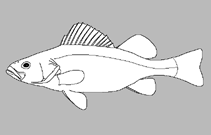 No image available for this species;
drawing shows typical species in Percidae.
Imagem do Google
drawing shows typical species in Percidae.
Classificação / Nomes Nomes comuns | Sinônimos | Catalog of Fishes(Gênero, Espécies) | ITIS | CoL | WoRMS | Cloffa
> Perciformes/Percoidei (Perchs) > Percidae (Perches) > Etheostomatinae
Etymology: Etheostoma: Greek, etheo = to strain + Greek, stoma = mouth; Rafinesque said "various mouths", but Jordan and Evermann suggest the name might have been intended as "Heterostoma (Ref. 45335); jimmycarter: Named for President Jimmy Carter, the 39th President of the United States of America, and his environmental leadership and accomplishments in the areas of national energy policy and wilderness protection, and his life-long commitment to social justice and basic human rights; noun in apposition.
Eponymy: James Earl ‘Jimmy’ Carter Jr (b: 1924), the 39th President of the USA and well-known birdwatcher, was honoured for his environmental leadership and accomplishments in the areas of national energy policy and wilderness protection, and his life-long [...] (Ref. 128868), visit book page.
Etymology: Etheostoma: Greek, etheo = to strain + Greek, stoma = mouth; Rafinesque said "various mouths", but Jordan and Evermann suggest the name might have been intended as "Heterostoma (Ref. 45335); jimmycarter: Named for President Jimmy Carter, the 39th President of the United States of America, and his environmental leadership and accomplishments in the areas of national energy policy and wilderness protection, and his life-long commitment to social justice and basic human rights; noun in apposition.
Eponymy: James Earl ‘Jimmy’ Carter Jr (b: 1924), the 39th President of the USA and well-known birdwatcher, was honoured for his environmental leadership and accomplishments in the areas of national energy policy and wilderness protection, and his life-long [...] (Ref. 128868), visit book page.
Meio ambiente: milieu / Zona climática / intervalo de profundidade / faixa de distribuição Ecologia
; Água doce bentopelágico. Temperate
Distribuição Territórios | Áreas da FAO | Ecossistemas | Ocorrências | Mapa de pontos | Introduções | Faunafri
North America: USA (Green River drainange of Kentucky and Tennessee).
Tamanho / Peso / Idade
Maturidade: Lm ? range ? - ? cm
Max length : 4.9 cm SL macho/indeterminado; (Ref. 92294); 4.7 cm SL (female)
Max length : 4.9 cm SL macho/indeterminado; (Ref. 92294); 4.7 cm SL (female)
Descrição suscinta Chaves de identificação | Morfologia | Morfometria
Espinhos dorsais (total) : 11 - 14; Raios dorsais (total) : 10 - 13; Espinhos anais: 2; Raios anais : 7 - 9. This breeding male of this species, a member of the subgenus Doration, is distinguished by the following characters: spinous dorsal fin with black marginal band, orange medial band, black submedial band interrupted by vertical orange streaks extending from medial band above to basal band, the basal band with bright orange pigment; soft dorsal, caudal, and pectoral fins with distinct bright orange spots on rays; soft dorsal and anal fins without blue pigment; anal fin with many distinct orange spots on rays; the face and lower head tangerine orange with blue on operculum, preoperculum, cheek, and suborbital bar (not on lips and mid-gular region); quadrate lateral blue blotches extend ventrad from lateral line scale row; blue wedge on ventral half of caudal fin base but not developed dorsally. In addition, there is no frenum; incomplete lateral line, unpored scales modally greater than 10 (14); the cheek is usually naked; no palatine teeth; dorsal fin spines modally 12-13; dorsal soft rays modally 11; anal fin soft rays modally 8; pectoral fin rays modally 15; the principal caudal fin rays modally 15; caudal peduncle scales modally 16; preoperculomandibular canal pores modally 10 (Ref. 92294).
Cross section: oval.
Cross section: oval.
Ciclo de vida ou comportamento de acasalamento Maturidade | Reprodução | Desova | Ovos | Fecundidade | Larvas
Referência principal
Carregar suas referências | Referências | Coordenador | Colaboradores
Layman, S.R. and R.L. Mayden, 2012. Morphological diversity and phylogenetics of the darter subgenus Doration (Percidae: Etheostoma), with descriptions of five new species. Bulletin of the Alabama Museum of Natural History 30:1-83. (Ref. 92294)
CITES
Not Evaluated
Ameaça para os humanos
Harmless
Uso pelos humanos
FAO - Publication: search | FishSource |
Mais informação
Ecologia Trófica
Itens alimentares (presas)
Composição da dieta
Consumo alimentar
Rações alimentares
Predadores
Itens alimentares (presas)
Composição da dieta
Consumo alimentar
Rações alimentares
Predadores
Ecologia
Ecologia
Ecologia
Dinâmica populacional
Parâmetros de crescimento
Idade máxima / tamanhos
Relação comprimento-peso.
Relação comprimento-comprimento.
Frequências de comprimento
Conversão de massa
Recrutamento
Abundância
Parâmetros de crescimento
Idade máxima / tamanhos
Relação comprimento-peso.
Relação comprimento-comprimento.
Frequências de comprimento
Conversão de massa
Recrutamento
Abundância
Ciclo de vida
Reprodução
Maturidade
Maturidade/Rel. das guelras
Fecundidade
Desova
Agregações de desova
Ovos
Desenvolvimento dos ovos
Larvas
Dinâmica larval
Reprodução
Maturidade
Maturidade/Rel. das guelras
Fecundidade
Desova
Agregações de desova
Ovos
Desenvolvimento dos ovos
Larvas
Dinâmica larval
Anatomia
Área branquial
Cérebro
Otólito
Área branquial
Cérebro
Otólito
Fisiologia
Composição corporal
Nutrientes
Consumo de oxigênio
Tipo de natação
Velocidade de natação
Pigmentos visuais
Som de peixe
Doenças e Parasitas
Toxicidade (LC50s)
Composição corporal
Nutrientes
Consumo de oxigênio
Tipo de natação
Velocidade de natação
Pigmentos visuais
Som de peixe
Doenças e Parasitas
Toxicidade (LC50s)
Genética
genoma
Genética
Heterozigosidade
Hereditariedade
Diversidade genética
genoma
Genética
Heterozigosidade
Hereditariedade
Diversidade genética
Relacionado a humanos
Sistemas de aquicultura
Perfis para aquacultura
Estirpes
Casos de Ciguatera
Selos, moedas, diversos.
Sistemas de aquicultura
Perfis para aquacultura
Estirpes
Casos de Ciguatera
Selos, moedas, diversos.
Ferramentas
Livro eletrônico | Guia de campo | Ferramenta auxiliar de frequências de comprimento | Ferramenta sobre a história de vida | Mapa de pontos |
Catch-MSY |
Relatórios especiais
Checar Manutenção em Aquário | Checar Planilhas de Fatos sobre as Espécies | Checar Planilhas de Fatos sobre Aquicultura
Baixar XML
Fontes da internet
AFORO (otoliths) | Aquatic Commons | BHL | Cloffa | Websites from users | Checar Observador de Peixes (FishWatcher) | CISTI | Catalog of Fishes: Gênero, Espécies | DiscoverLife | ECOTOX | FAO - Publication: search | Faunafri | Fishipedia | Fishtrace | GloBI | Google Books | Google Scholar | Google | IGFA World Record | OneZoom | Open Tree of Life | Otolith Atlas of Taiwan Fishes | PubMed | Reef Life Survey | Socotra Atlas | TreeBase | Árvore da vida | Wikipedia: Ir para, procura | World Records Freshwater Fishing | Zoobank | Registro zoológico
Estimativas baseadas em modelos
Índice de diversidade filogenética (Ref. 82804): PD50 = 0.5000 [Uniqueness, from 0.5 = low to 2.0 = high].
Bayesian length-weight: a=0.00676 (0.00303 - 0.01510), b=3.12 (2.94 - 3.30), in cm total length, based on LWR estimates for this Genus-body shape (Ref. 93245).
Nível Trófico (Ref. 69278): 3.2 ±0.5 se; based on size and trophs of closest relatives
Resiliência (Ref. 120179): Elevada, tempo mínimo de duplicação da população menor que 15 meses (Preliminary K or Fecundity.).