



Lufubuchromis relictus Schedel, Kupriyanov, Katongo & Schliewen, 2020
Hochladen Photos und videos
Google Bild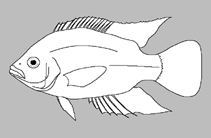 No image available for this species;
drawing shows typical species in Cichlidae.
Google Bild
drawing shows typical species in Cichlidae.
Klassifizierung / Names Namen | Synonyme | Catalog of Fishes(Gattung, Arten) | ITIS | CoL | WoRMS | Cloffa
> Cichliformes (Cichlids, convict blennies) > Cichlidae (Cichlids) > Pseudocrenilabrinae
Etymology: Lufubuchromis: 'Lufubu-' refers to the Lufubu River as the only species of the genus is restricted to the Upper Lufubu and its tributaries in northern Zambia; and '-chromis' a widely used suffix for cichlid genera; relictus: The species name relictus refers to the restricted distribution of this species in the isolated upper region of an ancient plateau; the basal phylogenetic position of Lufubuchromis as the ancient mitochondrial sister group of all other members of the Pseudocrenilabrus lineage suggests that it represents a relict ancient evolutionary lineage, that once may have had a wider distribution; the specific epithet is an adjective (Ref. 122072).
Etymology: Lufubuchromis: 'Lufubu-' refers to the Lufubu River as the only species of the genus is restricted to the Upper Lufubu and its tributaries in northern Zambia; and '-chromis' a widely used suffix for cichlid genera; relictus: The species name relictus refers to the restricted distribution of this species in the isolated upper region of an ancient plateau; the basal phylogenetic position of Lufubuchromis as the ancient mitochondrial sister group of all other members of the Pseudocrenilabrus lineage suggests that it represents a relict ancient evolutionary lineage, that once may have had a wider distribution; the specific epithet is an adjective (Ref. 122072).
Umwelt: Milieu / Klimazone / Tiefenbereich / Verbreitungsgebiet Ökologie
; süßwasser benthopelagisch. Tropical
Verbreitung Territorien | FAO Gebiete | Ökosysteme | Vorkommen | Punkt Karte | Einführungen | Faunafri
Africa: upper reaches of Lufubu River and its tributaries, in Zambia (Ref. 122072).
Größe / Gewicht / Alter
Kurzbeschreibung Bestimmungsschlüssel | Morphologie | Morphometrie
Rückenflossenstacheln (insgesamt) : 14 - 16; Rückenflossenweichstrahlen (insgesamt) : 9 - 11; Afterflossenstacheln: 3; Afterflossenweichstrahlen: 7 - 9; Wirbelzahl: 27 - 29. Diagnosis: Lufubuchromis relictus differs from Pseudocrenilabrus multicolor by having more abdominal vertebrae, 14-15 vs. 13; from Ps. nicholsi by having more abdominal vertebrae, 14-15 vs. 13, more total vertebrae, 27-29 vs. 25-26, and more dorsal fin spines, 15-16 vs. 13-14; and from Ps. pyrrhocaudalis by having more abdominal vertebrae, 14-15 vs. 12-13 (Ref. 122072). It is distinguished from Ps. philander philander by more abdominal vertebrae, 14-15 vs. 12-13; from Ps. philander dispersus and from several other Pseudocrenilabrus species of yet undefined taxonomic status by having more abdominal vertebrae, 14-15 vs. 13; in addition Lufubuchromis relictus has more dorsal fin spines than Ps. philander dispersus, 15-16 vs. 13-14, and from the putatively new species Pseudocrenilabrus sp. "Upper Kalungwishi" it is distinguished by having more total vertebrae, 27-29 vs. 26 (Ref. 122072). From Orthochromis machadoi it is distinguished by having comparatively large scales on the chest vs. a partially scaleless chest, with only deeply embedded and minute scales; furthermore, Lufubuchromis relictus tends to have more abdominal vertebrae, 14-15 vs. 13-14 and fewer caudal vertebrae, 13-15 vs. 15-16 (Ref. 122072). Lufubuchromis relictus is distinguished from the northern Zambia Orthochromis by having a large orange Pseudocrenilabrus blotch at the distal end of the anal fin vs. absent, and by having comparatively large scales on belly and chest vs. small to minute scales, if present deeply embedded on chest; further, Lufubuchromis relictus is distinguished from the northern Zambian Orthochromis by having fewer caudal vertebrae, 13-15 vs. 16-18, and fewer total vertebrae, 27-29 vs. 30-33 (Ref. 122072). Apart from colouration and its smaller maximum size Lufubuchromis relictus is distinguished from Palaeoplex palimpsest by its shorter dorsal fin spines, length of last dorsal fin spine 10.9-14.2% of standard length vs. 14.7-18.6%, and by having lower total gill raker counts, 10-12 vs. 12-17 (Ref. 122072).
Body shape (shape guide): short and / or deep.
Body shape (shape guide): short and / or deep.
Found in river, about 15 m wide with an estimated depth of 50 cm, rocky with patches of sand and gravel and with few patches of submerged vegetation (Ref. 122072). It is suggested that this species feeds on insect larvae and detritus (Ref. 122072). It is a maternal mouthbrooder (Ref. 122072).
Lebenszyklus und Paarungsverhalten Geschlechtsreife | Fortpflanzung | Ablaichen | Eier | Fruchtbarkeit | Larven
Hauptreferenz
Laden Sie Ihre Referenzen hoch | Referenzen | Koordinator : Kullander, Sven O. | Partner
Schedel, F.D.B., V.M.S. Kupriyanov, C. Katongo and U.K. Schliewen, 2020. Palaeoplex gen. nov. and Lufubuchromis gen. non, two new monotypic cichlid genera (Teleostei: Cichlidae) from northern Zambia. Zootaxa 4718(2):191-229. (Ref. 122072)
CITES
Not Evaluated
Bedrohung für Menschen
Harmless
Nutzung durch Menschen
FAO - Publication: search | FishSource |
Mehr Information
Trophische Ökologie
Lebensmittel (Beutetiere)
Nahrungszusammensetzung
Nahrungsaufnahme
Lebensmittelrationen
Räuber
Lebensmittel (Beutetiere)
Nahrungszusammensetzung
Nahrungsaufnahme
Lebensmittelrationen
Räuber
Populationsdynamik
Wachstumsparameter
Max. Alter/Größen
Länge-Gewicht-Rel.
Länge-Länge-Verhältnis.
Längenhäufigkeiten
Massenkonvertierung
Rekrutierung
Dichte
Wachstumsparameter
Max. Alter/Größen
Länge-Gewicht-Rel.
Länge-Länge-Verhältnis.
Längenhäufigkeiten
Massenkonvertierung
Rekrutierung
Dichte
Lebenszyklus
Fortpflanzung
Geschlechtsreife
Reifung/Kiemen rel.
Fruchtbarkeit
Ablaichen
Laichaggregationen
Eier
Eientwicklung
Larven
Larven Pop.Dyn.
Fortpflanzung
Geschlechtsreife
Reifung/Kiemen rel.
Fruchtbarkeit
Ablaichen
Laichaggregationen
Eier
Eientwicklung
Larven
Larven Pop.Dyn.
Anatomie
Kiemenoberfläche
Gehirn
Otolith
Kiemenoberfläche
Gehirn
Otolith
Physiologie
Körperliche Zusammensetzung
Nährstoffe
Sauerstoffverbrauch
Schwimmart
Schwimmgeschwindigkeit
Visuelle Pigmente
Fischgeräusche
Krankheiten und Parasiten
Toxizität (LC50s)
Körperliche Zusammensetzung
Nährstoffe
Sauerstoffverbrauch
Schwimmart
Schwimmgeschwindigkeit
Visuelle Pigmente
Fischgeräusche
Krankheiten und Parasiten
Toxizität (LC50s)
Genetik
Genom
Genetik
Heterozygotie
Vererbbarkeit
Genetische Vielfalt
Genom
Genetik
Heterozygotie
Vererbbarkeit
Genetische Vielfalt
Menschenbezogen
Aquakultur-Systeme
Aquakultur Profile
Zuchtlinien
Ciguatera-Fälle
Briefmarken, Münzen, Verschiedenes.
Aquakultur-Systeme
Aquakultur Profile
Zuchtlinien
Ciguatera-Fälle
Briefmarken, Münzen, Verschiedenes.
Tools
Zusatzinformationen
Download XML
Zusammenfassung | Punktdaten | Namen | Photos
Internet Quellen
AFORO (otoliths) | Aquatic Commons | BHL | Cloffa | Websites from users | FishWatcher Einträge suchen | CISTI | Catalog of Fishes: Gattung, Arten | DiscoverLife | ECOTOX | FAO - Publication: search | Faunafri | Fishipedia | Fishtrace | GloBI | Google Books | Google Scholar | Google | IGFA World Record | OneZoom | Open Tree of Life | Otolith Atlas of Taiwan Fishes | PubMed | Reef Life Survey | Socotra Atlas | TreeBase | Tree of Life | Wikipedia: Gehe zu, Suchen | World Records Freshwater Fishing | Zoobank | Zoologischer Rekord
Schätzungen auf der Grundlage von Modellen
Phylogenetischer Diversitätsindex (Ref. 82804): PD50 = 1.0000 [Uniqueness, from 0.5 = low to 2.0 = high].
Bayesian length-weight: a=0.01445 (0.00671 - 0.03113), b=2.99 (2.82 - 3.16), in cm total length, based on LWR estimates for this (Sub)family-body shape (Ref. 93245).
Trophische Ebene (Ref. 69278): 3.3 ±0.4 se; based on size and trophs of closest relatives
Widerstandsfähigkeit (Ref. 120179): hoch, Verdopplung der Population dauert weniger als 15 Monate. (Preliminary K or Fecundity.).