



Lufubuchromis relictus Schedel, Kupriyanov, Katongo & Schliewen, 2020
Carica il tuo foto e Video
Google image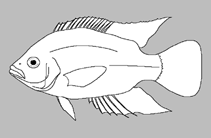 No image available for this species;
drawing shows typical species in Cichlidae.
Google image
drawing shows typical species in Cichlidae.
Classificazione / Nomi Nomi Comuni | Sinonimi | Catalog of Fishes(Genere, Specie) | ITIS | CoL | WoRMS | Cloffa
> Cichliformes (Cichlids, convict blennies) > Cichlidae (Cichlids) > Pseudocrenilabrinae
Etymology: Lufubuchromis: 'Lufubu-' refers to the Lufubu River as the only species of the genus is restricted to the Upper Lufubu and its tributaries in northern Zambia; and '-chromis' a widely used suffix for cichlid genera; relictus: The species name relictus refers to the restricted distribution of this species in the isolated upper region of an ancient plateau; the basal phylogenetic position of Lufubuchromis as the ancient mitochondrial sister group of all other members of the Pseudocrenilabrus lineage suggests that it represents a relict ancient evolutionary lineage, that once may have had a wider distribution; the specific epithet is an adjective (Ref. 122072).
Etymology: Lufubuchromis: 'Lufubu-' refers to the Lufubu River as the only species of the genus is restricted to the Upper Lufubu and its tributaries in northern Zambia; and '-chromis' a widely used suffix for cichlid genera; relictus: The species name relictus refers to the restricted distribution of this species in the isolated upper region of an ancient plateau; the basal phylogenetic position of Lufubuchromis as the ancient mitochondrial sister group of all other members of the Pseudocrenilabrus lineage suggests that it represents a relict ancient evolutionary lineage, that once may have had a wider distribution; the specific epithet is an adjective (Ref. 122072).
Ambiente: milieu / zona climatica / distribuzione batimetrica / gamma di distribuzione Ecologia
; acqua dolce benthopelagico. Tropical
Distribuzione Territories | Aree FAO | Ecosistemi | Presenze | Mappa dei ritrovamenti | Introduzioni | Faunafri
Africa: upper reaches of Lufubu River and its tributaries, in Zambia (Ref. 122072).
Dimensione / Peso / Età
Breve descrizione Chiavi di identificazione | Morfologia | Morfometria
Spine dorsali (totale) : 14 - 16; Raggi dorsali molli (totale) : 9 - 11; Spine anali: 3; Raggi anali molli: 7 - 9; Vertebre: 27 - 29. Diagnosis: Lufubuchromis relictus differs from Pseudocrenilabrus multicolor by having more abdominal vertebrae, 14-15 vs. 13; from Ps. nicholsi by having more abdominal vertebrae, 14-15 vs. 13, more total vertebrae, 27-29 vs. 25-26, and more dorsal fin spines, 15-16 vs. 13-14; and from Ps. pyrrhocaudalis by having more abdominal vertebrae, 14-15 vs. 12-13 (Ref. 122072). It is distinguished from Ps. philander philander by more abdominal vertebrae, 14-15 vs. 12-13; from Ps. philander dispersus and from several other Pseudocrenilabrus species of yet undefined taxonomic status by having more abdominal vertebrae, 14-15 vs. 13; in addition Lufubuchromis relictus has more dorsal fin spines than Ps. philander dispersus, 15-16 vs. 13-14, and from the putatively new species Pseudocrenilabrus sp. "Upper Kalungwishi" it is distinguished by having more total vertebrae, 27-29 vs. 26 (Ref. 122072). From Orthochromis machadoi it is distinguished by having comparatively large scales on the chest vs. a partially scaleless chest, with only deeply embedded and minute scales; furthermore, Lufubuchromis relictus tends to have more abdominal vertebrae, 14-15 vs. 13-14 and fewer caudal vertebrae, 13-15 vs. 15-16 (Ref. 122072). Lufubuchromis relictus is distinguished from the northern Zambia Orthochromis by having a large orange Pseudocrenilabrus blotch at the distal end of the anal fin vs. absent, and by having comparatively large scales on belly and chest vs. small to minute scales, if present deeply embedded on chest; further, Lufubuchromis relictus is distinguished from the northern Zambian Orthochromis by having fewer caudal vertebrae, 13-15 vs. 16-18, and fewer total vertebrae, 27-29 vs. 30-33 (Ref. 122072). Apart from colouration and its smaller maximum size Lufubuchromis relictus is distinguished from Palaeoplex palimpsest by its shorter dorsal fin spines, length of last dorsal fin spine 10.9-14.2% of standard length vs. 14.7-18.6%, and by having lower total gill raker counts, 10-12 vs. 12-17 (Ref. 122072).
Body shape (shape guide): short and / or deep.
Body shape (shape guide): short and / or deep.
Found in river, about 15 m wide with an estimated depth of 50 cm, rocky with patches of sand and gravel and with few patches of submerged vegetation (Ref. 122072). It is suggested that this species feeds on insect larvae and detritus (Ref. 122072). It is a maternal mouthbrooder (Ref. 122072).
Ciclo vitale e comportamento di accoppiamento Maturità | Riproduzione | Deposizione | Uova | Fecondità | Larve
Riferimento principale
Caricare le referenze | Bibliografia | Coordinatore : Kullander, Sven O. | Collaboratori
Schedel, F.D.B., V.M.S. Kupriyanov, C. Katongo and U.K. Schliewen, 2020. Palaeoplex gen. nov. and Lufubuchromis gen. non, two new monotypic cichlid genera (Teleostei: Cichlidae) from northern Zambia. Zootaxa 4718(2):191-229. (Ref. 122072)
CITES
Not Evaluated
Minaccia per l'uomo
Harmless
Usi umani
FAO - Publication: search | FishSource |
Informazioni ulteriori
Ecologia trofica
Articoli alimentari (prede)
Alimentazione
Consumo di cibo
Razioni alimentari
Predatori
Articoli alimentari (prede)
Alimentazione
Consumo di cibo
Razioni alimentari
Predatori
Dinamica della popolazione
Parametri di crescita
Età massima / dimensioni massime
Rapporto lunghezza-peso.
Lunghezza-lunghezza rel.
Lunghezza-frequenze
Conversione di massa
Reclutamento
Abbondanza
Parametri di crescita
Età massima / dimensioni massime
Rapporto lunghezza-peso.
Lunghezza-lunghezza rel.
Lunghezza-frequenze
Conversione di massa
Reclutamento
Abbondanza
Ciclo di vita
Riproduzione
Maturità
Maturità/Gli occhielli sono relativi.
Fecondità
Deposizione
Aggregazioni riproduttive
Uova
Sviluppo delle uova
Larve
Dinamica popolazioni larvali
Riproduzione
Maturità
Maturità/Gli occhielli sono relativi.
Fecondità
Deposizione
Aggregazioni riproduttive
Uova
Sviluppo delle uova
Larve
Dinamica popolazioni larvali
Anatomia
Area branchiale
Cervello
Otolite
Area branchiale
Cervello
Otolite
Fisiologia
Composizione corporea
Nutrienti
Consumo di ossigeno
Tipo di nuoto
Velocità di nuoto
Pigmenti visivi
Suono del pesce
Malattie e parassiti
Tossicità (LC50)
Composizione corporea
Nutrienti
Consumo di ossigeno
Tipo di nuoto
Velocità di nuoto
Pigmenti visivi
Suono del pesce
Malattie e parassiti
Tossicità (LC50)
Genetica
Genome
Genetica
Eterozigosi
Ereditarietà
Diversità genetica
Genome
Genetica
Eterozigosi
Ereditarietà
Diversità genetica
Legato all'uomo
Sistemi di acquacoltura
Profili di acquacoltura
Varietà
Casi di Ciguatera
Francobolli, monete, materiale vario.
Sistemi di acquacoltura
Profili di acquacoltura
Varietà
Casi di Ciguatera
Francobolli, monete, materiale vario.
Strumenti
Libro elettronico | Giuda pratica | Generatore frequenze di lunghezza | Strumento Parametri Biologici | Mappa dei ritrovamenti |
Cattura-MSY |
Rapporti speciali
Controllo della manutenzione dell'acquario | Verificare la presenza di schede informative sulle specie | Verifica delle schede informative sull'acquacoltura
Scarica XML
Fonti Internet
AFORO (otoliths) | Aquatic Commons | BHL | Cloffa | Websites from users | Check FishWatcher | CISTI | Catalog of Fishes: Genere, Specie | DiscoverLife | ECOTOX | FAO - Publication: search | Faunafri | Fishipedia | Fishtrace | GloBI | Google Books | Google Scholar | Google | IGFA World Record | OneZoom | Open Tree of Life | Otolith Atlas of Taiwan Fishes | PubMed | Reef Life Survey | Socotra Atlas | TreeBase | Tree of Life | Wikipedia: Go, ricerca | World Records Freshwater Fishing | Zoobank | Record zoologico
Stime basate su modelli
Indice di diversità filogenetica (Fonte Biblio. 82804): PD50 = 1.0000 [Uniqueness, from 0.5 = low to 2.0 = high].
Bayesian length-weight: a=0.01445 (0.00671 - 0.03113), b=2.99 (2.82 - 3.16), in cm total length, based on LWR estimates for this (Sub)family-body shape (Ref. 93245).
Livello trofico (Fonte Biblio. 69278): 3.3 ±0.4 se; based on size and trophs of closest relatives
Resilienza (Fonte Biblio. 120179): Alto, tempo minimo di raddoppiamento della popolazione meno di 15 mesi (Preliminary K or Fecundity.).