



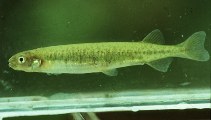
Classificazione / Nomi Nomi Comuni | Sinonimi | Catalog of Fishes(Genere, Specie) | ITIS | CoL | WoRMS | Cloffa
> Galaxiiformes (Southern smelts) > Galaxiidae (Galaxiids) > Galaxiinae
Etymology: Galaxias: Greek, galaxias, ou = a kind of fish (Ref. 45335).
More on author: Jenyns.
Etymology: Galaxias: Greek, galaxias, ou = a kind of fish (Ref. 45335).
More on author: Jenyns.
Taxonomic Remarks
zzzAT STOCKS Galaxias maculatus has the most disjunct distribution of any freshwater species. This distribution is best explained by dispersal of whitebait larval stage throughout the sea (Berra et al. 1996). See McDowall (1971b) for a detailed description.
Ambiente: milieu / zona climatica / distribuzione batimetrica / gamma di distribuzione Ecologia
marino; acqua dolce; salmastro benthopelagico; catadromo (Ref. 138269). Temperate; 10°C - 22°C (Ref. 2060); 27°S - 56°S, 112°W - 56°W
Distribuzione Territories | Aree FAO | Ecosistemi | Presenze | Mappa dei ritrovamenti | Introduzioni | Faunafri
Oceania: Australia (including Tasmania), Lord Howe Island, New Zealand and the Chatham Islands. South America: Ranges from along the Chilean side of the Andes near Valparaiso to the southern extremity of the island chain southeast of Tierra del Fuego. Also on the eastern side of the Andes in Argentina in isolated lakes (Meliquina, Traful, Nahuel Huapi, Gutierrez, and Pellegrini) which drain into the Atlantic Ocean via the Negro River. It occurs on Falkland Islands.
Dimensione / Peso / Età
Maturità: Lm ? range ? - ? cm
Max length : 19.0 cm SL maschio/sesso non determinato; (Ref. 44894); common length : 10.0 cm TL maschio/sesso non determinato; (Ref. 5259)
Max length : 19.0 cm SL maschio/sesso non determinato; (Ref. 44894); common length : 10.0 cm TL maschio/sesso non determinato; (Ref. 5259)
Breve descrizione Chiavi di identificazione | Morfologia | Morfometria
Spine dorsali (totale) : 0; Raggi dorsali molli (totale) : 10 - 12; Spine anali: 0; Raggi anali molli: 15 - 17.
Body shape (shape guide): elongated.
Body shape (shape guide): elongated.
Facultative air-breathing (Ref. 126274); Adults occur in a wide variety of habitat, but mostly in still or slow-flowing waters, mainly in streams, rivers and lakes within a short distance of the sea. They can survive in salinities up to 50 ppt. They feed on aquatic and terrestrial insects, and crustaceans. Adults typically migrate downstream into estuaries during high spring tides in autumn to spawn on fringing vegetation. Spawning does not occur beyond the river estuaries, making this species 'only marginally catadromous' (Ref. 46888). Many perish after spawning but some survive another year. Eggs develop out of water for two weeks and hatch upon the arrival of the next spring tide. Newly hatched larvae spend their first 5-6 months at sea before returning to fresh shoals of whitebait during spring. An important component of whitebait fisheries throughout the Southern Hemisphere (Ref. 44894). Utilized fresh and eaten fried (Ref. 9988, 44894).
Ciclo vitale e comportamento di accoppiamento Maturità | Riproduzione | Deposizione | Uova | Fecondità | Larve
For diadromous populations: deposit eggs on dense terrestrial vegetation that is flooded by the high tide. The eggs develop out of water in humid condition during the next 2 weeks. Hatching takes place when a second series of high tides again wash over the eggs. For landlocked population: fish migrate up to the tributary streams during floods. Deposit eggs on the flooded grassy banks and complete their development after the water level subsides. Hatching occurs during subsequent floods.
Riferimento principale
Caricare le referenze | Bibliografia | Coordinatore : Berra, Tim M. | Collaboratori
Allen, G.R., 1989. Freshwater fishes of Australia. T.F.H. Publications, Inc., Neptune City, New Jersey. (Ref. 5259)
Stato della Lista Rossa IUCN (Ref. 130435: Version 2025-2 (Global))
Least Concern (LC) ; Date assessed: 12 February 2019
CITES
Not Evaluated
Minaccia per l'uomo
Harmless
Usi umani
Pesca: commerciale; Pesce da pesca sportiva: si; esca: usually
FAO - Publication: search | FishSource | Sea Around Us
Informazioni ulteriori
Ecologia trofica
Articoli alimentari (prede)
Alimentazione
Consumo di cibo
Razioni alimentari
Predatori
Articoli alimentari (prede)
Alimentazione
Consumo di cibo
Razioni alimentari
Predatori
Dinamica della popolazione
Parametri di crescita
Età massima / dimensioni massime
Rapporto lunghezza-peso.
Lunghezza-lunghezza rel.
Lunghezza-frequenze
Conversione di massa
Reclutamento
Abbondanza
Parametri di crescita
Età massima / dimensioni massime
Rapporto lunghezza-peso.
Lunghezza-lunghezza rel.
Lunghezza-frequenze
Conversione di massa
Reclutamento
Abbondanza
Ciclo di vita
Riproduzione
Maturità
Maturità/Gli occhielli sono relativi.
Fecondità
Deposizione
Aggregazioni riproduttive
Uova
Sviluppo delle uova
Larve
Dinamica popolazioni larvali
Riproduzione
Maturità
Maturità/Gli occhielli sono relativi.
Fecondità
Deposizione
Aggregazioni riproduttive
Uova
Sviluppo delle uova
Larve
Dinamica popolazioni larvali
Anatomia
Area branchiale
Cervello
Otolite
Area branchiale
Cervello
Otolite
Fisiologia
Composizione corporea
Nutrienti
Consumo di ossigeno
Tipo di nuoto
Velocità di nuoto
Pigmenti visivi
Suono del pesce
Malattie e parassiti
Tossicità (LC50)
Composizione corporea
Nutrienti
Consumo di ossigeno
Tipo di nuoto
Velocità di nuoto
Pigmenti visivi
Suono del pesce
Malattie e parassiti
Tossicità (LC50)
Legato all'uomo
Sistemi di acquacoltura
Profili di acquacoltura
Varietà
Casi di Ciguatera
Francobolli, monete, materiale vario.
Sistemi di acquacoltura
Profili di acquacoltura
Varietà
Casi di Ciguatera
Francobolli, monete, materiale vario.
Strumenti
Libro elettronico | Giuda pratica | Chiavi di identificazione | Generatore frequenze di lunghezza | Strumento Parametri Biologici | Mappa dei ritrovamenti |
Cattura-MSY |
Rapporti speciali
Controllo della manutenzione dell'acquario | Verificare la presenza di schede informative sulle specie | Verifica delle schede informative sull'acquacoltura
Scarica XML
Fonti Internet
AFORO (otoliths) | Aquatic Commons | BHL | Cloffa | Websites from users | Check FishWatcher | CISTI | Catalog of Fishes: Genere, Specie | DiscoverLife | ECOTOX | FAO - Publication: search | Faunafri | Fishipedia | Fishtrace | GloBI | Google Books | Google Scholar | Google | IGFA World Record | OneZoom | Open Tree of Life | Otolith Atlas of Taiwan Fishes | PubMed | Reef Life Survey | Socotra Atlas | TreeBase | Tree of Life | Wikipedia: Go, ricerca | World Records Freshwater Fishing | Record zoologico
Stime basate su modelli
Indice di diversità filogenetica (Fonte Biblio. 82804): PD50 = 0.5000 [Uniqueness, from 0.5 = low to 2.0 = high].
Bayesian length-weight: a=0.00501 (0.00243 - 0.01032), b=3.16 (2.97 - 3.35), in cm total length, based on LWR estimates for this species & (Sub)family-body (Ref. 93245).
Livello trofico (Fonte Biblio. 69278): 3.2 ±0.2 se; based on diet studies.
Resilienza (Fonte Biblio. 120179): Medio, tempo minimo di raddoppiamento della popolazione 1.4 - 4.4 anni (Fec=175).
Nutrienti (Ref. 124155): Calcium = 54 [29, 145] mg/100g; Iron = 0.34 [0.18, 0.78] mg/100g; Protein = 14.9 [12.6, 17.1] %; Omega3 = 0.495 [0.193, 1.245] g/100g; Selenium = 7.4 [2.8, 17.1] μg/100g; VitaminA = 35.1 [10.5, 122.9] μg/100g; Zinc = 1.21 [0.76, 1.87] mg/100g (wet weight);