



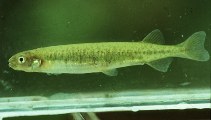
Clasificación / Nombres Nombres comunes | Sinónimos | Catalog of Fishes(Género, Especie) | ITIS | CoL | WoRMS | Cloffa
> Galaxiiformes (Southern smelts) > Galaxiidae (Galaxiids) > Galaxiinae
Etymology: Galaxias: Greek, galaxias, ou = a kind of fish (Ref. 45335).
More on author: Jenyns.
Etymology: Galaxias: Greek, galaxias, ou = a kind of fish (Ref. 45335).
More on author: Jenyns.
Taxonomic Remarks
zzzAT STOCKS Galaxias maculatus has the most disjunct distribution of any freshwater species. This distribution is best explained by dispersal of whitebait larval stage throughout the sea (Berra et al. 1996). See McDowall (1971b) for a detailed description.
Entorno: milieu / zona climática / rango de profundidad / gama de distribución Ecología
marino; agua dulce; salobre bentopelágico; catadromo (Ref. 138269). Temperate; 10°C - 22°C (Ref. 2060); 27°S - 56°S, 112°W - 56°W
Distribución Territorios | Áreas FAO | Ecosistemas | Ocurrencias, apariciones | Mapa de puntos | Introducciones | Faunafri
Oceania: Australia (including Tasmania), Lord Howe Island, New Zealand and the Chatham Islands. South America: Ranges from along the Chilean side of the Andes near Valparaiso to the southern extremity of the island chain southeast of Tierra del Fuego. Also on the eastern side of the Andes in Argentina in isolated lakes (Meliquina, Traful, Nahuel Huapi, Gutierrez, and Pellegrini) which drain into the Atlantic Ocean via the Negro River. It occurs on Falkland Islands.
Tamaño / Peso / Edad
Madurez: Lm ? range ? - ? cm
Max length : 19.0 cm SL macho / no sexado; (Ref. 44894); common length : 10.0 cm TL macho / no sexado; (Ref. 5259)
Max length : 19.0 cm SL macho / no sexado; (Ref. 44894); common length : 10.0 cm TL macho / no sexado; (Ref. 5259)
Descripción breve Claves de identificación | Morfología | Morfometría
Espinas dorsales (total) : 0; Radios blandos dorsales (total) : 10 - 12; Espinas anales: 0; Radios blandos anales: 15 - 17.
Body shape (shape guide): elongated.
Body shape (shape guide): elongated.
Facultative air-breathing (Ref. 126274); Adults occur in a wide variety of habitat, but mostly in still or slow-flowing waters, mainly in streams, rivers and lakes within a short distance of the sea. They can survive in salinities up to 50 ppt. They feed on aquatic and terrestrial insects, and crustaceans. Adults typically migrate downstream into estuaries during high spring tides in autumn to spawn on fringing vegetation. Spawning does not occur beyond the river estuaries, making this species 'only marginally catadromous' (Ref. 46888). Many perish after spawning but some survive another year. Eggs develop out of water for two weeks and hatch upon the arrival of the next spring tide. Newly hatched larvae spend their first 5-6 months at sea before returning to fresh shoals of whitebait during spring. An important component of whitebait fisheries throughout the Southern Hemisphere (Ref. 44894). Utilized fresh and eaten fried (Ref. 9988, 44894).
Ciclo vital y comportamiento de apareamiento Madurez | Reproducción | Puesta | Huevos | Fecundidad | Larva
For diadromous populations: deposit eggs on dense terrestrial vegetation that is flooded by the high tide. The eggs develop out of water in humid condition during the next 2 weeks. Hatching takes place when a second series of high tides again wash over the eggs. For landlocked population: fish migrate up to the tributary streams during floods. Deposit eggs on the flooded grassy banks and complete their development after the water level subsides. Hatching occurs during subsequent floods.
Referencia principal
Suba sus referencias | Referencias | Coordinador : Berra, Tim M. | Colaboradores
Allen, G.R., 1989. Freshwater fishes of Australia. T.F.H. Publications, Inc., Neptune City, New Jersey. (Ref. 5259)
Situación en la Lista Roja de la UICN (Ref. 130435: Version 2025-2 (Global))
Least Concern (LC) ; Date assessed: 12 February 2019
CITES
Not Evaluated
Amenaza para el ser humano
Harmless
Usos humanos
Pesquerías: comercial; pesca deportiva: si; carnada: usually
FAO - Publication: search | FishSource | Sea Around Us
Más información
Ecología Trófica
Alimentos (presas)
Composición de la dieta
consumo de alimento
Raciones de comida
Despredadores
Alimentos (presas)
Composición de la dieta
consumo de alimento
Raciones de comida
Despredadores
Dinámica de la población
Coeficiente del crecimiento para
Edades / tallas máximas
Longitud-peso rel.
Longitud-longitud rel.
Longitud-frecuencias
Conversión de masas
Reclutamiento
Abundancia
Coeficiente del crecimiento para
Edades / tallas máximas
Longitud-peso rel.
Longitud-longitud rel.
Longitud-frecuencias
Conversión de masas
Reclutamiento
Abundancia
Ciclo de vida
Reproducción
Madurez
Madurez/Gills rel.
Fecundidad
Puesta
Agregaciones de desove
Huevos
Desarrollo de los huevos
Larva
Dinámica larvaria
Reproducción
Madurez
Madurez/Gills rel.
Fecundidad
Puesta
Agregaciones de desove
Huevos
Desarrollo de los huevos
Larva
Dinámica larvaria
Distribución
Territorios
Áreas FAO
Ecosistemas
Ocurrencias, apariciones
Introducciones
BRUVS - Vídeos
Territorios
Áreas FAO
Ecosistemas
Ocurrencias, apariciones
Introducciones
BRUVS - Vídeos
Anatomía
Superficie branquial
Cerebro
Otolito
Superficie branquial
Cerebro
Otolito
Fisiología
Composición corporal
Nutrientes
Consumo del oxígeno
Tipo de natación
Velocidad de natación
Pigmentos visuales
Sonido de peces
Enfermedades y parásitos
Toxicidad (CL50)
Composición corporal
Nutrientes
Consumo del oxígeno
Tipo de natación
Velocidad de natación
Pigmentos visuales
Sonido de peces
Enfermedades y parásitos
Toxicidad (CL50)
Relacionados con el ser humano
Sistemas de acuicultura
Perfiles de acuicultura
Razas
Ciguatera cases
Sellos, monedas, varios
Sistemas de acuicultura
Perfiles de acuicultura
Razas
Ciguatera cases
Sellos, monedas, varios
Herramientas
Libro electrónico | Guía de campo | Claves de identificación | Asistente para frecuencias de tallas | Herramienta de ciclo de vida | Mapa de puntos |
Catch-MSY |
Informes especiales
Comprobar el mantenimiento del acuario | Buscar fichas sobre especies | Consulte las hojas informativas sobre acuicultura
Descargar XML
Fuentes de Internet
AFORO (otoliths) | Aquatic Commons | BHL | Cloffa | Websites from users | Check FishWatcher | CISTI | Catalog of Fishes: Género, Especie | DiscoverLife | ECOTOX | FAO - Publication: search | Faunafri | Fishipedia | Fishtrace | GloBI | Google Books | Google Scholar | Google | IGFA World Record | OneZoom | Open Tree of Life | Otolith Atlas of Taiwan Fishes | PubMed | Reef Life Survey | Socotra Atlas | TreeBase | Árbol de la vida | Wikipedia: Go, búsqueda | World Records Freshwater Fishing | Expediente Zoológico
Estimaciones basadas en modelos
Índice de diversidad filogenética (Referencia 82804): PD50 = 0.5000 [Uniqueness, from 0.5 = low to 2.0 = high].
Bayesian length-weight: a=0.00501 (0.00243 - 0.01032), b=3.16 (2.97 - 3.35), in cm total length, based on LWR estimates for this species & (Sub)family-body (Ref. 93245).
Nivel trófico (Referencia 69278): 3.2 ±0.2 se; based on diet studies.
Resiliencia (Referencia 120179): Medio, población duplicada en un tiempo mínimo de 1.4-4.4 años (Fec=175).
Nutrientes (Ref. 124155): Calcium = 54 [29, 145] mg/100g; Iron = 0.34 [0.18, 0.78] mg/100g; Protein = 14.9 [12.6, 17.1] %; Omega3 = 0.495 [0.193, 1.245] g/100g; Selenium = 7.4 [2.8, 17.1] μg/100g; VitaminA = 35.1 [10.5, 122.9] μg/100g; Zinc = 1.21 [0.76, 1.87] mg/100g (wet weight);