



Cetorhinus maximus (Gunnerus, 1765)
Basking shark
Ajouter votre observation dans Fish Watcher
| Native range | All suitable habitat | Point map | Year 2050 |

|
| This map was computer-generated and has not yet been reviewed. |
| Cetorhinus maximus AquaMaps Data sources: GBIF OBIS |
Envoyez vos Photos et vidéos
Images | vidéos | Timbres, pièces de monnaie, divers | Images Google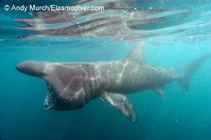 Cetorhinus maximus
Photo de Murch, A.
Images | vidéos | Timbres, pièces de monnaie, divers | Images Google
Photo de Murch, A.
Classification / Noms Noms communs | Synonymes | Catalog of Fishes(Genre, Espèce) | ITIS | CoL | WoRMS | Cloffa
Élasmobranches (requins et raies) (sharks and rays) > Lamniformes (Mackerel sharks) > Cetorhinidae (Basking sharks)
Etymology: Cetorhinus: cetus (L.), from ketos (Gr.) whale, referring to its size; rhinus, an ancient name for sharks, from rhine (Gr.), rasp, alluding to a shark’s jagged, rasp-like skin (See ETYFish); maximus: Latin for greatest, being the largest known fish (i.e., non-mammalian aquatic vertebrate) at the time (superseded by Rhincodon typus) (See ETYFish).
Etymology: Cetorhinus: cetus (L.), from ketos (Gr.) whale, referring to its size; rhinus, an ancient name for sharks, from rhine (Gr.), rasp, alluding to a shark’s jagged, rasp-like skin (See ETYFish); maximus: Latin for greatest, being the largest known fish (i.e., non-mammalian aquatic vertebrate) at the time (superseded by Rhincodon typus) (See ETYFish).
Environnement : milieu / zone climatique / profondeur / gamme de distribution Écologie
marin pelagic-oceanic; océanodrome (Ref. 87829); profondeur 0 - 2000 m (Ref. 26346), usually 0 - ? m (Ref. 55197). Temperate; 6°C - 24°C (Ref. 88171); 75°N - 58°S, 111°E - 42°E (Ref. 84930)
Distribution Territoires | Zones FAO | Écosystèmes | Occurrences | Carte par point | Introductions | Faunafri
Cosmopolitan, frequent in cold to warm temperate waters; rare in equatorial waters (Ref. 48844). Highly migratory species. At risk of extinction by overfishing because of low to very low productivity (Ref. 36717).
Longueur à la première maturité / Taille / Poids / Âge
Maturité: Lm 895.0, range 500 - 1000 cm
Max length : 1,520 cm TL mâle / non sexé; (Ref. 247); 980.0 cm TL (female); common length : 700 cm TL mâle / non sexé; (Ref. 6077); poids max. publié: 4.0 t (Ref. 4645)
Max length : 1,520 cm TL mâle / non sexé; (Ref. 247); 980.0 cm TL (female); common length : 700 cm TL mâle / non sexé; (Ref. 6077); poids max. publié: 4.0 t (Ref. 4645)
Description synthétique Clés d'identification | Morphologie | Morphométrie
Épines dorsales (Total) : 0; Épines anales: 0. Distinguished from all other sharks by the enormous gill slits practically encircling the head; dermal denticle gill rakers; pointed snout; huge, sub terminal mouth with minute hooked teeth; caudal peduncle with strong lateral keels, and lunate caudal fin. Body covered with placoid scales. Blackish to grey-brown, grey, or blue-grey, often with irregular white blotches under the head and abdomen (Ref. 43278). Also Ref. 309, 5983.
Body shape (shape guide): elongated; Cross section: circular.
Body shape (shape guide): elongated; Cross section: circular.
The second largest shark, reportedly reaching 1,220-1,520 cm TL (Ref. 247). Thought to live up to 50 years (Ref. 9030, 89083). Semi-oceanic or oceanic species, highly migratory (Ref. 43278). Found on continental and insular shelves, offshore and often close to land, just off the surf zone; enters enclosed bays (Ref. 247). Coastal-pelagic at 1 meter to unknown depths, probably epipelagic (Ref. 58302). Occurs singly, in pairs or groups of 3 or more, or in huge schools (group of up to 100 individuals has been reported) (Ref. 6871, 43278). Prefers water temperature between 8-16 °C (Ref. 88171). Makes extensive horizontal and vertical movements along the continental shelf and shelf edge to utilize productive feeding areas (Ref. 50200). During the summer months, it is found near the surface of boreal to warm-temperate areas (Ref. 43278) feeding on zooplankton by filtering (Ref. 88781). Found in deeper waters during winter (Ref. 6871, 50200, 58302). Undertakes long transoceanic migrations (e.g. from the British Isles to Newfoundland, Canada (Ref. 88824)) and moves between the northern and southern hemisphere in tropical mesopelagic water (Ref. 88825). These migrations have been found to cover distances of over 9,000 km. May form segregations by size or sex (Ref. 88171). Ovoviviparous (Ref. 50449). Regarded as ordinarily harmless and inoffensive but potentially dangerous if attacked (particularly when harpooned) (Ref. 247). In Bay of Fundy, Canada parasitic lampreys have been found attached to the back of basking sharks and sucking their blood (Ref. 83375). Utilized fresh, frozen and dried, or salted (Ref. 9987). Also valued for its liver for oil, fins for soup, hide for leather and carcass for fishmeal (Ref. 247). May be a potential source of anti-carcinoma drugs (Ref. 6034, 6035). Used in Chinese medicine (Ref. 12166). Threatened due to bycatch fisheries (Ref. 83294).
Cycle de vie et comportement reproducteur Maturité | Reproduction | Frai | Œufs | Fécondité | Larves
Distinct pairing with embrace (Ref. 205). Courtship behaviour patterns associated with elasmobranch reproduction were documented from an aerial observation which include 'parallel swimming', 'pectoral biting', 'nudging', and 'male on top of female'. Other mating behaviours particular to this species from the same aerial observation include nose-to-tail following; flank approach; close approach involving rostral contact or proximity with the gill, pectoral fin, vent, and dorsum; and echelon swimming (Ref. 37026). Exhibit ovoviparity (aplacental viviparity), with embryos feeding on other ova produced by the mother (oophagy) after the yolk sac is absorbed (Ref. 50449). Estimated gestation period 12-36 months (Ref. 247, 1765, 9030, 88829); TL at birth estimated between 150-200 cm; mating thought to take place during early summer; a female giving birth to young captured in August in Norwegian waters (Ref. 5983). Over a study period of 5 years, courtship-like behaviour was observed off southwest England between May and July, always in surface waters along thermal fronts; because actual mating was not observed, this may occur in deeper water (Ref. 88831). A one-year resting period between pregnancies is thought to occur, resulting in a 2-4 year interval between litters (Ref. 9030, 1765, 88829). Only one pregnant female has been observed giving birth to a litter of 6 pups (Ref. 88830).
Référence principale
Téléchargez vos références | Références | Coordinateur : Compagno, Leonard J.V. | Collaborateurs
Compagno, L.J.V., 1984. FAO Species Catalogue. Vol. 4. Sharks of the world. An annotated and illustrated catalogue of shark species known to date. Part 1 - Hexanchiformes to Lamniformes. FAO Fish. Synop. 125(4/1):1-249. Rome, FAO. (Ref. 247)
Statut dans la liste rouge de l'IUCN (Ref. 130435: Version 2025-2 (Global))
Menacé (EN) (A2bd); Date assessed: 07 November 2018
Menace pour l'homme
Traumatogenic (Ref. 247)
Utilisations par l'homme
Pêcheries: commercial
FAO - pêcheries: débarquements, Résumé espèce; Publication: search | FIRMS - Stock assessments | FishSource | Sea Around Us
Plus d'informations
Écologie trophique
Aliments (proies)
Composition du régime alimentaire
Consommation alimentaire
Rations alimentaires
Prédateurs
Aliments (proies)
Composition du régime alimentaire
Consommation alimentaire
Rations alimentaires
Prédateurs
Dynamique des populations
Paramètres de croissance
Âges / tailles maximales
Longueur-poids rel.
Rel. longueur-longueur.
Fréquences de longueurs
Conversion de masse
Recrutement
Abondance
Paramètres de croissance
Âges / tailles maximales
Longueur-poids rel.
Rel. longueur-longueur.
Fréquences de longueurs
Conversion de masse
Recrutement
Abondance
Cycle de vie
Reproduction
Maturité
Maturité/épines rel.
Fécondité
Frai
Agrégats de frai
Œufs
Développement de l'œuf
Larves
Dynamique des populations larvaires
Reproduction
Maturité
Maturité/épines rel.
Fécondité
Frai
Agrégats de frai
Œufs
Développement de l'œuf
Larves
Dynamique des populations larvaires
Physiologie
Composition corporelle
Nutriments
Consommation d'oxygène
Type de natation
Vitesse de nage
Pigments visuels
Son de poisson
Maladies et parasites
Toxicité (CL50)
Composition corporelle
Nutriments
Consommation d'oxygène
Type de natation
Vitesse de nage
Pigments visuels
Son de poisson
Maladies et parasites
Toxicité (CL50)
Liées à l'homme
Systèmes d'aquaculture
Profils d'aquaculture
Souches
Cas de ciguatera
Timbres, pièces de monnaie, divers
Systèmes d'aquaculture
Profils d'aquaculture
Souches
Cas de ciguatera
Timbres, pièces de monnaie, divers
Outils
E-book | Guide de terrain | Clés d'identification | Générateur de fréquences de longueur | Outil de dynamique de population | Carte par point |
Capture-MSY |
Articles particuliers
Télécharger en XML
Sources Internet
AFORO (otoliths) | Aquatic Commons | BHL | Cloffa | Websites from users | FishWatcher | CISTI | Catalog of Fishes: Genre, Espèce | DiscoverLife | DORIS | ECOTOX | FAO - pêcheries: débarquements, Résumé espèce; Publication: search | Faunafri | Fishipedia | Fishtrace | GloBI | Google Books | Google Scholar | Google | IGFA World Record | Bases de données nationales | OneZoom | Open Tree of Life | Otolith Atlas of Taiwan Fishes | PubMed | Reef Life Survey | Socotra Atlas | TreeBase | Arbre de Vie | Wikipedia: aller à, chercher | World Records Freshwater Fishing | Zoological Record
Estimations basées sur des modèles
Température préférée (Réf. 123201): 5.4 - 22.7, mean 11.4 °C (based on 10877 cells).
Indice de diversité phylogénétique (Réf. 82804): PD50 = 1.5000 [Uniqueness, from 0.5 = low to 2.0 = high].
Bayesian length-weight: a=0.00389 (0.00180 - 0.00842), b=3.12 (2.94 - 3.30), in cm total length, based on all LWR estimates for this body shape (Ref. 93245).
Niveau trophique (Réf. 69278): 3.2 ±0.3 se; based on diet studies.
Generation time: 17.7 ( na - na) years. Estimated as median ln(3)/K based on 1 growth studies.
Résilience (Réf. 120179): Très faible, temps minimum de doublement de population supérieur à 14 ans (Fec=1-2; Musick et al. 2000 (Ref. 36717)).
Prior r = 0.07, 95% CL = 0.04 - 0.10, Based on 2 data-limited stock assessments.
Nutriments (Ref. 124155): Calcium = 2.25 [0.46, 11.12] mg/100g; Iron = 0.218 [0.050, 0.684] mg/100g; Protein = 19.3 [16.7, 21.8] %; Omega3 = 0.317 [0.116, 0.875] g/100g; Selenium = 38.4 [9.2, 129.2] μg/100g; VitaminA = 2.24 [0.46, 11.41] μg/100g; Zinc = 0.226 [0.103, 0.441] mg/100g (wet weight);