



Cetorhinus maximus (Gunnerus, 1765)
Basking shark
Aggiungete la vostra osservazione in Fish Watcher
| Native range | All suitable habitat | Point map | Year 2050 |

|
| This map was computer-generated and has not yet been reviewed. |
| Cetorhinus maximus AquaMaps Data sources: GBIF OBIS |
Carica il tuo foto e Video
Immagini | Video | Francobolli, monete, materiale vario. | Google image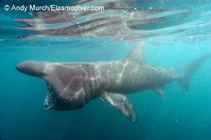 Cetorhinus maximus
Immagine di Murch, A.
Immagini | Video | Francobolli, monete, materiale vario. | Google image
Immagine di Murch, A.
Classificazione / Nomi Nomi Comuni | Sinonimi | Catalog of Fishes(Genere, Specie) | ITIS | CoL | WoRMS | Cloffa
Elasmobranchi (squali e razze) (sharks and rays) > Lamniformes (Mackerel sharks) > Cetorhinidae (Basking sharks)
Etymology: Cetorhinus: cetus (L.), from ketos (Gr.) whale, referring to its size; rhinus, an ancient name for sharks, from rhine (Gr.), rasp, alluding to a shark’s jagged, rasp-like skin (See ETYFish); maximus: Latin for greatest, being the largest known fish (i.e., non-mammalian aquatic vertebrate) at the time (superseded by Rhincodon typus) (See ETYFish).
Etymology: Cetorhinus: cetus (L.), from ketos (Gr.) whale, referring to its size; rhinus, an ancient name for sharks, from rhine (Gr.), rasp, alluding to a shark’s jagged, rasp-like skin (See ETYFish); maximus: Latin for greatest, being the largest known fish (i.e., non-mammalian aquatic vertebrate) at the time (superseded by Rhincodon typus) (See ETYFish).
Ambiente: milieu / zona climatica / distribuzione batimetrica / gamma di distribuzione Ecologia
marino pelagic-oceanic; oceanodromo (Ref. 87829); distribuzione batimetrica 0 - 2000 m (Ref. 26346), usually 0 - ? m (Ref. 55197). Temperate; 6°C - 24°C (Ref. 88171); 75°N - 58°S, 111°E - 42°E (Ref. 84930)
Distribuzione Territories | Aree FAO | Ecosistemi | Presenze | Mappa dei ritrovamenti | Introduzioni | Faunafri
Cosmopolitan, frequent in cold to warm temperate waters; rare in equatorial waters (Ref. 48844). Highly migratory species. At risk of extinction by overfishing because of low to very low productivity (Ref. 36717).
Lunghezza alla prima maturità / Dimensione / Peso / Età
Maturità: Lm 895.0, range 500 - 1000 cm
Max length : 1,520 cm TL maschio/sesso non determinato; (Ref. 247); 980.0 cm TL (female); common length : 700 cm TL maschio/sesso non determinato; (Ref. 6077); peso massimo pubblicato: 4.0 t (Ref. 4645)
Max length : 1,520 cm TL maschio/sesso non determinato; (Ref. 247); 980.0 cm TL (female); common length : 700 cm TL maschio/sesso non determinato; (Ref. 6077); peso massimo pubblicato: 4.0 t (Ref. 4645)
Breve descrizione Chiavi di identificazione | Morfologia | Morfometria
Spine dorsali (totale) : 0; Spine anali: 0. Distinguished from all other sharks by the enormous gill slits practically encircling the head; dermal denticle gill rakers; pointed snout; huge, sub terminal mouth with minute hooked teeth; caudal peduncle with strong lateral keels, and lunate caudal fin. Body covered with placoid scales. Blackish to grey-brown, grey, or blue-grey, often with irregular white blotches under the head and abdomen (Ref. 43278). Also Ref. 309, 5983.
Body shape (shape guide): elongated; Cross section: circular.
Body shape (shape guide): elongated; Cross section: circular.
The second largest shark, reportedly reaching 1,220-1,520 cm TL (Ref. 247). Thought to live up to 50 years (Ref. 9030, 89083). Semi-oceanic or oceanic species, highly migratory (Ref. 43278). Found on continental and insular shelves, offshore and often close to land, just off the surf zone; enters enclosed bays (Ref. 247). Coastal-pelagic at 1 meter to unknown depths, probably epipelagic (Ref. 58302). Occurs singly, in pairs or groups of 3 or more, or in huge schools (group of up to 100 individuals has been reported) (Ref. 6871, 43278). Prefers water temperature between 8-16 °C (Ref. 88171). Makes extensive horizontal and vertical movements along the continental shelf and shelf edge to utilize productive feeding areas (Ref. 50200). During the summer months, it is found near the surface of boreal to warm-temperate areas (Ref. 43278) feeding on zooplankton by filtering (Ref. 88781). Found in deeper waters during winter (Ref. 6871, 50200, 58302). Undertakes long transoceanic migrations (e.g. from the British Isles to Newfoundland, Canada (Ref. 88824)) and moves between the northern and southern hemisphere in tropical mesopelagic water (Ref. 88825). These migrations have been found to cover distances of over 9,000 km. May form segregations by size or sex (Ref. 88171). Ovoviviparous (Ref. 50449). Regarded as ordinarily harmless and inoffensive but potentially dangerous if attacked (particularly when harpooned) (Ref. 247). In Bay of Fundy, Canada parasitic lampreys have been found attached to the back of basking sharks and sucking their blood (Ref. 83375). Utilized fresh, frozen and dried, or salted (Ref. 9987). Also valued for its liver for oil, fins for soup, hide for leather and carcass for fishmeal (Ref. 247). May be a potential source of anti-carcinoma drugs (Ref. 6034, 6035). Used in Chinese medicine (Ref. 12166). Threatened due to bycatch fisheries (Ref. 83294).
Ciclo vitale e comportamento di accoppiamento Maturità | Riproduzione | Deposizione | Uova | Fecondità | Larve
Distinct pairing with embrace (Ref. 205). Courtship behaviour patterns associated with elasmobranch reproduction were documented from an aerial observation which include 'parallel swimming', 'pectoral biting', 'nudging', and 'male on top of female'. Other mating behaviours particular to this species from the same aerial observation include nose-to-tail following; flank approach; close approach involving rostral contact or proximity with the gill, pectoral fin, vent, and dorsum; and echelon swimming (Ref. 37026). Exhibit ovoviparity (aplacental viviparity), with embryos feeding on other ova produced by the mother (oophagy) after the yolk sac is absorbed (Ref. 50449). Estimated gestation period 12-36 months (Ref. 247, 1765, 9030, 88829); TL at birth estimated between 150-200 cm; mating thought to take place during early summer; a female giving birth to young captured in August in Norwegian waters (Ref. 5983). Over a study period of 5 years, courtship-like behaviour was observed off southwest England between May and July, always in surface waters along thermal fronts; because actual mating was not observed, this may occur in deeper water (Ref. 88831). A one-year resting period between pregnancies is thought to occur, resulting in a 2-4 year interval between litters (Ref. 9030, 1765, 88829). Only one pregnant female has been observed giving birth to a litter of 6 pups (Ref. 88830).
Riferimento principale
Caricare le referenze | Bibliografia | Coordinatore : Compagno, Leonard J.V. | Collaboratori
Compagno, L.J.V., 1984. FAO Species Catalogue. Vol. 4. Sharks of the world. An annotated and illustrated catalogue of shark species known to date. Part 1 - Hexanchiformes to Lamniformes. FAO Fish. Synop. 125(4/1):1-249. Rome, FAO. (Ref. 247)
Stato della Lista Rossa IUCN (Ref. 130435: Version 2025-2 (Global))
Endangered (EN) (A2bd); Date assessed: 07 November 2018
Minaccia per l'uomo
Traumatogenic (Ref. 247)
Usi umani
Pesca: commerciale
FAO - pesca: sbarchi, profilo della specie; Publication: search | FIRMS - Stock assessments | FishSource | Sea Around Us
Informazioni ulteriori
Ecologia trofica
Articoli alimentari (prede)
Alimentazione
Consumo di cibo
Razioni alimentari
Predatori
Articoli alimentari (prede)
Alimentazione
Consumo di cibo
Razioni alimentari
Predatori
Dinamica della popolazione
Parametri di crescita
Età massima / dimensioni massime
Rapporto lunghezza-peso.
Lunghezza-lunghezza rel.
Lunghezza-frequenze
Conversione di massa
Reclutamento
Abbondanza
Parametri di crescita
Età massima / dimensioni massime
Rapporto lunghezza-peso.
Lunghezza-lunghezza rel.
Lunghezza-frequenze
Conversione di massa
Reclutamento
Abbondanza
Ciclo di vita
Riproduzione
Maturità
Maturità/Gli occhielli sono relativi.
Fecondità
Deposizione
Aggregazioni riproduttive
Uova
Sviluppo delle uova
Larve
Dinamica popolazioni larvali
Riproduzione
Maturità
Maturità/Gli occhielli sono relativi.
Fecondità
Deposizione
Aggregazioni riproduttive
Uova
Sviluppo delle uova
Larve
Dinamica popolazioni larvali
Fisiologia
Composizione corporea
Nutrienti
Consumo di ossigeno
Tipo di nuoto
Velocità di nuoto
Pigmenti visivi
Suono del pesce
Malattie e parassiti
Tossicità (LC50)
Composizione corporea
Nutrienti
Consumo di ossigeno
Tipo di nuoto
Velocità di nuoto
Pigmenti visivi
Suono del pesce
Malattie e parassiti
Tossicità (LC50)
Legato all'uomo
Sistemi di acquacoltura
Profili di acquacoltura
Varietà
Casi di Ciguatera
Francobolli, monete, materiale vario.
Sistemi di acquacoltura
Profili di acquacoltura
Varietà
Casi di Ciguatera
Francobolli, monete, materiale vario.
Strumenti
Libro elettronico | Giuda pratica | Chiavi di identificazione | Generatore frequenze di lunghezza | Strumento Parametri Biologici | Mappa dei ritrovamenti |
Cattura-MSY |
Rapporti speciali
Controllo della manutenzione dell'acquario | Verificare la presenza di schede informative sulle specie | Verifica delle schede informative sull'acquacoltura
Scarica XML
Fonti Internet
AFORO (otoliths) | Aquatic Commons | BHL | Cloffa | Websites from users | Check FishWatcher | CISTI | Catalog of Fishes: Genere, Specie | DiscoverLife | DORIS | ECOTOX | FAO - pesca: sbarchi, profilo della specie; Publication: search | Faunafri | Fishipedia | Fishtrace | GloBI | Google Books | Google Scholar | Google | IGFA World Record | Database Nazionali | OneZoom | Open Tree of Life | Otolith Atlas of Taiwan Fishes | PubMed | Reef Life Survey | Socotra Atlas | TreeBase | Tree of Life | Wikipedia: Go, ricerca | World Records Freshwater Fishing | Record zoologico
Stime basate su modelli
Temperatura preferita (Fonte Biblio. 123201): 5.4 - 22.7, mean 11.4 °C (based on 10877 cells).
Indice di diversità filogenetica (Fonte Biblio. 82804): PD50 = 1.5000 [Uniqueness, from 0.5 = low to 2.0 = high].
Bayesian length-weight: a=0.00389 (0.00180 - 0.00842), b=3.12 (2.94 - 3.30), in cm total length, based on all LWR estimates for this body shape (Ref. 93245).
Livello trofico (Fonte Biblio. 69278): 3.2 ±0.3 se; based on diet studies.
Generation time: 17.7 ( na - na) years. Estimated as median ln(3)/K based on 1 growth studies.
Resilienza (Fonte Biblio. 120179): Molto basso, tempo minimo di raddoppiamento della popolazione più di 14 anni (Fec=1-2; Musick et al. 2000 (Ref. 36717)).
Prior r = 0.07, 95% CL = 0.04 - 0.10, Based on 2 data-limited stock assessments.
Nutrienti (Ref. 124155): Calcium = 2.25 [0.46, 11.12] mg/100g; Iron = 0.218 [0.050, 0.684] mg/100g; Protein = 19.3 [16.7, 21.8] %; Omega3 = 0.317 [0.116, 0.875] g/100g; Selenium = 38.4 [9.2, 129.2] μg/100g; VitaminA = 2.24 [0.46, 11.41] μg/100g; Zinc = 0.226 [0.103, 0.441] mg/100g (wet weight);