



Nothobranchius melanospilus (Pfeffer, 1896)
Blackspotted nothobranch
muatnaik fotos/gambar dan video
Gambar | imej Google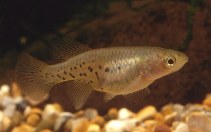 Nothobranchius melanospilus
Female foto/gambar oleh R A Hill ARPS
Gambar | imej Google
Female foto/gambar oleh R A Hill ARPS
klasifikasi / Nama Nama-nama umum | Sinonim (persamaan) | Catalog of Fishes(Marga, Jenis) | ITIS | CoL | WoRMS | Cloffa
> Cyprinodontiformes (Rivulines, killifishes and live bearers) > Nothobranchiidae (African rivulines)
Etymology: Nothobranchius: Greek, nothos = false + Greek, brangchia = gill (Ref. 45335).
Etymology: Nothobranchius: Greek, nothos = false + Greek, brangchia = gill (Ref. 45335).
Lingkungan: lingkungan / zona iklim / kisaran kedalaman / jangkauan distribusi Ekologi
; air tawar bentopelagis; nir-ruaya. Tropical; 22°C - 28°C (Ref. 2059)
Penyebaran Wilayah | Daerah-daerah FAO | Ekosistem | Kemunculan | peta titik | Introduksi | Faunafri
Africa: Unguja Island, Zanzibar archipelago, and adjacent mainland coastal rivers in eastern Tanzania (Ref. 83514, 122075); also reported from Umba and Ramisi rivers in Kenya (Ref. 83514).
Ukuran / Berat / umur
deskripsi pendek Kunci identifiaksi (pengenalan) | Morfologi | Morfometrik
Duri punggung (Keseluruhan (total)) : 0; duri punggung lunak (Keseluruhan (total)) : 15 - 17; Duri dubur: 0; Sirip dubur lunak: 16 - 19; vertebrata, bertulang belakang: 30 - 32. Diagnosis: Distinguished from all congeners by the combination of the following character states: caudal fin red with black posterior margin in males, narrow white margin to dorsal and anal fins, and silver iris; posterior portion of flank and unpaired fins with black spots in females; pre-dorsal length in males 62.4-65.1% of standard length; 5 + 15-16 gill-rakers on first branchial arch; 29-31 scales in longitudinal series; 16-18 series of scales around caudal peduncle; two longitudinal rows of scales between anterior supraorbital series of neuromasts; anterior supraorbital series of neuromasts arranged continuously, with four well-developed neuromasts; four neuromasts in posterior supraorbital series; 29-31 caudal-fin rays; 30-31 vertebrae; second proximal radial of dorsal fin between neural spines of 13th and 15th vertebrae (Ref. 83514, 122075). This species differs from Nothobranchius lucius in having a plain red caudal fin with narrow margin at the upper and lower corners in male (Ref. 83514).
Body shape (shape guide): fusiform / normal; Cross section: compressed.
Body shape (shape guide): fusiform / normal; Cross section: compressed.
Found in temporary pools in floodplains, rice fields, swamps, ditches and small streams (Ref. 3788). Found in water-filled depressions in floodplains of rivers; with vegetation often near edges, usually grasses; occasionally grasses cover the entire pool; if aquatic vegetation is present, it may comprise of Nymphea, Ottelia, Lagarosiphon, and Utricularia species; annual species; eggs deposited in substrate where they survive dry season; hatching at onset of wet season; rapid growth of fry; sexual maturity may be attained in six weeks; may be associated with other annual or non-annual fish species (Ref. 83514). Bottom spawner; 4 months incubation; difficult to maintain in aquarium (Ref. 27139).
Siklus hidup dan perilaku kawin Kematangan | Reproduksi, perkembang biakan | Pemijahan | telur-telur | Fekunditas | Larva
Annual fishes.
rujukan utama
Unggah referensi Anda | Acuan | Koordinator | mitra
Costa, W.J.E.M., 2017. Taxonomic revision of the seasonal killifish genus Nothobranchius from Zanzibar, East Africa (Cyprinodontoidei: Aplocheilidae). J. Nat. Hist. 51(27/28):1-16. (Ref. 122075)
Status IUCN Red List (Ref. 130435: Version 2025-2 (Global))
kurang bimbang (LC) ; Date assessed: 18 May 2020
CITES
Not Evaluated
ancaman kepada manusia
Harmless
penggunaan manusia
Perikanan: tidak ada kepentingan; Akuarium: Komersial
FAO - Publication: search | FishSource |
informasi lanjut
Dinamika populasi
Parameter pertumbuhan
Maks. usia / ukuran
Panjang-berat rel.
Panjang-panjang rel.
ukuran frekuensi
Konversi massa
pemulihan
Kelimpahan
Parameter pertumbuhan
Maks. usia / ukuran
Panjang-berat rel.
Panjang-panjang rel.
ukuran frekuensi
Konversi massa
pemulihan
Kelimpahan
Siklus hidup
Reproduksi, perkembang biakan
Kematangan
Kedewasaan / insang rel.
Fekunditas
Pemijahan
Agregasi pemijahan
telur-telur
pekembangan telor
Larva
Dinamika larva
Reproduksi, perkembang biakan
Kematangan
Kedewasaan / insang rel.
Fekunditas
Pemijahan
Agregasi pemijahan
telur-telur
pekembangan telor
Larva
Dinamika larva
Anatomi
Area insang
Otak
Otolith
Area insang
Otak
Otolith
Fisiologi
Komposisi tubuh
Nutrisi
Konsumsi oksigen
Jenis renang
Kecepatan berenang
Pigmen visual
Suara ikan
Penyakit & Parasit
Toksisitas (LC50)
Komposisi tubuh
Nutrisi
Konsumsi oksigen
Jenis renang
Kecepatan berenang
Pigmen visual
Suara ikan
Penyakit & Parasit
Toksisitas (LC50)
Yang berhubungan dengan manusia
Sistem akuakultur
profil budidaya air
Strain
Kasus Ciguatera
Perangko, koin, dll.
Sistem akuakultur
profil budidaya air
Strain
Kasus Ciguatera
Perangko, koin, dll.
Alat, peralatan
Kuis organik | E-book | Penuntun lapangan | tanda freqkuenci panjang | peringkat sejarah hidup | peta titik |
Tangkap-MSY |
laporan khas
muat turun XML
Sumber internet
AFORO (otoliths) | Aquatic Commons | BHL | Cloffa | Websites from users | semak peneliti ikan | CISTI | Catalog of Fishes: Marga, Jenis | DiscoverLife | ECOTOX | FAO - Publication: search | Faunafri | Fishipedia | Fishtrace | GloBI | Google Books | Google Scholar | Google | IGFA World Record | OneZoom | Open Tree of Life | Otolith Atlas of Taiwan Fishes | PubMed | Reef Life Survey | Socotra Atlas | TreeBase | Tree of Life | Wikipedia: pergi, Cari | World Records Freshwater Fishing | Catatan Zoologi
Estimasi berdasarkan model
Indeks keanekaragaman filogenetik (Acuan 82804): PD50 = 0.5000 [Uniqueness, from 0.5 = low to 2.0 = high].
Bayesian length-weight: a=0.01072 (0.00476 - 0.02414), b=2.95 (2.75 - 3.15), in cm total length, based on LWR estimates for this species & (Sub)family-body (Ref. 93245).
Tingkat Trofik (Acuan 69278): 3.3 ±0.45 se; based on food items.