



Nothobranchius melanospilus (Pfeffer, 1896)
Blackspotted nothobranch
Ladda upp din foton och Videor
Bilder | Google image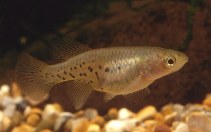 Nothobranchius melanospilus
Female Bild av R A Hill ARPS
Bilder | Google image
Female Bild av R A Hill ARPS
Klassificering / Namn Populärnamn | synonymer | Catalog of Fishes(Släkte, Arter) | ITIS | CoL | WoRMS | Cloffa
> Cyprinodontiformes (Rivulines, killifishes and live bearers) > Nothobranchiidae (African rivulines)
Etymology: Nothobranchius: Greek, nothos = false + Greek, brangchia = gill (Ref. 45335).
Etymology: Nothobranchius: Greek, nothos = false + Greek, brangchia = gill (Ref. 45335).
Miljö: miljö / Klimatzon / djupintervall / distributionsområde Ekologi
; sötvatten bentopelagisk; ej vandrande. Tropical; 22°C - 28°C (Ref. 2059)
Utbredning Territorier | FAO områden | Ekosystem | Förekomster | Prickkarta | Utplanteringar | Faunafri
Africa: Unguja Island, Zanzibar archipelago, and adjacent mainland coastal rivers in eastern Tanzania (Ref. 83514, 122075); also reported from Umba and Ramisi rivers in Kenya (Ref. 83514).
Storlek / Vikt / Ålder
Könsmognad: Lm ? range ? - ? cm
Max length : 5.0 cm SL hane/ej könsbestämd; (Ref. 122075); 5.3 cm SL (female)
Max length : 5.0 cm SL hane/ej könsbestämd; (Ref. 122075); 5.3 cm SL (female)
Kort beskrivning Bestämningsnycklar | Morfologi | Morfometri
Taggstrålar i ryggfenan (totalt) : 0; Mjukstrålar i ryggfenan (totalt) : 15 - 17; Taggstrålar i analfenan: 0; Mjukstrålar i analfenan: 16 - 19; Ryggkotor: 30 - 32. Diagnosis: Distinguished from all congeners by the combination of the following character states: caudal fin red with black posterior margin in males, narrow white margin to dorsal and anal fins, and silver iris; posterior portion of flank and unpaired fins with black spots in females; pre-dorsal length in males 62.4-65.1% of standard length; 5 + 15-16 gill-rakers on first branchial arch; 29-31 scales in longitudinal series; 16-18 series of scales around caudal peduncle; two longitudinal rows of scales between anterior supraorbital series of neuromasts; anterior supraorbital series of neuromasts arranged continuously, with four well-developed neuromasts; four neuromasts in posterior supraorbital series; 29-31 caudal-fin rays; 30-31 vertebrae; second proximal radial of dorsal fin between neural spines of 13th and 15th vertebrae (Ref. 83514, 122075). This species differs from Nothobranchius lucius in having a plain red caudal fin with narrow margin at the upper and lower corners in male (Ref. 83514).
Body shape (shape guide): fusiform / normal; Cross section: compressed.
Body shape (shape guide): fusiform / normal; Cross section: compressed.
Found in temporary pools in floodplains, rice fields, swamps, ditches and small streams (Ref. 3788). Found in water-filled depressions in floodplains of rivers; with vegetation often near edges, usually grasses; occasionally grasses cover the entire pool; if aquatic vegetation is present, it may comprise of Nymphea, Ottelia, Lagarosiphon, and Utricularia species; annual species; eggs deposited in substrate where they survive dry season; hatching at onset of wet season; rapid growth of fry; sexual maturity may be attained in six weeks; may be associated with other annual or non-annual fish species (Ref. 83514). Bottom spawner; 4 months incubation; difficult to maintain in aquarium (Ref. 27139).
Livscykel och parningsbeteende Könsmognad | Reproduktion | Lek | Ägg | Fekunditet | Larver
Annual fishes.
Huvudreferens
Ladda upp dina referenser | referenser | Koordinator | Medarbetare
Costa, W.J.E.M., 2017. Taxonomic revision of the seasonal killifish genus Nothobranchius from Zanzibar, East Africa (Cyprinodontoidei: Aplocheilidae). J. Nat. Hist. 51(27/28):1-16. (Ref. 122075)
Status på IUCN:s rödlista (Ref. 130435: Version 2025-2 (Global))
Least Concern (LC) ; Date assessed: 18 May 2020
CITES
Not Evaluated
Hot mot människor
Harmless
Mänskliga användningsområden
Fiskeri: saknar intresse; Akvarium: Kommersiell
FAO - Publication: search | FishSource |
Ytterligare information
Populationsdynamik
Tillväxtparametrar
Max. åldrar / storlekar
Längd-vikt rel.
Längd-längd rel.
Längd-frekvenser
Massakonvertering
Rekrytering
Abundans
Tillväxtparametrar
Max. åldrar / storlekar
Längd-vikt rel.
Längd-längd rel.
Längd-frekvenser
Massakonvertering
Rekrytering
Abundans
Livscykel
Reproduktion
Könsmognad
Mognad/Gills rel.
Fekunditet
Lek
Lekande aggregat
Ägg
Utveckling av ägg
Larver
Larvdynamik
Reproduktion
Könsmognad
Mognad/Gills rel.
Fekunditet
Lek
Lekande aggregat
Ägg
Utveckling av ägg
Larver
Larvdynamik
Anatomi
Gälyta
Hjärna
Otolit
Gälyta
Hjärna
Otolit
Fysiologi
Kroppssammansättning
Näringsämnen
Syreförbrukning
Typ av simning
Simhastighet
Visuella pigment
Ljud från fisk
Sjukdomar & Parasiter
Toxicitet (LC50)
Kroppssammansättning
Näringsämnen
Syreförbrukning
Typ av simning
Simhastighet
Visuella pigment
Ljud från fisk
Sjukdomar & Parasiter
Toxicitet (LC50)
Människorelaterad
Vattenbrukssystem
Vattenbruksprofiler
Avelslinjer
Ciguatera-fall
Frimärken, mynt, diverse.
Vattenbrukssystem
Vattenbruksprofiler
Avelslinjer
Ciguatera-fall
Frimärken, mynt, diverse.
Verktyg
Organisk frågesport | E-bok | Fälthandbok | Längdfördelnings-verktyg | Livshistorie-verktyg | Prickkarta |
Fångst-MSY |
Särskilda rapporter
Kontrollera för underhåll av akvarium | Kontrollera om det finns faktablad om arter | Kontrollera om det finns faktablad om vattenbruk
Ladda ner XML
Internet-källor
AFORO (otoliths) | Aquatic Commons | BHL | Cloffa | Websites from users | Check FishWatcher | CISTI | Catalog of Fishes: Släkte, Arter | DiscoverLife | ECOTOX | FAO - Publication: search | Faunafri | Fishipedia | Fishtrace | GloBI | Google Books | Google Scholar | Google | IGFA World Record | OneZoom | Open Tree of Life | Otolith Atlas of Taiwan Fishes | PubMed | Reef Life Survey | Socotra Atlas | TreeBase | Tree of Life | Wikipedia: Go, sök | World Records Freshwater Fishing | Zoologiskt register
Uppskattningar baserade på modeller
Index för fylogenetisk mångfald (Ref. 82804): PD50 = 0.5000 [Uniqueness, from 0.5 = low to 2.0 = high].
Bayesian length-weight: a=0.01072 (0.00476 - 0.02414), b=2.95 (2.75 - 3.15), in cm total length, based on LWR estimates for this species & (Sub)family-body (Ref. 93245).
Trofisk nivå (Ref. 69278): 3.3 ±0.45 se; based on food items.