



Nothobranchius melanospilus (Pfeffer, 1896)
Blackspotted nothobranch
Uploaden van uw Foto's en video's
Afbeeldingen | Google afbeelding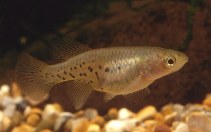 Nothobranchius melanospilus
Female Afbeelding van R A Hill ARPS
Afbeeldingen | Google afbeelding
Female Afbeelding van R A Hill ARPS
Classificatie / Namen Lokale namen | Synoniemen | Catalog of Fishes(Genus, Soort(en)) | ITIS | CoL | WoRMS | Cloffa
> Cyprinodontiformes (Rivulines, killifishes and live bearers) > Nothobranchiidae (African rivulines)
Etymology: Nothobranchius: Greek, nothos = false + Greek, brangchia = gill (Ref. 45335).
Etymology: Nothobranchius: Greek, nothos = false + Greek, brangchia = gill (Ref. 45335).
Milieu: milieu / Klimaatzone / Diepte / verspreidingsgebied Ecologie
; zoet water benthopelagisch; standvastig. Tropical; 22°C - 28°C (Ref. 2059)
Verspreiding Gebieden | FAO regio's | Ecosystemen | Voorkomen | Verspreidingskaart | Introducties | Faunafri
Africa: Unguja Island, Zanzibar archipelago, and adjacent mainland coastal rivers in eastern Tanzania (Ref. 83514, 122075); also reported from Umba and Ramisi rivers in Kenya (Ref. 83514).
Grootte / Gewicht / Leeftijd
Maturiteit: Lm ? range ? - ? cm
Max length : 5.0 cm SL mannelijk / geslacht onbekend; (Ref. 122075); 5.3 cm SL (female)
Max length : 5.0 cm SL mannelijk / geslacht onbekend; (Ref. 122075); 5.3 cm SL (female)
Korte beschrijving Determinatiesleutels | Morfologie | Morfometrie
Dorsale stekels (totaal) : 0; Dorsale zachte stralen (totaal) : 15 - 17; Anale stekels: 0; Anale zachte stralen: 16 - 19; Wervels: 30 - 32. Diagnosis: Distinguished from all congeners by the combination of the following character states: caudal fin red with black posterior margin in males, narrow white margin to dorsal and anal fins, and silver iris; posterior portion of flank and unpaired fins with black spots in females; pre-dorsal length in males 62.4-65.1% of standard length; 5 + 15-16 gill-rakers on first branchial arch; 29-31 scales in longitudinal series; 16-18 series of scales around caudal peduncle; two longitudinal rows of scales between anterior supraorbital series of neuromasts; anterior supraorbital series of neuromasts arranged continuously, with four well-developed neuromasts; four neuromasts in posterior supraorbital series; 29-31 caudal-fin rays; 30-31 vertebrae; second proximal radial of dorsal fin between neural spines of 13th and 15th vertebrae (Ref. 83514, 122075). This species differs from Nothobranchius lucius in having a plain red caudal fin with narrow margin at the upper and lower corners in male (Ref. 83514).
Body shape (shape guide): fusiform / normal; Cross section: compressed.
Body shape (shape guide): fusiform / normal; Cross section: compressed.
Found in temporary pools in floodplains, rice fields, swamps, ditches and small streams (Ref. 3788). Found in water-filled depressions in floodplains of rivers; with vegetation often near edges, usually grasses; occasionally grasses cover the entire pool; if aquatic vegetation is present, it may comprise of Nymphea, Ottelia, Lagarosiphon, and Utricularia species; annual species; eggs deposited in substrate where they survive dry season; hatching at onset of wet season; rapid growth of fry; sexual maturity may be attained in six weeks; may be associated with other annual or non-annual fish species (Ref. 83514). Bottom spawner; 4 months incubation; difficult to maintain in aquarium (Ref. 27139).
Levenscyclus en paargedrag Maturiteit | Voortplanting | Paaien | Eieren | Fecunditeit | Larven
Annual fishes.
Hoofdreferentie
Upload uw referenties | Referenties | Coördinator | Medewerkers
Costa, W.J.E.M., 2017. Taxonomic revision of the seasonal killifish genus Nothobranchius from Zanzibar, East Africa (Cyprinodontoidei: Aplocheilidae). J. Nat. Hist. 51(27/28):1-16. (Ref. 122075)
Status op de Rode Lijst van het IUCN (Ref. 130435: Version 2025-2 (Global))
Niet bedreigd (LC) ; Date assessed: 18 May 2020
CITES
Not Evaluated
Gevaar voor de mens
Harmless
Gebruik door de mens
Visserij: van geen belang; Aquarium: Commercieel
FAO - Publication: search | FishSource |
Meer informatie
Trofische ecologie
Voedsel (prooien)
Dieetsamenstelling
Voedselconsumptie
Voedselrantsoenen
Predatoren
Voedsel (prooien)
Dieetsamenstelling
Voedselconsumptie
Voedselrantsoenen
Predatoren
Populatiedynamica
Groeiparameters
Max. leeftijden / maten
Lengte-gewicht rel.
Lengte-lengte rel.
Lengtefrequenties
Massaconversie
Rekrutering
Abundantie
Groeiparameters
Max. leeftijden / maten
Lengte-gewicht rel.
Lengte-lengte rel.
Lengtefrequenties
Massaconversie
Rekrutering
Abundantie
Levenscyclus
Voortplanting
Maturiteit
Rijpheid/kieuwen rel.
Fecunditeit
Paaien
Paaibestanden
Eieren
Ontwikkeling van de eieren
Larven
Larvale populatiedynamiek
Voortplanting
Maturiteit
Rijpheid/kieuwen rel.
Fecunditeit
Paaien
Paaibestanden
Eieren
Ontwikkeling van de eieren
Larven
Larvale populatiedynamiek
Anatomie
Kieuwoppervlak
Hersenen
Otoliet
Kieuwoppervlak
Hersenen
Otoliet
Fysiologie
Lichaamssamenstelling
Voedingsstoffen
Zuurstofverbruik
Type zwemmen
Zwemsnelheid
Visuele pigmenten
Vis geluid
Ziekten en parasieten
Toxiciteit (LC50)
Lichaamssamenstelling
Voedingsstoffen
Zuurstofverbruik
Type zwemmen
Zwemsnelheid
Visuele pigmenten
Vis geluid
Ziekten en parasieten
Toxiciteit (LC50)
Menselijk gerelateerd
Aquacultuursystemen
Aquacultuurprofielen
Kweeklijnen
Ciguatera gevallen
Postzegels, munten, diversen.
Aquacultuursystemen
Aquacultuurprofielen
Kweeklijnen
Ciguatera gevallen
Postzegels, munten, diversen.
Tools
Biologische quiz | E-boek | Veldgids | Lengtefrequentie Tool | Levenscyclus tool | Verspreidingskaart |
Vangst-MSY |
Speciale rapporten
Bekijk gegevens voor het houden in een aquarium | Bekijk Fact Sheets voor de soort | Bekijk Aquacultuur Fact Sheets
Download XML
Internetbronnen
AFORO (otoliths) | Aquatic Commons | BHL | Cloffa | Websites from users | Bekijk FishWatcher | CISTI | Catalog of Fishes: Genus, Soort(en) | DiscoverLife | ECOTOX | FAO - Publication: search | Faunafri | Fishipedia | Fishtrace | GloBI | Google Books | Google Scholar | Google | IGFA World Record | OneZoom | Open Tree of Life | Otolith Atlas of Taiwan Fishes | PubMed | Reef Life Survey | Socotra Atlas | TreeBase | Tree of Life | Wikipedia: ga naar, zoek | World Records Freshwater Fishing | Zoological Record
Schattingen op basis van modellen
Fylogenetische diversiteitsindex (Ref. 82804): PD50 = 0.5000 [Uniqueness, from 0.5 = low to 2.0 = high].
Bayesian length-weight: a=0.01072 (0.00476 - 0.02414), b=2.95 (2.75 - 3.15), in cm total length, based on LWR estimates for this species & (Sub)family-body (Ref. 93245).
Trofisch niveau (Ref. 69278): 3.3 ±0.45 se; based on food items.