



Pelmatolapia mariae (Boulenger, 1899)
Spotted tilapia
Carica il tuo foto e Video
Immagini | Google image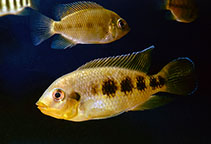 Pelmatolapia mariae
Immagine di Muséum-Aquarium de Nancy/D. Terver
Immagini | Google image
Immagine di Muséum-Aquarium de Nancy/D. Terver
Classificazione / Nomi Nomi Comuni | Sinonimi | Catalog of Fishes(Genere, Specie) | ITIS | CoL | WoRMS | Cloffa
> Cichliformes (Cichlids, convict blennies) > Cichlidae (Cichlids) > Pseudocrenilabrinae
Eponymy: Mary Henrietta Kingsley (1862–1900) was an ethnographic and scientific writer and explorer. [...] (Ref. 128868), visit book page.
More on author: Boulenger.
Eponymy: Mary Henrietta Kingsley (1862–1900) was an ethnographic and scientific writer and explorer. [...] (Ref. 128868), visit book page.
More on author: Boulenger.
Ambiente: milieu / zona climatica / distribuzione batimetrica / gamma di distribuzione Ecologia
; acqua dolce; salmastro demersale; pH range: 6.0 - 8.0; dH range: 5 - 19. Tropical; 20°C - 25°C (Ref. 1672); 9°N - 2°N, 9°W - 11°E (Ref. 55202)
Distribuzione Territories | Aree FAO | Ecosistemi | Presenze | Mappa dei ritrovamenti | Introduzioni | Faunafri
Africa: coastal lagoons and lower river courses from the Tabou River (Côte d'Ivoire) to the Kribi River (Cameroon), but absent from the area between the Pra River (Ghana) and Benin (Ref. 53405). Also recorded from the lower Ntem, Cameroon (81260).
Dimensione / Peso / Età
Maturità: Lm ? range ? - ? cm
Max length : 32.3 cm SL maschio/sesso non determinato; (Ref. 81260); common length : 17.5 cm TL maschio/sesso non determinato; (Ref. 12193); peso massimo pubblicato: 1.4 kg (Ref. 40637)
Max length : 32.3 cm SL maschio/sesso non determinato; (Ref. 81260); common length : 17.5 cm TL maschio/sesso non determinato; (Ref. 12193); peso massimo pubblicato: 1.4 kg (Ref. 40637)
Breve descrizione Chiavi di identificazione | Morfologia | Morfometria
Spine dorsali (totale) : 15 - 17; Raggi dorsali molli (totale) : 13 - 15; Spine anali: 3; Raggi anali molli: 10 - 11. Diagnosis: body rather elevated (body depth 46.9-51.6% SL) (Ref. 53405). Head profile rounded (Ref. 81260). Outer teeth on jaws bicuspid (Ref. 53405), gracile (Ref. 81260) and spatulated (Ref. 53405, 81260). Lower pharyngeal jaw teeth relatively small and narrow near posterior border of bone, forming an almost felt-like covering (Ref. 81260). Micro-gillrakers present; adults (> 150 mm) with a series of dark blotches in the middle of the flanks (sometimes body entirely blackish) (Ref. 53405, 81260). Juveniles with 7-9 large vertical bands (Ref. 53405). Ventral scales with central red spot; 12 or more rakers on lower limb of first gill arch (Ref. 81260).
Body shape (shape guide): fusiform / normal.
Body shape (shape guide): fusiform / normal.
Live in still or flowing waters in rocky or mud-bottom areas (Ref. 44894). Occur in warm springs and mud-bottomed to sand-bottomed canals (Ref. 5723). Clearly prefers a herbivorous diet, including algae, higher plants and parts of cassava, but also accepts insects and shrimps (along with their eggs) (Ref. 52307). Consume plant matter. Reache sexual maturity at 10-15 centimeters length. Parents prepare nest site on logs, leaves and other debris. Prolific species (Ref. 52307). The eggs (600-3300 per female) are guarded by the parents and hatch in 1-3 days. Larvae need 6-8 additional days to develop before they can swim freely (Ref. 52307). Parental care of the brood continues until the fish are about (1.5 cm, Ref. 52307) 2.5-3.0 centimeters (Ref. 44894). Occurs in mixed groups composed of individuals of varying size/age, along with individuals of other species (Ref. 52307). Pair-bonding, open (Ref. 52307) substrate brooder (Ref. 52307, 81260) with both parents guarding the brood (Ref. 52307). Maximum size was recorded at 39.4 cm TL (Ref. 40637).
Ciclo vitale e comportamento di accoppiamento Maturità | Riproduzione | Deposizione | Uova | Fecondità | Larve
Produces up to 2000 eggs.
Riferimento principale
Caricare le referenze | Bibliografia | Coordinatore : Kullander, Sven O. | Collaboratori
Dunz, A.R. and U.K. Schliewen, 2013. Molecular phylogeny and revised classification of the haplotilapiine cichlid fishes formerly referred to as "Tilapia". Mol. Phylogenet. Evol. 68(1):64-80. (Ref. 93285)
Stato della Lista Rossa IUCN (Ref. 130435: Version 2025-2 (Global))
Least Concern (LC) ; Date assessed: 16 October 2019
CITES
Not Evaluated
Minaccia per l'uomo
Harmless
Usi umani
Pesce da pesca sportiva: si; Acquario: Commerciale
FAO - Publication: search | FishSource |
Informazioni ulteriori
Ecologia trofica
Articoli alimentari (prede)
Alimentazione
Consumo di cibo
Razioni alimentari
Predatori
Articoli alimentari (prede)
Alimentazione
Consumo di cibo
Razioni alimentari
Predatori
Ecologia
Ecologia
Ecologia
Dinamica della popolazione
Parametri di crescita
Età massima / dimensioni massime
Rapporto lunghezza-peso.
Lunghezza-lunghezza rel.
Lunghezza-frequenze
Conversione di massa
Reclutamento
Abbondanza
Parametri di crescita
Età massima / dimensioni massime
Rapporto lunghezza-peso.
Lunghezza-lunghezza rel.
Lunghezza-frequenze
Conversione di massa
Reclutamento
Abbondanza
Ciclo di vita
Riproduzione
Maturità
Maturità/Gli occhielli sono relativi.
Fecondità
Deposizione
Aggregazioni riproduttive
Uova
Sviluppo delle uova
Larve
Dinamica popolazioni larvali
Riproduzione
Maturità
Maturità/Gli occhielli sono relativi.
Fecondità
Deposizione
Aggregazioni riproduttive
Uova
Sviluppo delle uova
Larve
Dinamica popolazioni larvali
Anatomia
Area branchiale
Cervello
Otolite
Area branchiale
Cervello
Otolite
Fisiologia
Composizione corporea
Nutrienti
Consumo di ossigeno
Tipo di nuoto
Velocità di nuoto
Pigmenti visivi
Suono del pesce
Malattie e parassiti
Tossicità (LC50)
Composizione corporea
Nutrienti
Consumo di ossigeno
Tipo di nuoto
Velocità di nuoto
Pigmenti visivi
Suono del pesce
Malattie e parassiti
Tossicità (LC50)
Legato all'uomo
Sistemi di acquacoltura
Profili di acquacoltura
Varietà
Casi di Ciguatera
Francobolli, monete, materiale vario.
Sistemi di acquacoltura
Profili di acquacoltura
Varietà
Casi di Ciguatera
Francobolli, monete, materiale vario.
Strumenti
Libro elettronico | Giuda pratica | Chiavi di identificazione | Generatore frequenze di lunghezza | Strumento Parametri Biologici | Mappa dei ritrovamenti |
Cattura-MSY |
Rapporti speciali
Controllo della manutenzione dell'acquario | Verificare la presenza di schede informative sulle specie | Verifica delle schede informative sull'acquacoltura
Scarica XML
Fonti Internet
AFORO (otoliths) | Alien/Invasive Species database | Aquatic Commons | BHL | Cloffa | Websites from users | Check FishWatcher | CISTI | Catalog of Fishes: Genere, Specie | DiscoverLife | ECOTOX | FAO - Publication: search | Faunafri | Fishipedia | Fishtrace | GloBI | Google Books | Google Scholar | Google | IGFA World Record | OneZoom | Open Tree of Life | Otolith Atlas of Taiwan Fishes | Acquari pubblici | PubMed | Reef Life Survey | Socotra Atlas | TreeBase | Tree of Life | Wikipedia: Go, ricerca | World Records Freshwater Fishing | Record zoologico
Stime basate su modelli
Indice di diversità filogenetica (Fonte Biblio. 82804): PD50 = 0.7500 [Uniqueness, from 0.5 = low to 2.0 = high].
Bayesian length-weight: a=0.01585 (0.01361 - 0.01845), b=3.00 (2.96 - 3.04), in cm total length, based on LWR estimates for this species (Ref. 93245).
Livello trofico (Fonte Biblio. 69278): 3.5 ±0.5 se; based on size and trophs of closest relatives
Generation time: 2.4 ( na - na) years. Estimated as median ln(3)/K based on 1 growth studies.
Resilienza (Fonte Biblio. 120179): Medio, tempo minimo di raddoppiamento della popolazione 1.4 - 4.4 anni (Fec = 2,000).
Nutrienti (Ref. 124155): Calcium = 195 [105, 334] mg/100g; Iron = 1.41 [0.84, 2.69] mg/100g; Protein = 18.6 [17.1, 20.0] %; Omega3 = 0.247 [0.139, 0.509] g/100g; Selenium = 47.5 [28.7, 82.9] μg/100g; VitaminA = 15.7 [4.6, 38.4] μg/100g; Zinc = 1.8 [1.3, 2.7] mg/100g (wet weight);