



Pelmatolapia mariae (Boulenger, 1899)
Spotted tilapia
Carregue seu(sua) Fotos e vídeos
Fotos | Imagem do Google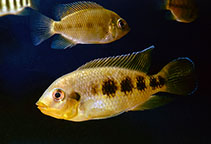 Pelmatolapia mariae
Foto de Muséum-Aquarium de Nancy/D. Terver
Fotos | Imagem do Google
Foto de Muséum-Aquarium de Nancy/D. Terver
Classificação / Nomes Nomes comuns | Sinônimos | Catalog of Fishes(Gênero, Espécies) | ITIS | CoL | WoRMS | Cloffa
> Cichliformes (Cichlids, convict blennies) > Cichlidae (Cichlids) > Pseudocrenilabrinae
Eponymy: Mary Henrietta Kingsley (1862–1900) was an ethnographic and scientific writer and explorer. [...] (Ref. 128868), visit book page.
More on author: Boulenger.
Eponymy: Mary Henrietta Kingsley (1862–1900) was an ethnographic and scientific writer and explorer. [...] (Ref. 128868), visit book page.
More on author: Boulenger.
Meio ambiente: milieu / Zona climática / intervalo de profundidade / faixa de distribuição Ecologia
; Água doce; estuarina demersal; pH range: 6.0 - 8.0; dH range: 5 - 19. Tropical; 20°C - 25°C (Ref. 1672); 9°N - 2°N, 9°W - 11°E (Ref. 55202)
Distribuição Territórios | Áreas da FAO | Ecossistemas | Ocorrências | Mapa de pontos | Introduções | Faunafri
Africa: coastal lagoons and lower river courses from the Tabou River (Côte d'Ivoire) to the Kribi River (Cameroon), but absent from the area between the Pra River (Ghana) and Benin (Ref. 53405). Also recorded from the lower Ntem, Cameroon (81260).
Tamanho / Peso / Idade
Maturidade: Lm ? range ? - ? cm
Max length : 32.3 cm SL macho/indeterminado; (Ref. 81260); common length : 17.5 cm TL macho/indeterminado; (Ref. 12193); peso máx. publicado: 1.4 kg (Ref. 40637)
Max length : 32.3 cm SL macho/indeterminado; (Ref. 81260); common length : 17.5 cm TL macho/indeterminado; (Ref. 12193); peso máx. publicado: 1.4 kg (Ref. 40637)
Descrição suscinta Chaves de identificação | Morfologia | Morfometria
Espinhos dorsais (total) : 15 - 17; Raios dorsais (total) : 13 - 15; Espinhos anais: 3; Raios anais : 10 - 11. Diagnosis: body rather elevated (body depth 46.9-51.6% SL) (Ref. 53405). Head profile rounded (Ref. 81260). Outer teeth on jaws bicuspid (Ref. 53405), gracile (Ref. 81260) and spatulated (Ref. 53405, 81260). Lower pharyngeal jaw teeth relatively small and narrow near posterior border of bone, forming an almost felt-like covering (Ref. 81260). Micro-gillrakers present; adults (> 150 mm) with a series of dark blotches in the middle of the flanks (sometimes body entirely blackish) (Ref. 53405, 81260). Juveniles with 7-9 large vertical bands (Ref. 53405). Ventral scales with central red spot; 12 or more rakers on lower limb of first gill arch (Ref. 81260).
Body shape (shape guide): fusiform / normal.
Body shape (shape guide): fusiform / normal.
Live in still or flowing waters in rocky or mud-bottom areas (Ref. 44894). Occur in warm springs and mud-bottomed to sand-bottomed canals (Ref. 5723). Clearly prefers a herbivorous diet, including algae, higher plants and parts of cassava, but also accepts insects and shrimps (along with their eggs) (Ref. 52307). Consume plant matter. Reache sexual maturity at 10-15 centimeters length. Parents prepare nest site on logs, leaves and other debris. Prolific species (Ref. 52307). The eggs (600-3300 per female) are guarded by the parents and hatch in 1-3 days. Larvae need 6-8 additional days to develop before they can swim freely (Ref. 52307). Parental care of the brood continues until the fish are about (1.5 cm, Ref. 52307) 2.5-3.0 centimeters (Ref. 44894). Occurs in mixed groups composed of individuals of varying size/age, along with individuals of other species (Ref. 52307). Pair-bonding, open (Ref. 52307) substrate brooder (Ref. 52307, 81260) with both parents guarding the brood (Ref. 52307). Maximum size was recorded at 39.4 cm TL (Ref. 40637).
Ciclo de vida ou comportamento de acasalamento Maturidade | Reprodução | Desova | Ovos | Fecundidade | Larvas
Produces up to 2000 eggs.
Referência principal
Carregar suas referências | Referências | Coordenador : Kullander, Sven O. | Colaboradores
Dunz, A.R. and U.K. Schliewen, 2013. Molecular phylogeny and revised classification of the haplotilapiine cichlid fishes formerly referred to as "Tilapia". Mol. Phylogenet. Evol. 68(1):64-80. (Ref. 93285)
Status na Lista Vermelha da UICN (Ref. 130435: Version 2025-2 (Global))
Segura ou pouco preocupante (LC) ; Date assessed: 16 October 2019
CITES
Not Evaluated
Ameaça para os humanos
Harmless
Uso pelos humanos
Peixe esportivo: sim; Aquário: Espécies comerciais
FAO - Publication: search | FishSource |
Mais informação
Ecologia Trófica
Itens alimentares (presas)
Composição da dieta
Consumo alimentar
Rações alimentares
Predadores
Itens alimentares (presas)
Composição da dieta
Consumo alimentar
Rações alimentares
Predadores
Ecologia
Ecologia
Ecologia
Dinâmica populacional
Parâmetros de crescimento
Idade máxima / tamanhos
Relação comprimento-peso.
Relação comprimento-comprimento.
Frequências de comprimento
Conversão de massa
Recrutamento
Abundância
Parâmetros de crescimento
Idade máxima / tamanhos
Relação comprimento-peso.
Relação comprimento-comprimento.
Frequências de comprimento
Conversão de massa
Recrutamento
Abundância
Ciclo de vida
Reprodução
Maturidade
Maturidade/Rel. das guelras
Fecundidade
Desova
Agregações de desova
Ovos
Desenvolvimento dos ovos
Larvas
Dinâmica larval
Reprodução
Maturidade
Maturidade/Rel. das guelras
Fecundidade
Desova
Agregações de desova
Ovos
Desenvolvimento dos ovos
Larvas
Dinâmica larval
Anatomia
Área branquial
Cérebro
Otólito
Área branquial
Cérebro
Otólito
Fisiologia
Composição corporal
Nutrientes
Consumo de oxigênio
Tipo de natação
Velocidade de natação
Pigmentos visuais
Som de peixe
Doenças e Parasitas
Toxicidade (LC50s)
Composição corporal
Nutrientes
Consumo de oxigênio
Tipo de natação
Velocidade de natação
Pigmentos visuais
Som de peixe
Doenças e Parasitas
Toxicidade (LC50s)
Relacionado a humanos
Sistemas de aquicultura
Perfis para aquacultura
Estirpes
Casos de Ciguatera
Selos, moedas, diversos.
Sistemas de aquicultura
Perfis para aquacultura
Estirpes
Casos de Ciguatera
Selos, moedas, diversos.
Ferramentas
Livro eletrônico | Guia de campo | Chaves de identificação | Ferramenta auxiliar de frequências de comprimento | Ferramenta sobre a história de vida | Mapa de pontos |
Catch-MSY |
Relatórios especiais
Checar Manutenção em Aquário | Checar Planilhas de Fatos sobre as Espécies | Checar Planilhas de Fatos sobre Aquicultura
Baixar XML
Fontes da internet
AFORO (otoliths) | Banco de dados para Espécies Aliens/Invasivas | Aquatic Commons | BHL | Cloffa | Websites from users | Checar Observador de Peixes (FishWatcher) | CISTI | Catalog of Fishes: Gênero, Espécies | DiscoverLife | ECOTOX | FAO - Publication: search | Faunafri | Fishipedia | Fishtrace | GloBI | Google Books | Google Scholar | Google | IGFA World Record | OneZoom | Open Tree of Life | Otolith Atlas of Taiwan Fishes | Aquários públicos | PubMed | Reef Life Survey | Socotra Atlas | TreeBase | Árvore da vida | Wikipedia: Ir para, procura | World Records Freshwater Fishing | Registro zoológico
Estimativas baseadas em modelos
Índice de diversidade filogenética (Ref. 82804): PD50 = 0.7500 [Uniqueness, from 0.5 = low to 2.0 = high].
Bayesian length-weight: a=0.01585 (0.01361 - 0.01845), b=3.00 (2.96 - 3.04), in cm total length, based on LWR estimates for this species (Ref. 93245).
Nível Trófico (Ref. 69278): 3.5 ±0.5 se; based on size and trophs of closest relatives
Generation time: 2.4 ( na - na) years. Estimated as median ln(3)/K based on 1 growth studies.
Resiliência (Ref. 120179): médio(a), tempo mínimo de duplicação da população 1,4 - 4,4 anos (Fec = 2,000).
Nutrientes (Ref. 124155): Calcium = 195 [105, 334] mg/100g; Iron = 1.41 [0.84, 2.69] mg/100g; Protein = 18.6 [17.1, 20.0] %; Omega3 = 0.247 [0.139, 0.509] g/100g; Selenium = 47.5 [28.7, 82.9] μg/100g; VitaminA = 15.7 [4.6, 38.4] μg/100g; Zinc = 1.8 [1.3, 2.7] mg/100g (wet weight);