



Occidentis hubbsi (Vladykov & Kott, 1976)
Kern brook lamprey
Envoyez vos Photos et vidéos
Images | Images Google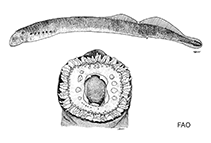 Occidentis hubbsi
Male Photo de FAO
Images | Images Google
Male Photo de FAO
Classification / Noms Noms communs | Synonymes | Catalog of Fishes(Genre, Espèce) | ITIS | CoL | WoRMS | Cloffa
> Petromyzontiformes (Lampreys) > Petromyzontidae (Northern lampreys) > Lampetrinae
Etymology: hubbsi: In honor of American ichthyologist Carl L. Hubbs (1894-1979), “distinguished friend and a keen student of lamprey taxonomy” [placed in Entosphenus by some workers] (See ETYFish).
Eponymy: Professor Carl Levitt (Leavitt) Hubbs (1894–1979) was a giant of American ichthyology. [...] (Ref. 128868), visit book page.
Etymology: hubbsi: In honor of American ichthyologist Carl L. Hubbs (1894-1979), “distinguished friend and a keen student of lamprey taxonomy” [placed in Entosphenus by some workers] (See ETYFish).
Eponymy: Professor Carl Levitt (Leavitt) Hubbs (1894–1979) was a giant of American ichthyology. [...] (Ref. 128868), visit book page.
Environnement : milieu / zone climatique / profondeur / gamme de distribution Écologie
; eau douce démersal; potamodrome (Ref. 126106). Temperate; 38°N - 36°N
Distribution Territoires | Zones FAO | Écosystèmes | Occurrences | Carte par point | Introductions | Faunafri
North America: East side of San Joaquin Valley in lower Merced, Kaweah, Kings, and San Joaquin rivers in California, USA.
Taille / Poids / Âge
Maturité: Lm ? range ? - ? cm
Max length : 14.2 cm TL mâle / non sexé; (Ref. 89241); common length : 12.9 cm TL mâle / non sexé; (Ref. 12193)
Max length : 14.2 cm TL mâle / non sexé; (Ref. 89241); common length : 12.9 cm TL mâle / non sexé; (Ref. 12193)
Description synthétique Clés d'identification | Morphologie | Morphométrie
Épines dorsales (Total) : 0; Épines anales: 0. Characterized by having expanded oral disc narrower than head, usually 52-56 trunk myomeres, 2 supraoral teeth, usually 1-1-1-1 lateral circumoral teeth, 9-12 unicuspid posterior circumoral teeth, 5 infraoral teeth and coloration consisting of gray to brown above, white below, black specks on dorsal and caudal fins, and no black on lateral-line pores (Ref. 86798). Adults: 8.1-14.2 cm TL; body proportions (percentage of TL based on 127 specimens 8.1-14.2 cm TL): 7.8-14.4 prebranchial length, 8.5-12.8 branchial length, 44.6-56.9 trunk length, 24.3-30.8 tail length, 0.8-2.8 eye length and 3.7-8.7 disc length, 8.3-16.7 urogenital papilla length (percentage of branchial length in 9 spawning males 10.6-12.4 cm TL); trunk myomeres, 50-57. Adult dentition: supraoral lamina, 2 unicuspid teeth, rarely 3; infraoral lamina, 4-unicuspid teeth, usually 5; 4 endolaterals on each side, rarely 3; endolateral formula, typically 1-1-1-1, the first endolateral may also be bicuspid, the second and third endolaterals bi- or tricuspid, and the fourth bicuspid, however, no endolateral formula of 2-3-3-2 was encountered in 40 individuals examined; 2 row of anterials, 3-9 unicuspid teeth in total, three of these in the first row; exolaterals absent; 1 row of posterials, 8-12 unicuspid teeth in a continuous (complete) row or discontinuous (incomplete) row of only six unicuspid teeth; transverse lingual lamina, cusps too poorly developed to count, however, the median one not enlarged; longitudinal lingual laminae, cusps too poorly developed to count. Velar tentacles in adults, 3-5, with tubercles; median velar tentacle shorter than the lateral ones immediately next to it; no velar wings; body coloration (preserved), gray-brown on dorsal and lateral aspects, whitish on ventral aspect; extent of caudal fin pigmentation, 1% to <25%; caudal fin shape, rounded (Ref. 89241).
Body shape (shape guide): eel-like.
Body shape (shape guide): eel-like.
Adults inhabit silty backwaters of rivers and spawns in gravel riffles (Ref. 86798). Both the larval and adult stages were originally collected from the Friant-Kern Canal, which is 85% concrete lined and has a discharge greater than 57 m3/sec; an artificial habitat. Adults occur in the Merced River, which should be considered typical habitat. Adults nonparasitic (Ref. 89241).
Cycle de vie et comportement reproducteur Maturité | Reproduction | Frai | Œufs | Fécondité | Larves
Référence principale
Téléchargez vos références | Références | Coordinateur | Collaborateurs
Page, L.M. and B.M. Burr, 1991. A field guide to freshwater fishes of North America north of Mexico. Houghton Mifflin Company, Boston. 432 p. (Ref. 5723)
Statut dans la liste rouge de l'IUCN (Ref. 130435: Version 2025-2 (Global))
Vulnérable (VU) (B1ab(iii)+2ab(iii)); Date assessed: 21 February 2012
CITES
Not Evaluated
Menace pour l'homme
Harmless
Utilisations par l'homme
Pêcheries: sans intérêt
FAO - Publication: search | FishSource |
Plus d'informations
Écologie trophique
Aliments (proies)
Composition du régime alimentaire
Consommation alimentaire
Rations alimentaires
Prédateurs
Aliments (proies)
Composition du régime alimentaire
Consommation alimentaire
Rations alimentaires
Prédateurs
Écologie
Écologie
Écologie
Dynamique des populations
Paramètres de croissance
Âges / tailles maximales
Longueur-poids rel.
Rel. longueur-longueur.
Fréquences de longueurs
Conversion de masse
Recrutement
Abondance
Paramètres de croissance
Âges / tailles maximales
Longueur-poids rel.
Rel. longueur-longueur.
Fréquences de longueurs
Conversion de masse
Recrutement
Abondance
Cycle de vie
Reproduction
Maturité
Maturité/épines rel.
Fécondité
Frai
Agrégats de frai
Œufs
Développement de l'œuf
Larves
Dynamique des populations larvaires
Reproduction
Maturité
Maturité/épines rel.
Fécondité
Frai
Agrégats de frai
Œufs
Développement de l'œuf
Larves
Dynamique des populations larvaires
Anatomie
Surface branchiale
Cerveau
Otolithe
Surface branchiale
Cerveau
Otolithe
Physiologie
Composition corporelle
Nutriments
Consommation d'oxygène
Type de natation
Vitesse de nage
Pigments visuels
Son de poisson
Maladies et parasites
Toxicité (CL50)
Composition corporelle
Nutriments
Consommation d'oxygène
Type de natation
Vitesse de nage
Pigments visuels
Son de poisson
Maladies et parasites
Toxicité (CL50)
Génétique
génôme
Génétique
Hétérozygotie
Héritabilité
Diversité génétique
génôme
Génétique
Hétérozygotie
Héritabilité
Diversité génétique
Liées à l'homme
Systèmes d'aquaculture
Profils d'aquaculture
Souches
Cas de ciguatera
Timbres, pièces de monnaie, divers
Systèmes d'aquaculture
Profils d'aquaculture
Souches
Cas de ciguatera
Timbres, pièces de monnaie, divers
Outils
E-book | Guide de terrain | Clés d'identification | Générateur de fréquences de longueur | Outil de dynamique de population | Carte par point |
Capture-MSY |
Articles particuliers
Télécharger en XML
Sources Internet
AFORO (otoliths) | Aquatic Commons | BHL | Cloffa | Websites from users | FishWatcher | CISTI | Catalog of Fishes: Genre, Espèce | DiscoverLife | ECOTOX | FAO - Publication: search | Faunafri | Fishipedia | Fishtrace | GloBI | Google Books | Google Scholar | Google | IGFA World Record | OneZoom | Open Tree of Life | Otolith Atlas of Taiwan Fishes | PubMed | Reef Life Survey | Socotra Atlas | TreeBase | Arbre de Vie | Wikipedia: aller à, chercher | World Records Freshwater Fishing | Zoological Record
Estimations basées sur des modèles
Indice de diversité phylogénétique (Réf. 82804): PD50 = 0.6250 [Uniqueness, from 0.5 = low to 2.0 = high].
Bayesian length-weight: a=0.00132 (0.00060 - 0.00290), b=2.99 (2.80 - 3.18), in cm total length, based on LWR estimates for this (Sub)family-body shape (Ref. 93245).
Niveau trophique (Réf. 69278): 3.8 ±0.8 se; based on size and trophs of closest relatives
Résilience (Réf. 120179): Faible, temps minimum de doublement de population : 4,5 à 14 années (Semelparous species, assuming tm (= tmax) > 4).