



Occidentis hubbsi (Vladykov & Kott, 1976)
Kern brook lamprey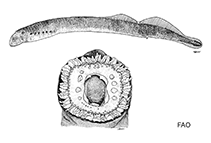
分類 / 名前 共通名の | 類義語 | Catalog of Fishes(部類, 種) | ITIS | CoL | WoRMS | Cloffa
> Petromyzontiformes (Lampreys) > Petromyzontidae (Northern lampreys) > Lampetrinae
Etymology: hubbsi: In honor of American ichthyologist Carl L. Hubbs (1894-1979), “distinguished friend and a keen student of lamprey taxonomy” [placed in Entosphenus by some workers] (See ETYFish).
Eponymy: Professor Carl Levitt (Leavitt) Hubbs (1894–1979) was a giant of American ichthyology. [...] (Ref. 128868), visit book page.
Etymology: hubbsi: In honor of American ichthyologist Carl L. Hubbs (1894-1979), “distinguished friend and a keen student of lamprey taxonomy” [placed in Entosphenus by some workers] (See ETYFish).
Eponymy: Professor Carl Levitt (Leavitt) Hubbs (1894–1979) was a giant of American ichthyology. [...] (Ref. 128868), visit book page.
環境:環境 / 気候帯 / 深さの範囲 / 分布範囲 生態学
; 新鮮な水 底生の; potamodromous (Ref. 126106). Temperate; 38°N - 36°N
分布 領土 | 国連食糧農業機関の区域 | エコシステム | 事件 | 目的のマップ | 導入 | Faunafri
North America: East side of San Joaquin Valley in lower Merced, Kaweah, Kings, and San Joaquin rivers in California, USA.
サイズ / 重さ / 年齢
成熟: Lm ? range ? - ? cm
Max length : 14.2 cm TL オス/雌雄の選別がない; (Ref. 89241); common length : 12.9 cm TL オス/雌雄の選別がない; (Ref. 12193)
Max length : 14.2 cm TL オス/雌雄の選別がない; (Ref. 89241); common length : 12.9 cm TL オス/雌雄の選別がない; (Ref. 12193)
簡単な記述 検索表 | 形態学 | 形態計測学
背面の脊椎 (合計) : 0; 肛門の骨: 0. Characterized by having expanded oral disc narrower than head, usually 52-56 trunk myomeres, 2 supraoral teeth, usually 1-1-1-1 lateral circumoral teeth, 9-12 unicuspid posterior circumoral teeth, 5 infraoral teeth and coloration consisting of gray to brown above, white below, black specks on dorsal and caudal fins, and no black on lateral-line pores (Ref. 86798). Adults: 8.1-14.2 cm TL; body proportions (percentage of TL based on 127 specimens 8.1-14.2 cm TL): 7.8-14.4 prebranchial length, 8.5-12.8 branchial length, 44.6-56.9 trunk length, 24.3-30.8 tail length, 0.8-2.8 eye length and 3.7-8.7 disc length, 8.3-16.7 urogenital papilla length (percentage of branchial length in 9 spawning males 10.6-12.4 cm TL); trunk myomeres, 50-57. Adult dentition: supraoral lamina, 2 unicuspid teeth, rarely 3; infraoral lamina, 4-unicuspid teeth, usually 5; 4 endolaterals on each side, rarely 3; endolateral formula, typically 1-1-1-1, the first endolateral may also be bicuspid, the second and third endolaterals bi- or tricuspid, and the fourth bicuspid, however, no endolateral formula of 2-3-3-2 was encountered in 40 individuals examined; 2 row of anterials, 3-9 unicuspid teeth in total, three of these in the first row; exolaterals absent; 1 row of posterials, 8-12 unicuspid teeth in a continuous (complete) row or discontinuous (incomplete) row of only six unicuspid teeth; transverse lingual lamina, cusps too poorly developed to count, however, the median one not enlarged; longitudinal lingual laminae, cusps too poorly developed to count. Velar tentacles in adults, 3-5, with tubercles; median velar tentacle shorter than the lateral ones immediately next to it; no velar wings; body coloration (preserved), gray-brown on dorsal and lateral aspects, whitish on ventral aspect; extent of caudal fin pigmentation, 1% to <25%; caudal fin shape, rounded (Ref. 89241).
Body shape (shape guide): eel-like.
Body shape (shape guide): eel-like.
Adults inhabit silty backwaters of rivers and spawns in gravel riffles (Ref. 86798). Both the larval and adult stages were originally collected from the Friant-Kern Canal, which is 85% concrete lined and has a discharge greater than 57 m3/sec; an artificial habitat. Adults occur in the Merced River, which should be considered typical habitat. Adults nonparasitic (Ref. 89241).
ライフサイクルと交尾行動 成熟 | 繁殖 | 放精 | 卵 | 生産力 | 幼生
主な参考文献
参考文献のアップロード | 参考文献 | コーディネーター | 協力者
Page, L.M. and B.M. Burr, 1991. A field guide to freshwater fishes of North America north of Mexico. Houghton Mifflin Company, Boston. 432 p. (Ref. 5723)
IUCNのレッドリストの状況は (Ref. 130435: Version 2025-2 (Global))
脆弱 (VU) (B1ab(iii)+2ab(iii)); Date assessed: 21 February 2012
CITES
Not Evaluated
人間に対する脅威
Harmless
人間の用途
水産業: 興味がない
FAO - Publication: search | FishSource |
より多くの情報
解剖学
カマ
脳
オトリス
カマ
脳
オトリス
生理学
体組成
栄養素
酸素消費
水泳タイプ
泳ぐ速さ
視覚色素
フィッシュ・サウンド
病気と寄生虫
毒性(LC50)
体組成
栄養素
酸素消費
水泳タイプ
泳ぐ速さ
視覚色素
フィッシュ・サウンド
病気と寄生虫
毒性(LC50)
遺伝子の
ゲノム
遺伝子の
ヘテロ接合性
遺伝
遺伝的多様性
ゲノム
遺伝子の
ヘテロ接合性
遺伝
遺伝的多様性
用具
特記事項
XMLをダウンロードして下さい
インターネットの情報源
AFORO (otoliths) | Aquatic Commons | BHL | Cloffa | Websites from users | Check FishWatcher | CISTI | Catalog of Fishes: 部類, 種 | DiscoverLife | ECOTOX | FAO - Publication: search | Faunafri | Fishipedia | Fishtrace | GloBI | Google Books | Google Scholar | Google | IGFA World Record | OneZoom | Open Tree of Life | Otolith Atlas of Taiwan Fishes | PubMed | Reef Life Survey | Socotra Atlas | TreeBase | 生命の木 | Wikipedia: 行く, 検索する | World Records Freshwater Fishing | 動物に関する記録
モデルに基づく推定値
系統多様性指数 (参照 82804): PD50 = 0.6250 [Uniqueness, from 0.5 = low to 2.0 = high].
Bayesian length-weight: a=0.00132 (0.00060 - 0.00290), b=2.99 (2.80 - 3.18), in cm total length, based on LWR estimates for this (Sub)family-body shape (Ref. 93245).
栄養段階 (参照 69278): 3.8 ±0.8 se; based on size and trophs of closest relatives
回復力 (参照 120179): 低い, 4.5年~14年の倍増期間の最小個体群 (Semelparous species, assuming tm (= tmax) > 4).