



Occidentis hubbsi (Vladykov & Kott, 1976)
Kern brook lamprey
Adicionar o seu Fotografias e vídeos
Fotografias | Imagem do Google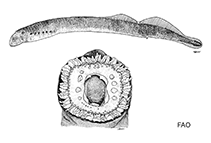 Occidentis hubbsi
Male Fotografia de FAO
Fotografias | Imagem do Google
Male Fotografia de FAO
Classificação / Nomes Nomes comuns | Sinónimos | Catalog of Fishes(Género, Espécies) | ITIS | CoL | WoRMS | Cloffa
> Petromyzontiformes (Lampreys) > Petromyzontidae (Northern lampreys) > Lampetrinae
Etymology: hubbsi: In honor of American ichthyologist Carl L. Hubbs (1894-1979), “distinguished friend and a keen student of lamprey taxonomy” [placed in Entosphenus by some workers] (See ETYFish).
Eponymy: Professor Carl Levitt (Leavitt) Hubbs (1894–1979) was a giant of American ichthyology. [...] (Ref. 128868), visit book page.
Etymology: hubbsi: In honor of American ichthyologist Carl L. Hubbs (1894-1979), “distinguished friend and a keen student of lamprey taxonomy” [placed in Entosphenus by some workers] (See ETYFish).
Eponymy: Professor Carl Levitt (Leavitt) Hubbs (1894–1979) was a giant of American ichthyology. [...] (Ref. 128868), visit book page.
Ambiente: milieu / zona climática / intervalo de profundidade / gama de distribuição Ecologia
; Água doce demersal; potamódromo (Ref. 126106). Temperate; 38°N - 36°N
Distribuição Territórios | Áreas FAO | Ecossistemas | Ocorrências | Mapa dos pontos | Introduções | Faunafri
North America: East side of San Joaquin Valley in lower Merced, Kaweah, Kings, and San Joaquin rivers in California, USA.
Tamanho / Peso / Idade
Maturidade: Lm ? range ? - ? cm
Max length : 14.2 cm TL macho/indeterminado; (Ref. 89241); common length : 12.9 cm TL macho/indeterminado; (Ref. 12193)
Max length : 14.2 cm TL macho/indeterminado; (Ref. 89241); common length : 12.9 cm TL macho/indeterminado; (Ref. 12193)
Descrição breve Chaves de identificação | Morfologia | Morfometria
Espinhos dorsais (total) : 0; Espinhos anais: 0. Characterized by having expanded oral disc narrower than head, usually 52-56 trunk myomeres, 2 supraoral teeth, usually 1-1-1-1 lateral circumoral teeth, 9-12 unicuspid posterior circumoral teeth, 5 infraoral teeth and coloration consisting of gray to brown above, white below, black specks on dorsal and caudal fins, and no black on lateral-line pores (Ref. 86798). Adults: 8.1-14.2 cm TL; body proportions (percentage of TL based on 127 specimens 8.1-14.2 cm TL): 7.8-14.4 prebranchial length, 8.5-12.8 branchial length, 44.6-56.9 trunk length, 24.3-30.8 tail length, 0.8-2.8 eye length and 3.7-8.7 disc length, 8.3-16.7 urogenital papilla length (percentage of branchial length in 9 spawning males 10.6-12.4 cm TL); trunk myomeres, 50-57. Adult dentition: supraoral lamina, 2 unicuspid teeth, rarely 3; infraoral lamina, 4-unicuspid teeth, usually 5; 4 endolaterals on each side, rarely 3; endolateral formula, typically 1-1-1-1, the first endolateral may also be bicuspid, the second and third endolaterals bi- or tricuspid, and the fourth bicuspid, however, no endolateral formula of 2-3-3-2 was encountered in 40 individuals examined; 2 row of anterials, 3-9 unicuspid teeth in total, three of these in the first row; exolaterals absent; 1 row of posterials, 8-12 unicuspid teeth in a continuous (complete) row or discontinuous (incomplete) row of only six unicuspid teeth; transverse lingual lamina, cusps too poorly developed to count, however, the median one not enlarged; longitudinal lingual laminae, cusps too poorly developed to count. Velar tentacles in adults, 3-5, with tubercles; median velar tentacle shorter than the lateral ones immediately next to it; no velar wings; body coloration (preserved), gray-brown on dorsal and lateral aspects, whitish on ventral aspect; extent of caudal fin pigmentation, 1% to <25%; caudal fin shape, rounded (Ref. 89241).
Body shape (shape guide): eel-like.
Body shape (shape guide): eel-like.
Adults inhabit silty backwaters of rivers and spawns in gravel riffles (Ref. 86798). Both the larval and adult stages were originally collected from the Friant-Kern Canal, which is 85% concrete lined and has a discharge greater than 57 m3/sec; an artificial habitat. Adults occur in the Merced River, which should be considered typical habitat. Adults nonparasitic (Ref. 89241).
Ciclo de vida e comportamento de acasalamento Maturidade | Reprodução | Desova | Ovos | Fecundidade | Larvas
Referência principal
Carregar as suas referências | Referências | Coordenador | Colaboradores
Page, L.M. and B.M. Burr, 1991. A field guide to freshwater fishes of North America north of Mexico. Houghton Mifflin Company, Boston. 432 p. (Ref. 5723)
Categoria na Lista Vermelha da IUCN (Ref. 130435: Version 2025-2 (Global))
Vulnerável (VU) (B1ab(iii)+2ab(iii)); Date assessed: 21 February 2012
CITES
Not Evaluated
Ameaça para o homem
Harmless
Utilização humana
Pescarias: sem interesse
FAO - Publication: search | FishSource |
Mais informação
Ecologia Trófica
Produtos alimentares (presas)
Composição da dieta
Consumo alimentar
Rações alimentares
Predadores
Produtos alimentares (presas)
Composição da dieta
Consumo alimentar
Rações alimentares
Predadores
Ecologia
Ecologia
Ecologia
Dinâmica das populações
Parâmetros de crescimento
Idades / tamanhos máximos
Comprimento-peso rel.
Comprimento-comprimento rel.
Frequência de comprimento
Conversão de massa
Recrutamento
Abundância
Parâmetros de crescimento
Idades / tamanhos máximos
Comprimento-peso rel.
Comprimento-comprimento rel.
Frequência de comprimento
Conversão de massa
Recrutamento
Abundância
Ciclo de vida
Reprodução
Maturidade
Maturidade/Rel. das guelras
Fecundidade
Desova
Agregações de desova
Ovos
Desenvolvimento dos ovos
Larvas
Dinâmica larvar
Reprodução
Maturidade
Maturidade/Rel. das guelras
Fecundidade
Desova
Agregações de desova
Ovos
Desenvolvimento dos ovos
Larvas
Dinâmica larvar
Anatomia
Área branquial
Cérebro
Otólitos
Área branquial
Cérebro
Otólitos
Fisiologia
Composição corporal
Nutrientes
Consumo de oxigénio
Tipo de natação
Velocidade de natação
Pigmentos visuais
Som de peixe
Doenças e Parasitas
Toxicidade (LC50s)
Composição corporal
Nutrientes
Consumo de oxigénio
Tipo de natação
Velocidade de natação
Pigmentos visuais
Som de peixe
Doenças e Parasitas
Toxicidade (LC50s)
Genética
genoma
Genética
Heterozigotia
Hereditariedade
Diversidade genética
genoma
Genética
Heterozigotia
Hereditariedade
Diversidade genética
Relacionado com o ser humano
Sistemas de aquacultura
Perfis para aquacultura
Estirpes
Casos de Ciguatera
Selos, moedas, diversos.
Sistemas de aquacultura
Perfis para aquacultura
Estirpes
Casos de Ciguatera
Selos, moedas, diversos.
Ferramentas
E-book | Guia de campo | Chaves de identificação | Ferramenta auxiliar de frequências de comprimento | Ferramenta sobre a história de vida | Mapa dos pontos |
Captura-MSY |
Relatórios especiais
Descarregue XML
Fontes da internet
AFORO (otoliths) | Aquatic Commons | BHL | Cloffa | Websites from users | Consultar FishWatcher | CISTI | Catalog of Fishes: Género, Espécies | DiscoverLife | ECOTOX | FAO - Publication: search | Faunafri | Fishipedia | Fishtrace | GloBI | Google Books | Google Scholar | Google | IGFA World Record | OneZoom | Open Tree of Life | Otolith Atlas of Taiwan Fishes | PubMed | Reef Life Survey | Socotra Atlas | TreeBase | Árvore da vida | Wikipedia: ir para, procurar | World Records Freshwater Fishing | Registo zoológico
Estimativas baseadas em modelos
Índice de diversidade filogenética (Ref. 82804): PD50 = 0.6250 [Uniqueness, from 0.5 = low to 2.0 = high].
Bayesian length-weight: a=0.00132 (0.00060 - 0.00290), b=2.99 (2.80 - 3.18), in cm total length, based on LWR estimates for this (Sub)family-body shape (Ref. 93245).
Nível Trófico (Ref. 69278): 3.8 ±0.8 se; based on size and trophs of closest relatives
Resiliência (Ref. 120179): Baixo, tempo mínimo de duplicação da população 4,5 - 14 anos (Semelparous species, assuming tm (= tmax) > 4).