



Adicionar o seu Fotografias e vídeos
Fotografias | vídeos | Imagem do Google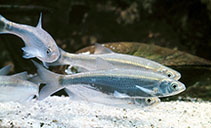 Alburnus alburnus
Fotografia de Muséum-Aquarium de Nancy/D. Terver
Fotografias | vídeos | Imagem do Google
Fotografia de Muséum-Aquarium de Nancy/D. Terver
Classificação / Nomes Nomes comuns | Sinónimos | Catalog of Fishes(Género, Espécies) | ITIS | CoL | WoRMS | Cloffa
> Cypriniformes (Carps) > Leuciscidae (Minnows) > Leuciscinae
Etymology: Alburnus: From the city of Al Bura, where the fish was known (Ref. 45335).
More on author: Linnaeus.
Etymology: Alburnus: From the city of Al Bura, where the fish was known (Ref. 45335).
More on author: Linnaeus.
Ambiente: milieu / zona climática / intervalo de profundidade / gama de distribuição Ecologia
; Água doce; estuarina bentopelágico; pH range: 7.0 - ? ; dH range: 10 - ?; potamódromo (Ref. 51243); intervalo de profundidade 1 - ? m (Ref. 30578). Temperate; 10°C - 20°C (Ref. 2059); 68°N - 35°N, 6°W - 60°E
Distribuição Territórios | Áreas FAO | Ecossistemas | Ocorrências | Mapa dos pontos | Introduções | Faunafri
Europe and Asia: most of Europe north of Caucasus, Pyrénées and Alps, eastward to Ural and Emba. Naturally absent from Iberian Peninsula, Adriatic and Aegean basins (except Maritza drainage), Italy, Ireland, Great Britain (except southeast), Norway and Scandinavia north of 67°N, Caspian basin south of Volga. In Anatolia, Marmara basin. Locally introduced in Spain, Portugal and Italy. At least one country reports adverse ecological impact after introduction.
Comprimento na primeira maturidade / Tamanho / Peso / Idade
Maturidade: Lm 9.9, range 9 - ? cm
Max length : 25.0 cm TL macho/indeterminado; (Ref. 30578); common length : 15.0 cm TL macho/indeterminado; (Ref. 30578); peso máx. Publicado: 60.00 g (Ref. 30578)
Max length : 25.0 cm TL macho/indeterminado; (Ref. 30578); common length : 15.0 cm TL macho/indeterminado; (Ref. 30578); peso máx. Publicado: 60.00 g (Ref. 30578)
Descrição breve Chaves de identificação | Morfologia | Morfometria
Espinhos dorsais (total) : 2 - 4; Raios dorsais moles (total) : 7 - 9; Espinhos anais: 3; Raios anais moles: 14 - 20; Vértebras: 41 - 44. Diagnosed from congeners in Europe by the possession of the following characters: origin of anal fin below branched dorsal rays 4-5; lateral line with 45-48 + 3 scales; anal fin with 17-20½ branched rays; 16-22 gill rakers; ventral keel exposed from anus to pelvic base; lateral stripe absent in life, faint or absent in preserved specimens; and mouth slightly superior (Ref. 59043). Caudal fin with 19 rays (Ref. 2196). Also Ref. 40476.
Body shape (shape guide): fusiform / normal.
Body shape (shape guide): fusiform / normal.
Inhabits open waters of lakes and medium to large rivers. Forms large aggregations in backwaters and other still waters during winter. Adults occur in shoals near the surface. Larvae live in littoral zone of rivers and lakes while juveniles leave shores and occupy a pelagic habitat, feeding on plankton, drifting insects or invertebrates fallen on the water surface (Ref. 59043). Feeds mainly on plankton, including crustaceans (Ref. 30578) and insects (Ref. 9696). Spawns in shallow riffles or along stony shores of lakes, occasionally above submerged vegetation (Ref. 59043). Excellent as bait for carnivorous fishes. May be captured using the smallest hook and a fly as bait. Its flesh is tasty (Ref. 30578). Of little interest to commercial or sport fisheries in its native range because of its small size (Ref. 1739). Scales were previously utilized in making Essence d"Orient, a coating for artificial pearls (Ref. 59043).
Ciclo de vida e comportamento de acasalamento Maturidade | Reprodução | Desova | Ovos | Fecundidade | Larvas
Eggs hatch in about 4 days (Ref. 59043).
Referência principal
Carregar as suas referências | Referências | Coordenador | Colaboradores
Kottelat, M., 1997. European freshwater fishes. An heuristic checklist of the freshwater fishes of Europe (exclusive of former USSR), with an introduction for non-systematists and comments on nomenclature and conservation. Biologia, Bratislava, 52/Suppl. 5:1-271. (Ref. 13696)
Categoria na Lista Vermelha da IUCN (Ref. 130435: Version 2025-2 (Global))
Preocupação menor (LC) ; Date assessed: 05 December 2023
CITES
Not Evaluated
Ameaça para o homem
Utilização humana
Pescarias: pouco comercial; Aquacultura: espécies comerciais; isco: usually
FAO - Sistemas de aquacultura: produção; pescarias: desembarques; Publication: search | FishSource |
Mais informação
Ecologia Trófica
Produtos alimentares (presas)
Composição da dieta
Consumo alimentar
Rações alimentares
Predadores
Produtos alimentares (presas)
Composição da dieta
Consumo alimentar
Rações alimentares
Predadores
Dinâmica das populações
Parâmetros de crescimento
Idades / tamanhos máximos
Comprimento-peso rel.
Comprimento-comprimento rel.
Frequência de comprimento
Conversão de massa
Recrutamento
Abundância
Parâmetros de crescimento
Idades / tamanhos máximos
Comprimento-peso rel.
Comprimento-comprimento rel.
Frequência de comprimento
Conversão de massa
Recrutamento
Abundância
Ciclo de vida
Reprodução
Maturidade
Maturidade/Rel. das guelras
Fecundidade
Desova
Agregações de desova
Ovos
Desenvolvimento dos ovos
Larvas
Dinâmica larvar
Reprodução
Maturidade
Maturidade/Rel. das guelras
Fecundidade
Desova
Agregações de desova
Ovos
Desenvolvimento dos ovos
Larvas
Dinâmica larvar
Anatomia
Área branquial
Cérebro
Otólitos
Área branquial
Cérebro
Otólitos
Fisiologia
Composição corporal
Nutrientes
Consumo de oxigénio
Tipo de natação
Velocidade de natação
Pigmentos visuais
Som de peixe
Doenças e Parasitas
Toxicidade (LC50s)
Composição corporal
Nutrientes
Consumo de oxigénio
Tipo de natação
Velocidade de natação
Pigmentos visuais
Som de peixe
Doenças e Parasitas
Toxicidade (LC50s)
Relacionado com o ser humano
Sistemas de aquacultura
Perfis para aquacultura
Estirpes
Casos de Ciguatera
Selos, moedas, diversos.
Sistemas de aquacultura
Perfis para aquacultura
Estirpes
Casos de Ciguatera
Selos, moedas, diversos.
Ferramentas
Questionário orgânico | E-book | Guia de campo | Chaves de identificação | Ferramenta auxiliar de frequências de comprimento | Ferramenta sobre a história de vida | Mapa dos pontos |
Captura-MSY |
Relatórios especiais
Descarregue XML
Fontes da internet
AFORO (otoliths) | Alien/Invasive Species database | Aquatic Commons | BHL | Cloffa | Websites from users | Consultar FishWatcher | CISTI | Catalog of Fishes: Género, Espécies | DiscoverLife | DORIS | ECOTOX | FAO - Sistemas de aquacultura: produção; pescarias: desembarques; Publication: search | Faunafri | Fishipedia | Fishtrace | GloBI | Google Books | Google Scholar | Google | IGFA World Record | Bases de dados nacionais | OneZoom | Open Tree of Life | Otolith Atlas of Taiwan Fishes | Aquários públicos | PubMed | Reef Life Survey | Socotra Atlas | TreeBase | Árvore da vida | Wikipedia: ir para, procurar | World Records Freshwater Fishing | Registo zoológico
Estimativas baseadas em modelos
Índice de diversidade filogenética (Ref. 82804): PD50 = 0.5000 [Uniqueness, from 0.5 = low to 2.0 = high].
Bayesian length-weight: a=0.00562 (0.00484 - 0.00653), b=3.12 (3.09 - 3.15), in cm total length, based on LWR estimates for this species (Ref. 93245).
Nível Trófico (Ref. 69278): 2.7 ±0.29 se; based on food items.
Resiliência (Ref. 120179): Médio, tempo mínimo de duplicação da população 1,4 - 4,4 anos (tm=2-3; K=0.19; tmax=7; Fec=1,500).
Nutrientes (Ref. 124155): Calcium = 80.3 [38.4, 133.1] mg/100g; Iron = 0.46 [0.27, 0.84] mg/100g; Protein = 16.7 [15.1, 18.1] %; Omega3 = 0.697 [0.310, 1.491] g/100g; Selenium = 9.19 [4.33, 19.16] μg/100g; VitaminA = 40.5 [14.0, 121.6] μg/100g; Zinc = 0.965 [0.689, 1.367] mg/100g (wet weight);