



Sube tu fotos y Vídeos
Imágenes | Vídeos | Google image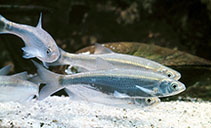 Alburnus alburnus
Foto de Muséum-Aquarium de Nancy/D. Terver
Imágenes | Vídeos | Google image
Foto de Muséum-Aquarium de Nancy/D. Terver
Clasificación / Nombres Nombres comunes | Sinónimos | Catalog of Fishes(Género, Especie) | ITIS | CoL | WoRMS | Cloffa
> Cypriniformes (Carps) > Leuciscidae (Minnows) > Leuciscinae
Etymology: Alburnus: From the city of Al Bura, where the fish was known (Ref. 45335).
More on author: Linnaeus.
Etymology: Alburnus: From the city of Al Bura, where the fish was known (Ref. 45335).
More on author: Linnaeus.
Entorno: milieu / zona climática / rango de profundidad / gama de distribución Ecología
; agua dulce; salobre bentopelágico; pH range: 7.0 - ? ; dH range: 10 - ?; potamodromo (Ref. 51243); rango de profundidad 1 - ? m (Ref. 30578). Temperate; 10°C - 20°C (Ref. 2059); 68°N - 35°N, 6°W - 60°E
Distribución Territorios | Áreas FAO | Ecosistemas | Ocurrencias, apariciones | Mapa de puntos | Introducciones | Faunafri
Europe and Asia: most of Europe north of Caucasus, Pyrénées and Alps, eastward to Ural and Emba. Naturally absent from Iberian Peninsula, Adriatic and Aegean basins (except Maritza drainage), Italy, Ireland, Great Britain (except southeast), Norway and Scandinavia north of 67°N, Caspian basin south of Volga. In Anatolia, Marmara basin. Locally introduced in Spain, Portugal and Italy. At least one country reports adverse ecological impact after introduction.
Longitud en la primera madurez / Tamaño / Peso / Edad
Madurez: Lm 9.9, range 9 - ? cm
Max length : 25.0 cm TL macho / no sexado; (Ref. 30578); common length : 15.0 cm TL macho / no sexado; (Ref. 30578); peso máximo publicado: 60.00 g (Ref. 30578)
Max length : 25.0 cm TL macho / no sexado; (Ref. 30578); common length : 15.0 cm TL macho / no sexado; (Ref. 30578); peso máximo publicado: 60.00 g (Ref. 30578)
Descripción breve Claves de identificación | Morfología | Morfometría
Espinas dorsales (total) : 2 - 4; Radios blandos dorsales (total) : 7 - 9; Espinas anales: 3; Radios blandos anales: 14 - 20; Vértebra: 41 - 44. Diagnosed from congeners in Europe by the possession of the following characters: origin of anal fin below branched dorsal rays 4-5; lateral line with 45-48 + 3 scales; anal fin with 17-20½ branched rays; 16-22 gill rakers; ventral keel exposed from anus to pelvic base; lateral stripe absent in life, faint or absent in preserved specimens; and mouth slightly superior (Ref. 59043). Caudal fin with 19 rays (Ref. 2196). Also Ref. 40476.
Body shape (shape guide): fusiform / normal.
Body shape (shape guide): fusiform / normal.
Inhabits open waters of lakes and medium to large rivers. Forms large aggregations in backwaters and other still waters during winter. Adults occur in shoals near the surface. Larvae live in littoral zone of rivers and lakes while juveniles leave shores and occupy a pelagic habitat, feeding on plankton, drifting insects or invertebrates fallen on the water surface (Ref. 59043). Feeds mainly on plankton, including crustaceans (Ref. 30578) and insects (Ref. 9696). Spawns in shallow riffles or along stony shores of lakes, occasionally above submerged vegetation (Ref. 59043). Excellent as bait for carnivorous fishes. May be captured using the smallest hook and a fly as bait. Its flesh is tasty (Ref. 30578). Of little interest to commercial or sport fisheries in its native range because of its small size (Ref. 1739). Scales were previously utilized in making Essence d"Orient, a coating for artificial pearls (Ref. 59043).
Ciclo vital y comportamiento de apareamiento Madurez | Reproducción | Puesta | Huevos | Fecundidad | Larva
Eggs hatch in about 4 days (Ref. 59043).
Referencia principal
Suba sus referencias | Referencias | Coordinador | Colaboradores
Kottelat, M., 1997. European freshwater fishes. An heuristic checklist of the freshwater fishes of Europe (exclusive of former USSR), with an introduction for non-systematists and comments on nomenclature and conservation. Biologia, Bratislava, 52/Suppl. 5:1-271. (Ref. 13696)
Situación en la Lista Roja de la UICN (Ref. 130435: Version 2025-2 (Global))
Least Concern (LC) ; Date assessed: 05 December 2023
CITES
Not Evaluated
Amenaza para el ser humano
Usos humanos
Pesquerías: escaso valor comercial; Acuicultura: comercial; carnada: usually
FAO - Sistemas de acuicultura: producción; pesquerías: desembarques; Publication: search | FishSource |
Más información
Ecología Trófica
Alimentos (presas)
Composición de la dieta
consumo de alimento
Raciones de comida
Despredadores
Alimentos (presas)
Composición de la dieta
consumo de alimento
Raciones de comida
Despredadores
Dinámica de la población
Coeficiente del crecimiento para
Edades / tallas máximas
Longitud-peso rel.
Longitud-longitud rel.
Longitud-frecuencias
Conversión de masas
Reclutamiento
Abundancia
Coeficiente del crecimiento para
Edades / tallas máximas
Longitud-peso rel.
Longitud-longitud rel.
Longitud-frecuencias
Conversión de masas
Reclutamiento
Abundancia
Ciclo de vida
Reproducción
Madurez
Madurez/Gills rel.
Fecundidad
Puesta
Agregaciones de desove
Huevos
Desarrollo de los huevos
Larva
Dinámica larvaria
Reproducción
Madurez
Madurez/Gills rel.
Fecundidad
Puesta
Agregaciones de desove
Huevos
Desarrollo de los huevos
Larva
Dinámica larvaria
Distribución
Territorios
Áreas FAO
Ecosistemas
Ocurrencias, apariciones
Introducciones
BRUVS - Vídeos
Territorios
Áreas FAO
Ecosistemas
Ocurrencias, apariciones
Introducciones
BRUVS - Vídeos
Anatomía
Superficie branquial
Cerebro
Otolito
Superficie branquial
Cerebro
Otolito
Fisiología
Composición corporal
Nutrientes
Consumo del oxígeno
Tipo de natación
Velocidad de natación
Pigmentos visuales
Sonido de peces
Enfermedades y parásitos
Toxicidad (CL50)
Composición corporal
Nutrientes
Consumo del oxígeno
Tipo de natación
Velocidad de natación
Pigmentos visuales
Sonido de peces
Enfermedades y parásitos
Toxicidad (CL50)
Relacionados con el ser humano
Sistemas de acuicultura
Perfiles de acuicultura
Razas
Ciguatera cases
Sellos, monedas, varios
Sistemas de acuicultura
Perfiles de acuicultura
Razas
Ciguatera cases
Sellos, monedas, varios
Herramientas
Cuestionario orgánico | Libro electrónico | Guía de campo | Claves de identificación | Asistente para frecuencias de tallas | Herramienta de ciclo de vida | Mapa de puntos |
Catch-MSY |
Informes especiales
Comprobar el mantenimiento del acuario | Buscar fichas sobre especies | Consulte las hojas informativas sobre acuicultura
Descargar XML
Fuentes de Internet
AFORO (otoliths) | Alien/Invasive Species database | Aquatic Commons | BHL | Cloffa | Websites from users | Check FishWatcher | CISTI | Catalog of Fishes: Género, Especie | DiscoverLife | DORIS | ECOTOX | FAO - Sistemas de acuicultura: producción; pesquerías: desembarques; Publication: search | Faunafri | Fishipedia | Fishtrace | GloBI | Google Books | Google Scholar | Google | IGFA World Record | Bases de datos nacionales | OneZoom | Open Tree of Life | Otolith Atlas of Taiwan Fishes | Acuarios públicos | PubMed | Reef Life Survey | Socotra Atlas | TreeBase | Árbol de la vida | Wikipedia: Go, búsqueda | World Records Freshwater Fishing | Expediente Zoológico
Estimaciones basadas en modelos
Índice de diversidad filogenética (Referencia 82804): PD50 = 0.5000 [Uniqueness, from 0.5 = low to 2.0 = high].
Bayesian length-weight: a=0.00562 (0.00484 - 0.00653), b=3.12 (3.09 - 3.15), in cm total length, based on LWR estimates for this species (Ref. 93245).
Nivel trófico (Referencia 69278): 2.7 ±0.29 se; based on food items.
Resiliencia (Referencia 120179): Medio, población duplicada en un tiempo mínimo de 1.4-4.4 años (tm=2-3; K=0.19; tmax=7; Fec=1,500).
Nutrientes (Ref. 124155): Calcium = 80.3 [38.4, 133.1] mg/100g; Iron = 0.46 [0.27, 0.84] mg/100g; Protein = 16.7 [15.1, 18.1] %; Omega3 = 0.697 [0.310, 1.491] g/100g; Selenium = 9.19 [4.33, 19.16] μg/100g; VitaminA = 40.5 [14.0, 121.6] μg/100g; Zinc = 0.965 [0.689, 1.367] mg/100g (wet weight);