



Nothobranchius rachovii Ahl, 1926
Bluefin notho
Uploaden van uw Foto's en video's
Afbeeldingen | Postzegels, munten, diversen. | Google afbeelding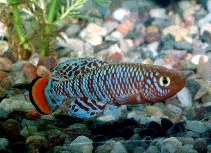 Nothobranchius rachovii
Afbeelding van Plistil, J.
Afbeeldingen | Postzegels, munten, diversen. | Google afbeelding
Afbeelding van Plistil, J.
Classificatie / Namen Lokale namen | Synoniemen | Catalog of Fishes(Genus, Soort(en)) | ITIS | CoL | WoRMS | Cloffa
> Cyprinodontiformes (Rivulines, killifishes and live bearers) > Nothobranchiidae (African rivulines)
Etymology: Nothobranchius: Greek, nothos = false + Greek, brangchia = gill (Ref. 45335); rachovii: Named in honour of Arthur Rachow (Ref. 97289).
Eponymy: Arthur Rachow (1884–1960) was a self-taught pioneer German aquarist. [...] (Ref. 128868), visit book page.
More on author: Ahl.
Etymology: Nothobranchius: Greek, nothos = false + Greek, brangchia = gill (Ref. 45335); rachovii: Named in honour of Arthur Rachow (Ref. 97289).
Eponymy: Arthur Rachow (1884–1960) was a self-taught pioneer German aquarist. [...] (Ref. 128868), visit book page.
More on author: Ahl.
Milieu: milieu / Klimaatzone / Diepte / verspreidingsgebied Ecologie
; zoet water benthopelagisch; pH range: 6.0 - 7.0; dH range: 4 - 6; standvastig. Tropical; 20°C - 24°C (Ref. 1672); 19°S - 20°S
Verspreiding Gebieden | FAO regio's | Ecosystemen | Voorkomen | Verspreidingskaart | Introducties | Faunafri
Africa: temporary pools and swamps or water-filled depressions in the lowland floodplains of the lower Pungwe River and lower Zambezi River (Ref. 85866), probably also in floodplains of other rivers between Pungwe and Zambezi River (Ref. 85866).
Grootte / Gewicht / Leeftijd
Korte beschrijving Determinatiesleutels | Morfologie | Morfometrie
Dorsale stekels (totaal) : 0; Dorsale zachte stralen (totaal) : 15 - 17; Anale stekels: 0; Anale zachte stralen: 15 - 18. Diagnosis: Nothobranchius rachovii is distinguished from other species of the genus by the following combination of characters: in males, a bright colouration consisting of alternating light blue and orange-red bars on the body and fins, orange-red head, and orange subterminal and black terminal bands in the caudal fin (Ref. 85866). It can be distinguished from the other species of the subgenus Nothobranchius as follows: from N. furzeri by male colouration, higher number of dorsal fin rays, 15-17 vs. 14-15, and a lower number of scales on the mid-longitudinal series, 26-28 vs. 28-30; from N. orthonotus by male colouration, lower number of scales on the mid-longitudinal series, 26-28 vs. 28-33, and shape of the dorsal profile, convex vs. flat; and from N. kadleci by male colouration and shape of the frontal region, higher number of dorsal and anal fin rays, 15-17 vs. 13-14 and 15-17 vs. 13-14 (Ref. 85866). Females can be distinguished by the presence of a reflective light blue spot on all scales of the flanks, vs. few, irregularly dispersed light blue-green spots in N. furzeri and N. kadleci or frequent presence of brown spots on body and fins in N. orthonotus (Ref. 85866). Nothobranchius rachovii can also be distinguished from all other species of the genus by its low number of diploid chromosomes, 2n=16 (Ref. 85866).
Body shape (shape guide): fusiform / normal.
Body shape (shape guide): fusiform / normal.
Found in water-filled depressions in the floodplains of rivers; water depth is variable and decreases as the dry season progresses, eventually drying out completely (Ref. 85866). Littoral vegetation usually consists of grasses; aquatic vegetation may consis of Nymphea, Ottelia, Lagarosiphon and Utricularia species; occasionally, the swamps are used by local inhabitants to cultivate rice (Ref. 85866). Very difficult to maintain in aquarium (Ref. 27139).
Levenscyclus en paargedrag Maturiteit | Voortplanting | Paaien | Eieren | Fecunditeit | Larven
Annual fish. Matures after 12 weeks. This updates previous information from Ref. 1672.
Hoofdreferentie
Upload uw referenties | Referenties | Coördinator | Medewerkers
Shidlovskiy, K.M., B.R. Watters and R.H. Wildekamp, 2010. Notes on the annual killifish species Nothobranchius rachovii (Cyprinodontiformes; Nothobranchiidae) with the description of two new species. Zootaxa 2724:37-57. (Ref. 85866)
Status op de Rode Lijst van het IUCN (Ref. 130435: Version 2025-2 (Global))
Niet bedreigd (LC) ; Date assessed: 08 January 2019
CITES
Not Evaluated
Gevaar voor de mens
Harmless
Gebruik door de mens
Aquarium: Commercieel
FAO - Publication: search | FishSource |
Meer informatie
Trofische ecologie
Voedsel (prooien)
Dieetsamenstelling
Voedselconsumptie
Voedselrantsoenen
Predatoren
Voedsel (prooien)
Dieetsamenstelling
Voedselconsumptie
Voedselrantsoenen
Predatoren
Populatiedynamica
Groeiparameters
Max. leeftijden / maten
Lengte-gewicht rel.
Lengte-lengte rel.
Lengtefrequenties
Massaconversie
Rekrutering
Abundantie
Groeiparameters
Max. leeftijden / maten
Lengte-gewicht rel.
Lengte-lengte rel.
Lengtefrequenties
Massaconversie
Rekrutering
Abundantie
Levenscyclus
Voortplanting
Maturiteit
Rijpheid/kieuwen rel.
Fecunditeit
Paaien
Paaibestanden
Eieren
Ontwikkeling van de eieren
Larven
Larvale populatiedynamiek
Voortplanting
Maturiteit
Rijpheid/kieuwen rel.
Fecunditeit
Paaien
Paaibestanden
Eieren
Ontwikkeling van de eieren
Larven
Larvale populatiedynamiek
Anatomie
Kieuwoppervlak
Hersenen
Otoliet
Kieuwoppervlak
Hersenen
Otoliet
Fysiologie
Lichaamssamenstelling
Voedingsstoffen
Zuurstofverbruik
Type zwemmen
Zwemsnelheid
Visuele pigmenten
Vis geluid
Ziekten en parasieten
Toxiciteit (LC50)
Lichaamssamenstelling
Voedingsstoffen
Zuurstofverbruik
Type zwemmen
Zwemsnelheid
Visuele pigmenten
Vis geluid
Ziekten en parasieten
Toxiciteit (LC50)
Menselijk gerelateerd
Aquacultuursystemen
Aquacultuurprofielen
Kweeklijnen
Ciguatera gevallen
Postzegels, munten, diversen.
Aquacultuursystemen
Aquacultuurprofielen
Kweeklijnen
Ciguatera gevallen
Postzegels, munten, diversen.
Tools
Speciale rapporten
Bekijk gegevens voor het houden in een aquarium | Bekijk Fact Sheets voor de soort | Bekijk Aquacultuur Fact Sheets
Download XML
Internetbronnen
AFORO (otoliths) | Aquatic Commons | BHL | Cloffa | Websites from users | Bekijk FishWatcher | CISTI | Catalog of Fishes: Genus, Soort(en) | DiscoverLife | ECOTOX | FAO - Publication: search | Faunafri | Fishipedia | Fishtrace | GloBI | Google Books | Google Scholar | Google | IGFA World Record | OneZoom | Open Tree of Life | Otolith Atlas of Taiwan Fishes | PubMed | Reef Life Survey | Socotra Atlas | TreeBase | Tree of Life | Wikipedia: ga naar, zoek | World Records Freshwater Fishing | Zoobank | Zoological Record
Schattingen op basis van modellen
Fylogenetische diversiteitsindex (Ref. 82804): PD50 = 0.5000 [Uniqueness, from 0.5 = low to 2.0 = high].
Bayesian length-weight: a=0.01096 (0.00461 - 0.02608), b=2.94 (2.74 - 3.14), in cm total length, based on LWR estimates for this (Sub)family-body shape (Ref. 93245).
Trofisch niveau (Ref. 69278): 3.2 ±0.4 se; based on size and trophs of closest relatives