



Nothobranchius rachovii Ahl, 1926
Bluefin notho
Adicionar o seu Fotografias e vídeos
Fotografias | Selos, moedas, diversos. | Imagem do Google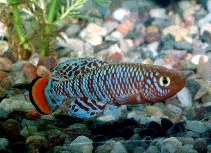 Nothobranchius rachovii
Fotografia de Plistil, J.
Fotografias | Selos, moedas, diversos. | Imagem do Google
Fotografia de Plistil, J.
Classificação / Nomes Nomes comuns | Sinónimos | Catalog of Fishes(Género, Espécies) | ITIS | CoL | WoRMS | Cloffa
> Cyprinodontiformes (Rivulines, killifishes and live bearers) > Nothobranchiidae (African rivulines)
Etymology: Nothobranchius: Greek, nothos = false + Greek, brangchia = gill (Ref. 45335); rachovii: Named in honour of Arthur Rachow (Ref. 97289).
Eponymy: Arthur Rachow (1884–1960) was a self-taught pioneer German aquarist. [...] (Ref. 128868), visit book page.
More on author: Ahl.
Etymology: Nothobranchius: Greek, nothos = false + Greek, brangchia = gill (Ref. 45335); rachovii: Named in honour of Arthur Rachow (Ref. 97289).
Eponymy: Arthur Rachow (1884–1960) was a self-taught pioneer German aquarist. [...] (Ref. 128868), visit book page.
More on author: Ahl.
Ambiente: milieu / zona climática / intervalo de profundidade / gama de distribuição Ecologia
; Água doce bentopelágico; pH range: 6.0 - 7.0; dH range: 4 - 6; não migratória. Tropical; 20°C - 24°C (Ref. 1672); 19°S - 20°S
Distribuição Territórios | Áreas FAO | Ecossistemas | Ocorrências | Mapa dos pontos | Introduções | Faunafri
Africa: temporary pools and swamps or water-filled depressions in the lowland floodplains of the lower Pungwe River and lower Zambezi River (Ref. 85866), probably also in floodplains of other rivers between Pungwe and Zambezi River (Ref. 85866).
Tamanho / Peso / Idade
Descrição breve Chaves de identificação | Morfologia | Morfometria
Espinhos dorsais (total) : 0; Raios dorsais moles (total) : 15 - 17; Espinhos anais: 0; Raios anais moles: 15 - 18. Diagnosis: Nothobranchius rachovii is distinguished from other species of the genus by the following combination of characters: in males, a bright colouration consisting of alternating light blue and orange-red bars on the body and fins, orange-red head, and orange subterminal and black terminal bands in the caudal fin (Ref. 85866). It can be distinguished from the other species of the subgenus Nothobranchius as follows: from N. furzeri by male colouration, higher number of dorsal fin rays, 15-17 vs. 14-15, and a lower number of scales on the mid-longitudinal series, 26-28 vs. 28-30; from N. orthonotus by male colouration, lower number of scales on the mid-longitudinal series, 26-28 vs. 28-33, and shape of the dorsal profile, convex vs. flat; and from N. kadleci by male colouration and shape of the frontal region, higher number of dorsal and anal fin rays, 15-17 vs. 13-14 and 15-17 vs. 13-14 (Ref. 85866). Females can be distinguished by the presence of a reflective light blue spot on all scales of the flanks, vs. few, irregularly dispersed light blue-green spots in N. furzeri and N. kadleci or frequent presence of brown spots on body and fins in N. orthonotus (Ref. 85866). Nothobranchius rachovii can also be distinguished from all other species of the genus by its low number of diploid chromosomes, 2n=16 (Ref. 85866).
Body shape (shape guide): fusiform / normal.
Body shape (shape guide): fusiform / normal.
Found in water-filled depressions in the floodplains of rivers; water depth is variable and decreases as the dry season progresses, eventually drying out completely (Ref. 85866). Littoral vegetation usually consists of grasses; aquatic vegetation may consis of Nymphea, Ottelia, Lagarosiphon and Utricularia species; occasionally, the swamps are used by local inhabitants to cultivate rice (Ref. 85866). Very difficult to maintain in aquarium (Ref. 27139).
Ciclo de vida e comportamento de acasalamento Maturidade | Reprodução | Desova | Ovos | Fecundidade | Larvas
Annual fish. Matures after 12 weeks. This updates previous information from Ref. 1672.
Referência principal
Carregar as suas referências | Referências | Coordenador | Colaboradores
Shidlovskiy, K.M., B.R. Watters and R.H. Wildekamp, 2010. Notes on the annual killifish species Nothobranchius rachovii (Cyprinodontiformes; Nothobranchiidae) with the description of two new species. Zootaxa 2724:37-57. (Ref. 85866)
Categoria na Lista Vermelha da IUCN (Ref. 130435: Version 2025-2 (Global))
Preocupação menor (LC) ; Date assessed: 08 January 2019
CITES
Not Evaluated
Ameaça para o homem
Harmless
Utilização humana
Aquário: Espécies comerciais
FAO - Publication: search | FishSource |
Mais informação
Ecologia Trófica
Produtos alimentares (presas)
Composição da dieta
Consumo alimentar
Rações alimentares
Predadores
Produtos alimentares (presas)
Composição da dieta
Consumo alimentar
Rações alimentares
Predadores
Dinâmica das populações
Parâmetros de crescimento
Idades / tamanhos máximos
Comprimento-peso rel.
Comprimento-comprimento rel.
Frequência de comprimento
Conversão de massa
Recrutamento
Abundância
Parâmetros de crescimento
Idades / tamanhos máximos
Comprimento-peso rel.
Comprimento-comprimento rel.
Frequência de comprimento
Conversão de massa
Recrutamento
Abundância
Ciclo de vida
Reprodução
Maturidade
Maturidade/Rel. das guelras
Fecundidade
Desova
Agregações de desova
Ovos
Desenvolvimento dos ovos
Larvas
Dinâmica larvar
Reprodução
Maturidade
Maturidade/Rel. das guelras
Fecundidade
Desova
Agregações de desova
Ovos
Desenvolvimento dos ovos
Larvas
Dinâmica larvar
Anatomia
Área branquial
Cérebro
Otólitos
Área branquial
Cérebro
Otólitos
Fisiologia
Composição corporal
Nutrientes
Consumo de oxigénio
Tipo de natação
Velocidade de natação
Pigmentos visuais
Som de peixe
Doenças e Parasitas
Toxicidade (LC50s)
Composição corporal
Nutrientes
Consumo de oxigénio
Tipo de natação
Velocidade de natação
Pigmentos visuais
Som de peixe
Doenças e Parasitas
Toxicidade (LC50s)
Relacionado com o ser humano
Sistemas de aquacultura
Perfis para aquacultura
Estirpes
Casos de Ciguatera
Selos, moedas, diversos.
Sistemas de aquacultura
Perfis para aquacultura
Estirpes
Casos de Ciguatera
Selos, moedas, diversos.
Ferramentas
E-book | Guia de campo | Ferramenta auxiliar de frequências de comprimento | Ferramenta sobre a história de vida | Mapa dos pontos |
Captura-MSY |
Relatórios especiais
Descarregue XML
Fontes da internet
AFORO (otoliths) | Aquatic Commons | BHL | Cloffa | Websites from users | Consultar FishWatcher | CISTI | Catalog of Fishes: Género, Espécies | DiscoverLife | ECOTOX | FAO - Publication: search | Faunafri | Fishipedia | Fishtrace | GloBI | Google Books | Google Scholar | Google | IGFA World Record | OneZoom | Open Tree of Life | Otolith Atlas of Taiwan Fishes | PubMed | Reef Life Survey | Socotra Atlas | TreeBase | Árvore da vida | Wikipedia: ir para, procurar | World Records Freshwater Fishing | Zoobank | Registo zoológico
Estimativas baseadas em modelos
Índice de diversidade filogenética (Ref. 82804): PD50 = 0.5000 [Uniqueness, from 0.5 = low to 2.0 = high].
Bayesian length-weight: a=0.01096 (0.00461 - 0.02608), b=2.94 (2.74 - 3.14), in cm total length, based on LWR estimates for this (Sub)family-body shape (Ref. 93245).
Nível Trófico (Ref. 69278): 3.2 ±0.4 se; based on size and trophs of closest relatives