



Nothobranchius rachovii Ahl, 1926
Bluefin notho
Carica il tuo foto e Video
Immagini | Francobolli, monete, materiale vario. | Google image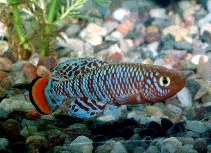 Nothobranchius rachovii
Immagine di Plistil, J.
Immagini | Francobolli, monete, materiale vario. | Google image
Immagine di Plistil, J.
Classificazione / Nomi Nomi Comuni | Sinonimi | Catalog of Fishes(Genere, Specie) | ITIS | CoL | WoRMS | Cloffa
> Cyprinodontiformes (Rivulines, killifishes and live bearers) > Nothobranchiidae (African rivulines)
Etymology: Nothobranchius: Greek, nothos = false + Greek, brangchia = gill (Ref. 45335); rachovii: Named in honour of Arthur Rachow (Ref. 97289).
Eponymy: Arthur Rachow (1884–1960) was a self-taught pioneer German aquarist. [...] (Ref. 128868), visit book page.
More on author: Ahl.
Etymology: Nothobranchius: Greek, nothos = false + Greek, brangchia = gill (Ref. 45335); rachovii: Named in honour of Arthur Rachow (Ref. 97289).
Eponymy: Arthur Rachow (1884–1960) was a self-taught pioneer German aquarist. [...] (Ref. 128868), visit book page.
More on author: Ahl.
Ambiente: milieu / zona climatica / distribuzione batimetrica / gamma di distribuzione Ecologia
; acqua dolce benthopelagico; pH range: 6.0 - 7.0; dH range: 4 - 6; non migratori. Tropical; 20°C - 24°C (Ref. 1672); 19°S - 20°S
Distribuzione Territories | Aree FAO | Ecosistemi | Presenze | Mappa dei ritrovamenti | Introduzioni | Faunafri
Africa: temporary pools and swamps or water-filled depressions in the lowland floodplains of the lower Pungwe River and lower Zambezi River (Ref. 85866), probably also in floodplains of other rivers between Pungwe and Zambezi River (Ref. 85866).
Dimensione / Peso / Età
Breve descrizione Chiavi di identificazione | Morfologia | Morfometria
Spine dorsali (totale) : 0; Raggi dorsali molli (totale) : 15 - 17; Spine anali: 0; Raggi anali molli: 15 - 18. Diagnosis: Nothobranchius rachovii is distinguished from other species of the genus by the following combination of characters: in males, a bright colouration consisting of alternating light blue and orange-red bars on the body and fins, orange-red head, and orange subterminal and black terminal bands in the caudal fin (Ref. 85866). It can be distinguished from the other species of the subgenus Nothobranchius as follows: from N. furzeri by male colouration, higher number of dorsal fin rays, 15-17 vs. 14-15, and a lower number of scales on the mid-longitudinal series, 26-28 vs. 28-30; from N. orthonotus by male colouration, lower number of scales on the mid-longitudinal series, 26-28 vs. 28-33, and shape of the dorsal profile, convex vs. flat; and from N. kadleci by male colouration and shape of the frontal region, higher number of dorsal and anal fin rays, 15-17 vs. 13-14 and 15-17 vs. 13-14 (Ref. 85866). Females can be distinguished by the presence of a reflective light blue spot on all scales of the flanks, vs. few, irregularly dispersed light blue-green spots in N. furzeri and N. kadleci or frequent presence of brown spots on body and fins in N. orthonotus (Ref. 85866). Nothobranchius rachovii can also be distinguished from all other species of the genus by its low number of diploid chromosomes, 2n=16 (Ref. 85866).
Body shape (shape guide): fusiform / normal.
Body shape (shape guide): fusiform / normal.
Found in water-filled depressions in the floodplains of rivers; water depth is variable and decreases as the dry season progresses, eventually drying out completely (Ref. 85866). Littoral vegetation usually consists of grasses; aquatic vegetation may consis of Nymphea, Ottelia, Lagarosiphon and Utricularia species; occasionally, the swamps are used by local inhabitants to cultivate rice (Ref. 85866). Very difficult to maintain in aquarium (Ref. 27139).
Ciclo vitale e comportamento di accoppiamento Maturità | Riproduzione | Deposizione | Uova | Fecondità | Larve
Annual fish. Matures after 12 weeks. This updates previous information from Ref. 1672.
Riferimento principale
Caricare le referenze | Bibliografia | Coordinatore | Collaboratori
Shidlovskiy, K.M., B.R. Watters and R.H. Wildekamp, 2010. Notes on the annual killifish species Nothobranchius rachovii (Cyprinodontiformes; Nothobranchiidae) with the description of two new species. Zootaxa 2724:37-57. (Ref. 85866)
Stato della Lista Rossa IUCN (Ref. 130435: Version 2025-2 (Global))
Least Concern (LC) ; Date assessed: 08 January 2019
CITES
Not Evaluated
Minaccia per l'uomo
Harmless
Usi umani
Acquario: Commerciale
FAO - Publication: search | FishSource |
Informazioni ulteriori
Ecologia trofica
Articoli alimentari (prede)
Alimentazione
Consumo di cibo
Razioni alimentari
Predatori
Articoli alimentari (prede)
Alimentazione
Consumo di cibo
Razioni alimentari
Predatori
Dinamica della popolazione
Parametri di crescita
Età massima / dimensioni massime
Rapporto lunghezza-peso.
Lunghezza-lunghezza rel.
Lunghezza-frequenze
Conversione di massa
Reclutamento
Abbondanza
Parametri di crescita
Età massima / dimensioni massime
Rapporto lunghezza-peso.
Lunghezza-lunghezza rel.
Lunghezza-frequenze
Conversione di massa
Reclutamento
Abbondanza
Ciclo di vita
Riproduzione
Maturità
Maturità/Gli occhielli sono relativi.
Fecondità
Deposizione
Aggregazioni riproduttive
Uova
Sviluppo delle uova
Larve
Dinamica popolazioni larvali
Riproduzione
Maturità
Maturità/Gli occhielli sono relativi.
Fecondità
Deposizione
Aggregazioni riproduttive
Uova
Sviluppo delle uova
Larve
Dinamica popolazioni larvali
Anatomia
Area branchiale
Cervello
Otolite
Area branchiale
Cervello
Otolite
Fisiologia
Composizione corporea
Nutrienti
Consumo di ossigeno
Tipo di nuoto
Velocità di nuoto
Pigmenti visivi
Suono del pesce
Malattie e parassiti
Tossicità (LC50)
Composizione corporea
Nutrienti
Consumo di ossigeno
Tipo di nuoto
Velocità di nuoto
Pigmenti visivi
Suono del pesce
Malattie e parassiti
Tossicità (LC50)
Legato all'uomo
Sistemi di acquacoltura
Profili di acquacoltura
Varietà
Casi di Ciguatera
Francobolli, monete, materiale vario.
Sistemi di acquacoltura
Profili di acquacoltura
Varietà
Casi di Ciguatera
Francobolli, monete, materiale vario.
Strumenti
Libro elettronico | Giuda pratica | Generatore frequenze di lunghezza | Strumento Parametri Biologici | Mappa dei ritrovamenti |
Cattura-MSY |
Rapporti speciali
Controllo della manutenzione dell'acquario | Verificare la presenza di schede informative sulle specie | Verifica delle schede informative sull'acquacoltura
Scarica XML
Fonti Internet
AFORO (otoliths) | Aquatic Commons | BHL | Cloffa | Websites from users | Check FishWatcher | CISTI | Catalog of Fishes: Genere, Specie | DiscoverLife | ECOTOX | FAO - Publication: search | Faunafri | Fishipedia | Fishtrace | GloBI | Google Books | Google Scholar | Google | IGFA World Record | OneZoom | Open Tree of Life | Otolith Atlas of Taiwan Fishes | PubMed | Reef Life Survey | Socotra Atlas | TreeBase | Tree of Life | Wikipedia: Go, ricerca | World Records Freshwater Fishing | Zoobank | Record zoologico
Stime basate su modelli
Indice di diversità filogenetica (Fonte Biblio. 82804): PD50 = 0.5000 [Uniqueness, from 0.5 = low to 2.0 = high].
Bayesian length-weight: a=0.01096 (0.00461 - 0.02608), b=2.94 (2.74 - 3.14), in cm total length, based on LWR estimates for this (Sub)family-body shape (Ref. 93245).
Livello trofico (Fonte Biblio. 69278): 3.2 ±0.4 se; based on size and trophs of closest relatives