



Nothobranchius rachovii Ahl, 1926
Bluefin notho
Envoyez vos Photos et vidéos
Images | Timbres, pièces de monnaie, divers | Images Google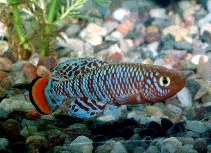 Nothobranchius rachovii
Photo de Plistil, J.
Images | Timbres, pièces de monnaie, divers | Images Google
Photo de Plistil, J.
Classification / Noms Noms communs | Synonymes | Catalog of Fishes(Genre, Espèce) | ITIS | CoL | WoRMS | Cloffa
> Cyprinodontiformes (Rivulines, killifishes and live bearers) > Nothobranchiidae (African rivulines)
Etymology: Nothobranchius: Greek, nothos = false + Greek, brangchia = gill (Ref. 45335); rachovii: Named in honour of Arthur Rachow (Ref. 97289).
Eponymy: Arthur Rachow (1884–1960) was a self-taught pioneer German aquarist. [...] (Ref. 128868), visit book page.
More on author: Ahl.
Etymology: Nothobranchius: Greek, nothos = false + Greek, brangchia = gill (Ref. 45335); rachovii: Named in honour of Arthur Rachow (Ref. 97289).
Eponymy: Arthur Rachow (1884–1960) was a self-taught pioneer German aquarist. [...] (Ref. 128868), visit book page.
More on author: Ahl.
Environnement : milieu / zone climatique / profondeur / gamme de distribution Écologie
; eau douce benthopélagique; pH range: 6.0 - 7.0; dH range: 4 - 6; non migrateur. Tropical; 20°C - 24°C (Ref. 1672); 19°S - 20°S
Distribution Territoires | Zones FAO | Écosystèmes | Occurrences | Carte par point | Introductions | Faunafri
Africa: temporary pools and swamps or water-filled depressions in the lowland floodplains of the lower Pungwe River and lower Zambezi River (Ref. 85866), probably also in floodplains of other rivers between Pungwe and Zambezi River (Ref. 85866).
Taille / Poids / Âge
Description synthétique Clés d'identification | Morphologie | Morphométrie
Épines dorsales (Total) : 0; Rayons mous dorsaux (Total) : 15 - 17; Épines anales: 0; Rayons mous anaux: 15 - 18. Diagnosis: Nothobranchius rachovii is distinguished from other species of the genus by the following combination of characters: in males, a bright colouration consisting of alternating light blue and orange-red bars on the body and fins, orange-red head, and orange subterminal and black terminal bands in the caudal fin (Ref. 85866). It can be distinguished from the other species of the subgenus Nothobranchius as follows: from N. furzeri by male colouration, higher number of dorsal fin rays, 15-17 vs. 14-15, and a lower number of scales on the mid-longitudinal series, 26-28 vs. 28-30; from N. orthonotus by male colouration, lower number of scales on the mid-longitudinal series, 26-28 vs. 28-33, and shape of the dorsal profile, convex vs. flat; and from N. kadleci by male colouration and shape of the frontal region, higher number of dorsal and anal fin rays, 15-17 vs. 13-14 and 15-17 vs. 13-14 (Ref. 85866). Females can be distinguished by the presence of a reflective light blue spot on all scales of the flanks, vs. few, irregularly dispersed light blue-green spots in N. furzeri and N. kadleci or frequent presence of brown spots on body and fins in N. orthonotus (Ref. 85866). Nothobranchius rachovii can also be distinguished from all other species of the genus by its low number of diploid chromosomes, 2n=16 (Ref. 85866).
Body shape (shape guide): fusiform / normal.
Body shape (shape guide): fusiform / normal.
Found in water-filled depressions in the floodplains of rivers; water depth is variable and decreases as the dry season progresses, eventually drying out completely (Ref. 85866). Littoral vegetation usually consists of grasses; aquatic vegetation may consis of Nymphea, Ottelia, Lagarosiphon and Utricularia species; occasionally, the swamps are used by local inhabitants to cultivate rice (Ref. 85866). Very difficult to maintain in aquarium (Ref. 27139).
Cycle de vie et comportement reproducteur Maturité | Reproduction | Frai | Œufs | Fécondité | Larves
Annual fish. Matures after 12 weeks. This updates previous information from Ref. 1672.
Référence principale
Téléchargez vos références | Références | Coordinateur | Collaborateurs
Shidlovskiy, K.M., B.R. Watters and R.H. Wildekamp, 2010. Notes on the annual killifish species Nothobranchius rachovii (Cyprinodontiformes; Nothobranchiidae) with the description of two new species. Zootaxa 2724:37-57. (Ref. 85866)
Statut dans la liste rouge de l'IUCN (Ref. 130435: Version 2025-2 (Global))
Préoccupation mineure (LC) ; Date assessed: 08 January 2019
CITES
Not Evaluated
Menace pour l'homme
Harmless
Utilisations par l'homme
Aquarium: Commercial
FAO - Publication: search | FishSource |
Plus d'informations
Écologie trophique
Aliments (proies)
Composition du régime alimentaire
Consommation alimentaire
Rations alimentaires
Prédateurs
Aliments (proies)
Composition du régime alimentaire
Consommation alimentaire
Rations alimentaires
Prédateurs
Dynamique des populations
Paramètres de croissance
Âges / tailles maximales
Longueur-poids rel.
Rel. longueur-longueur.
Fréquences de longueurs
Conversion de masse
Recrutement
Abondance
Paramètres de croissance
Âges / tailles maximales
Longueur-poids rel.
Rel. longueur-longueur.
Fréquences de longueurs
Conversion de masse
Recrutement
Abondance
Cycle de vie
Reproduction
Maturité
Maturité/épines rel.
Fécondité
Frai
Agrégats de frai
Œufs
Développement de l'œuf
Larves
Dynamique des populations larvaires
Reproduction
Maturité
Maturité/épines rel.
Fécondité
Frai
Agrégats de frai
Œufs
Développement de l'œuf
Larves
Dynamique des populations larvaires
Anatomie
Surface branchiale
Cerveau
Otolithe
Surface branchiale
Cerveau
Otolithe
Physiologie
Composition corporelle
Nutriments
Consommation d'oxygène
Type de natation
Vitesse de nage
Pigments visuels
Son de poisson
Maladies et parasites
Toxicité (CL50)
Composition corporelle
Nutriments
Consommation d'oxygène
Type de natation
Vitesse de nage
Pigments visuels
Son de poisson
Maladies et parasites
Toxicité (CL50)
Liées à l'homme
Systèmes d'aquaculture
Profils d'aquaculture
Souches
Cas de ciguatera
Timbres, pièces de monnaie, divers
Systèmes d'aquaculture
Profils d'aquaculture
Souches
Cas de ciguatera
Timbres, pièces de monnaie, divers
Outils
E-book | Guide de terrain | Générateur de fréquences de longueur | Outil de dynamique de population | Carte par point |
Capture-MSY |
Articles particuliers
Télécharger en XML
Sources Internet
AFORO (otoliths) | Aquatic Commons | BHL | Cloffa | Websites from users | FishWatcher | CISTI | Catalog of Fishes: Genre, Espèce | DiscoverLife | ECOTOX | FAO - Publication: search | Faunafri | Fishipedia | Fishtrace | GloBI | Google Books | Google Scholar | Google | IGFA World Record | OneZoom | Open Tree of Life | Otolith Atlas of Taiwan Fishes | PubMed | Reef Life Survey | Socotra Atlas | TreeBase | Arbre de Vie | Wikipedia: aller à, chercher | World Records Freshwater Fishing | Zoobank | Zoological Record
Estimations basées sur des modèles
Indice de diversité phylogénétique (Réf. 82804): PD50 = 0.5000 [Uniqueness, from 0.5 = low to 2.0 = high].
Bayesian length-weight: a=0.01096 (0.00461 - 0.02608), b=2.94 (2.74 - 3.14), in cm total length, based on LWR estimates for this (Sub)family-body shape (Ref. 93245).
Niveau trophique (Réf. 69278): 3.2 ±0.4 se; based on size and trophs of closest relatives