



Envoyez vos Photos et vidéos
Images | Images Google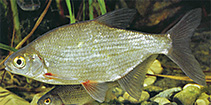 Blicca bjoerkna
Photo de Hartl, A.
Images | Images Google
Photo de Hartl, A.
Classification / Noms Noms communs | Synonymes | Catalog of Fishes(Genre, Espèce) | ITIS | CoL | WoRMS | Cloffa
Environnement : milieu / zone climatique / profondeur / gamme de distribution Écologie
; eau douce; saumâtre démersal; potamodrome (Ref. 51243); profondeur 0 - ? m. Temperate; 4°C - 20°C (Ref. 2059); 65°N - 40°N
Distribution Territoires | Zones FAO | Écosystèmes | Occurrences | Carte par point | Introductions | Faunafri
Europe and Asia: North, Baltic, White, Black (south to Rioni drainage) and Caspian Sea basins, Atlantic basin southward to Adour drainage (France; possibly introduced southward of Loire) and Mediterranean basin in France (Hérault and Rhône drainages). In Aral, Marmara and Anatolian Black Sea basins west of Ankara. Naturally absent from Iberian Peninsula, Italy, Adriatic basin, Crimea, Great Britain (except southeast), Scandinavia north of Sundsvall (Sweden) and 65° N (Finland). Locally introduced in Spain and northeastern Italy; in France, apparently introduced in smal coastal drainages of Var.
Longueur à la première maturité / Taille / Poids / Âge
Maturité: Lm ? range ? - ? cm
Max length : 45.5 cm TL mâle / non sexé; (Ref. 88166); common length : 20.0 cm TL mâle / non sexé; (Ref. 556); poids max. publié: 1.0 kg (Ref. 30578)
Max length : 45.5 cm TL mâle / non sexé; (Ref. 88166); common length : 20.0 cm TL mâle / non sexé; (Ref. 556); poids max. publié: 1.0 kg (Ref. 30578)
Description synthétique Clés d'identification | Morphologie | Morphométrie
Épines dorsales (Total) : 3; Rayons mous dorsaux (Total) : 8; Épines anales: 3; Rayons mous anaux: 19 - 22; Vertèbres: 39 - 40. The only species of the genus which can be diagnosed from similar species of genera Ballerus, Blicca and Vimba by having the following characters: mouth sub-inferior, which can not be extended as a tube; scales on lateral line 43-46 + 2-3 ; anal fin with 19-23½ branched rays; eye diameter about equal to snout length in individuals larger than 10 cm SL; pharyngeal teeth 2,5-2,5; and orange or reddish base of paired fins (Ref. 59043). Caudal fin with 17-19 rays (Ref. 2196).
Body shape (shape guide): fusiform / normal.
Body shape (shape guide): fusiform / normal.
Gregarious and frequents stagnant waters of lakes and reservoirs, rivers and canals with calm waters. Occurs in a wide variety of shallow, warm lowland lakes and slow-flowing lower reaches of large rivers and canals. Frequently very abundant on bottom of large sandy rivers. Larvae live in still water bodies. Mainly nocturnal. Feeds on benthic invertebrates. Spawns along shores on submerged vegetations, roots or even on shallow gravel bottom (Ref. 59043). Reproduction takes place in May to July. Exhibits polyandry (Ref. 6114). Regularly hybridizes with Vimba vimba (Ref. 59043). Of little interest to game fishers and consumers (Ref. 30578). Unpopular with commercial fishers due to its small size and competition with more desired species.
Cycle de vie et comportement reproducteur Maturité | Reproduction | Frai | Œufs | Fécondité | Larves
Exhibits polyandry, with courting tactics developed by males. Trembling and splashing movements signal release of eggs and sperms on plant substratum (Ref. 6114). Eggs are sticky (Ref. 59043).
Référence principale
Téléchargez vos références | Références | Coordinateur | Collaborateurs
Kottelat, M. and J. Freyhof, 2007. Handbook of European freshwater fishes. Publications Kottelat, Cornol and Freyhof, Berlin. 646 pp. (Ref. 59043)
Statut dans la liste rouge de l'IUCN (Ref. 130435: Version 2025-2 (Global))
Préoccupation mineure (LC) ; Date assessed: 27 May 2022
CITES
Not Evaluated
Menace pour l'homme
Harmless
Utilisations par l'homme
Pêcheries: intérêt commercial mineur; Aquarium: Aquariums publics; appât: occasionally
FAO - Systèmes d'aquaculture: production; pêcheries: débarquements; Publication: search | FishSource |
Plus d'informations
Écologie trophique
Aliments (proies)
Composition du régime alimentaire
Consommation alimentaire
Rations alimentaires
Prédateurs
Aliments (proies)
Composition du régime alimentaire
Consommation alimentaire
Rations alimentaires
Prédateurs
Dynamique des populations
Paramètres de croissance
Âges / tailles maximales
Longueur-poids rel.
Rel. longueur-longueur.
Fréquences de longueurs
Conversion de masse
Recrutement
Abondance
Paramètres de croissance
Âges / tailles maximales
Longueur-poids rel.
Rel. longueur-longueur.
Fréquences de longueurs
Conversion de masse
Recrutement
Abondance
Physiologie
Composition corporelle
Nutriments
Consommation d'oxygène
Type de natation
Vitesse de nage
Pigments visuels
Son de poisson
Maladies et parasites
Toxicité (CL50)
Composition corporelle
Nutriments
Consommation d'oxygène
Type de natation
Vitesse de nage
Pigments visuels
Son de poisson
Maladies et parasites
Toxicité (CL50)
Liées à l'homme
Systèmes d'aquaculture
Profils d'aquaculture
Souches
Cas de ciguatera
Timbres, pièces de monnaie, divers
Systèmes d'aquaculture
Profils d'aquaculture
Souches
Cas de ciguatera
Timbres, pièces de monnaie, divers
Outils
E-book | Guide de terrain | Clés d'identification | Générateur de fréquences de longueur | Outil de dynamique de population | Carte par point |
Capture-MSY |
Articles particuliers
Télécharger en XML
Sources Internet
AFORO (otoliths) | Alien/Invasive Species database | Aquatic Commons | BHL | Cloffa | Websites from users | FishWatcher | CISTI | Catalog of Fishes: Genre, Espèce | DiscoverLife | ECOTOX | FAO - Systèmes d'aquaculture: production; pêcheries: débarquements; Publication: search | Faunafri | Fishipedia | Fishtrace | GloBI | Google Books | Google Scholar | Google | IGFA World Record | Bases de données nationales | OneZoom | Open Tree of Life | Otolith Atlas of Taiwan Fishes | Aquariums publics | PubMed | Reef Life Survey | Socotra Atlas | TreeBase | Arbre de Vie | Wikipedia: aller à, chercher | World Records Freshwater Fishing | Zoological Record
Estimations basées sur des modèles
Indice de diversité phylogénétique (Réf. 82804): PD50 = 1.0000 [Uniqueness, from 0.5 = low to 2.0 = high].
Bayesian length-weight: a=0.00741 (0.00667 - 0.00824), b=3.15 (3.12 - 3.18), in cm total length, based on LWR estimates for this species (Ref. 93245).
Niveau trophique (Réf. 69278): 3.2 ±0.0 se; based on diet studies.
Résilience (Réf. 120179): Milieu, temps minimum de doublement de population : 1,4 à 4,4 années (K=0.10-0.27; tm=3-4).
Nutriments (Ref. 124155): Calcium = 66.8 [32.4, 112.3] mg/100g; Iron = 0.407 [0.243, 0.722] mg/100g; Protein = 17.7 [16.1, 19.1] %; Omega3 = 0.605 [0.278, 1.290] g/100g; Selenium = 7.59 [3.59, 16.22] μg/100g; VitaminA = 19.1 [6.1, 60.6] μg/100g; Zinc = 0.826 [0.581, 1.185] mg/100g (wet weight);