



Hochladen Photos und videos
Bilder | Google Bild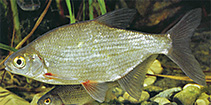 Blicca bjoerkna
Photo von Hartl, A.
Bilder | Google Bild
Photo von Hartl, A.
Klassifizierung / Names Namen | Synonyme | Catalog of Fishes(Gattung, Arten) | ITIS | CoL | WoRMS | Cloffa
Umwelt: Milieu / Klimazone / Tiefenbereich / Verbreitungsgebiet Ökologie
; süßwasser; brackwasser demersal; potamodrom (Ref. 51243); tiefenbereich 0 - ? m. Temperate; 4°C - 20°C (Ref. 2059); 65°N - 40°N
Verbreitung Territorien | FAO Gebiete | Ökosysteme | Vorkommen | Punkt Karte | Einführungen | Faunafri
Europe and Asia: North, Baltic, White, Black (south to Rioni drainage) and Caspian Sea basins, Atlantic basin southward to Adour drainage (France; possibly introduced southward of Loire) and Mediterranean basin in France (Hérault and Rhône drainages). In Aral, Marmara and Anatolian Black Sea basins west of Ankara. Naturally absent from Iberian Peninsula, Italy, Adriatic basin, Crimea, Great Britain (except southeast), Scandinavia north of Sundsvall (Sweden) and 65° N (Finland). Locally introduced in Spain and northeastern Italy; in France, apparently introduced in smal coastal drainages of Var.
Länge bei der ersten Reifung / Größe / Gewicht / Alter
Geschlechtsreife: Lm ? range ? - ? cm
Max length : 45.5 cm TL Männchen/unbestimmt; (Ref. 88166); common length : 20.0 cm TL Männchen/unbestimmt; (Ref. 556); max. veröff. Gewicht: 1.0 kg (Ref. 30578)
Max length : 45.5 cm TL Männchen/unbestimmt; (Ref. 88166); common length : 20.0 cm TL Männchen/unbestimmt; (Ref. 556); max. veröff. Gewicht: 1.0 kg (Ref. 30578)
Kurzbeschreibung Bestimmungsschlüssel | Morphologie | Morphometrie
Rückenflossenstacheln (insgesamt) : 3; Rückenflossenweichstrahlen (insgesamt) : 8; Afterflossenstacheln: 3; Afterflossenweichstrahlen: 19 - 22; Wirbelzahl: 39 - 40. The only species of the genus which can be diagnosed from similar species of genera Ballerus, Blicca and Vimba by having the following characters: mouth sub-inferior, which can not be extended as a tube; scales on lateral line 43-46 + 2-3 ; anal fin with 19-23½ branched rays; eye diameter about equal to snout length in individuals larger than 10 cm SL; pharyngeal teeth 2,5-2,5; and orange or reddish base of paired fins (Ref. 59043). Caudal fin with 17-19 rays (Ref. 2196).
Body shape (shape guide): fusiform / normal.
Body shape (shape guide): fusiform / normal.
Gregarious and frequents stagnant waters of lakes and reservoirs, rivers and canals with calm waters. Occurs in a wide variety of shallow, warm lowland lakes and slow-flowing lower reaches of large rivers and canals. Frequently very abundant on bottom of large sandy rivers. Larvae live in still water bodies. Mainly nocturnal. Feeds on benthic invertebrates. Spawns along shores on submerged vegetations, roots or even on shallow gravel bottom (Ref. 59043). Reproduction takes place in May to July. Exhibits polyandry (Ref. 6114). Regularly hybridizes with Vimba vimba (Ref. 59043). Of little interest to game fishers and consumers (Ref. 30578). Unpopular with commercial fishers due to its small size and competition with more desired species.
Lebenszyklus und Paarungsverhalten Geschlechtsreife | Fortpflanzung | Ablaichen | Eier | Fruchtbarkeit | Larven
Exhibits polyandry, with courting tactics developed by males. Trembling and splashing movements signal release of eggs and sperms on plant substratum (Ref. 6114). Eggs are sticky (Ref. 59043).
Hauptreferenz
Laden Sie Ihre Referenzen hoch | Referenzen | Koordinator | Partner
Kottelat, M. and J. Freyhof, 2007. Handbook of European freshwater fishes. Publications Kottelat, Cornol and Freyhof, Berlin. 646 pp. (Ref. 59043)
IUCN Rote Liste Status (Ref. 130435: Version 2025-2 (Global))
nicht bedroht (LC) ; Date assessed: 27 May 2022
CITES
Not Evaluated
Bedrohung für Menschen
Harmless
Nutzung durch Menschen
Fischereien: weniger kommerziell; Aquarium: Öffentliche Aquarien; Köder: occasionally
FAO - Aquakultur-Systeme: produktion; Fischereien: landungen; Publication: search | FishSource |
Mehr Information
Trophische Ökologie
Lebensmittel (Beutetiere)
Nahrungszusammensetzung
Nahrungsaufnahme
Lebensmittelrationen
Räuber
Lebensmittel (Beutetiere)
Nahrungszusammensetzung
Nahrungsaufnahme
Lebensmittelrationen
Räuber
Populationsdynamik
Wachstumsparameter
Max. Alter/Größen
Länge-Gewicht-Rel.
Länge-Länge-Verhältnis.
Längenhäufigkeiten
Massenkonvertierung
Rekrutierung
Dichte
Wachstumsparameter
Max. Alter/Größen
Länge-Gewicht-Rel.
Länge-Länge-Verhältnis.
Längenhäufigkeiten
Massenkonvertierung
Rekrutierung
Dichte
Lebenszyklus
Fortpflanzung
Geschlechtsreife
Reifung/Kiemen rel.
Fruchtbarkeit
Ablaichen
Laichaggregationen
Eier
Eientwicklung
Larven
Larven Pop.Dyn.
Fortpflanzung
Geschlechtsreife
Reifung/Kiemen rel.
Fruchtbarkeit
Ablaichen
Laichaggregationen
Eier
Eientwicklung
Larven
Larven Pop.Dyn.
Physiologie
Körperliche Zusammensetzung
Nährstoffe
Sauerstoffverbrauch
Schwimmart
Schwimmgeschwindigkeit
Visuelle Pigmente
Fischgeräusche
Krankheiten und Parasiten
Toxizität (LC50s)
Körperliche Zusammensetzung
Nährstoffe
Sauerstoffverbrauch
Schwimmart
Schwimmgeschwindigkeit
Visuelle Pigmente
Fischgeräusche
Krankheiten und Parasiten
Toxizität (LC50s)
Menschenbezogen
Aquakultur-Systeme
Aquakultur Profile
Zuchtlinien
Ciguatera-Fälle
Briefmarken, Münzen, Verschiedenes.
Aquakultur-Systeme
Aquakultur Profile
Zuchtlinien
Ciguatera-Fälle
Briefmarken, Münzen, Verschiedenes.
Tools
E-Book | Feldführer | Bestimmungsschlüssel | Längenhäufigkeits Tool | Lebensdaten Tool | Punkt Karte |
Catch-MSY |
Zusatzinformationen
Download XML
Zusammenfassung | Punktdaten | Namen | Photos
Internet Quellen
AFORO (otoliths) | Alien/Invasive Species database | Aquatic Commons | BHL | Cloffa | Websites from users | FishWatcher Einträge suchen | CISTI | Catalog of Fishes: Gattung, Arten | DiscoverLife | ECOTOX | FAO - Aquakultur-Systeme: produktion; Fischereien: landungen; Publication: search | Faunafri | Fishipedia | Fishtrace | GloBI | Google Books | Google Scholar | Google | IGFA World Record | Nationale Datenbanken | OneZoom | Open Tree of Life | Otolith Atlas of Taiwan Fishes | Öffentliche Aquarien | PubMed | Reef Life Survey | Socotra Atlas | TreeBase | Tree of Life | Wikipedia: Gehe zu, Suchen | World Records Freshwater Fishing | Zoologischer Rekord
Schätzungen auf der Grundlage von Modellen
Phylogenetischer Diversitätsindex (Ref. 82804): PD50 = 1.0000 [Uniqueness, from 0.5 = low to 2.0 = high].
Bayesian length-weight: a=0.00741 (0.00667 - 0.00824), b=3.15 (3.12 - 3.18), in cm total length, based on LWR estimates for this species (Ref. 93245).
Trophische Ebene (Ref. 69278): 3.2 ±0.0 se; based on diet studies.
Widerstandsfähigkeit (Ref. 120179): mittel, Verdopplung der Population dauert 1,4 - 4,4 Jahre. (K=0.10-0.27; tm=3-4).
Nährstoffe (Ref. 124155): Calcium = 66.8 [32.4, 112.3] mg/100g; Iron = 0.407 [0.243, 0.722] mg/100g; Protein = 17.7 [16.1, 19.1] %; Omega3 = 0.605 [0.278, 1.290] g/100g; Selenium = 7.59 [3.59, 16.22] μg/100g; VitaminA = 19.1 [6.1, 60.6] μg/100g; Zinc = 0.826 [0.581, 1.185] mg/100g (wet weight);